US adoptions becoming a major
pp. 9-10 · Read in the full issue
Special Report
industry in the Marshalls
Reports by GIFF JOHNSON
There were just a handful of adoptions of Marshallese children by Hjj
American families in 1996 - in 1997 the number in
Majuro leaped an astound
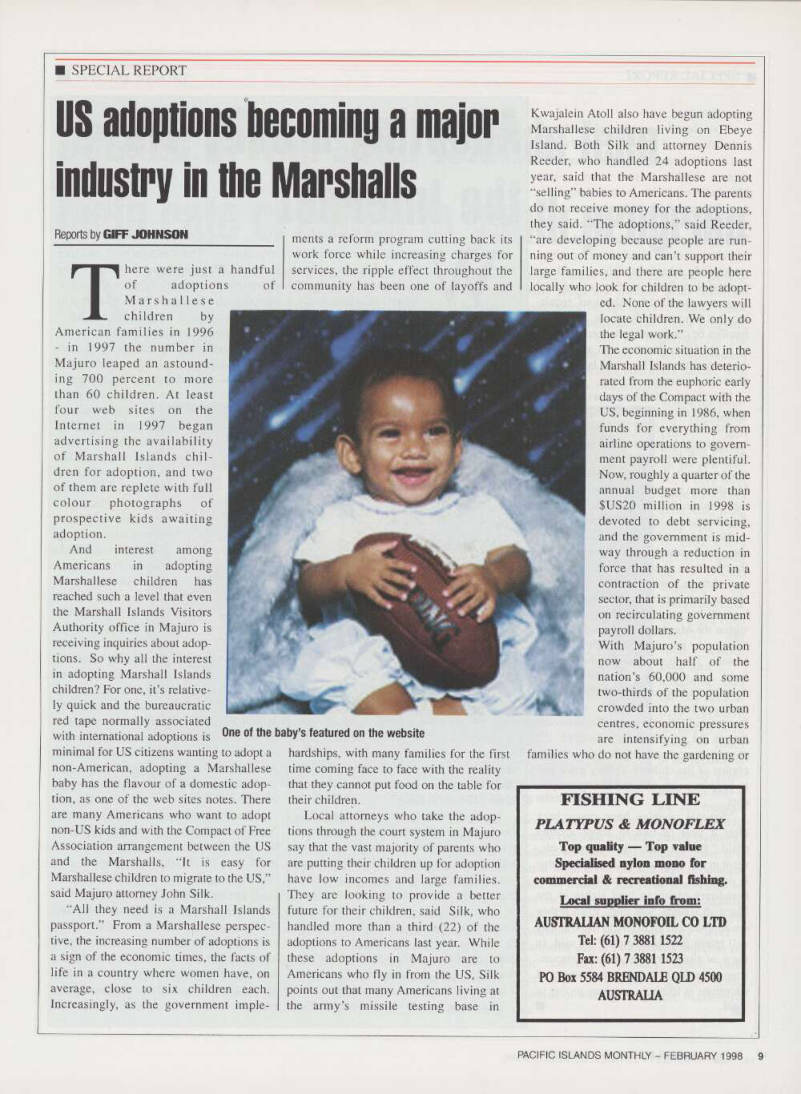
ing 700 percent to more than 60 children. At least four web sites on the Internet in 1997 began advertising the availability of Marshall Islands chil dren for adoption, and two of them are replete with full colour photographs of prospective kids awaiting adoption.
And interest among Americans in adopting Marshallese children has reached such a level that even the Marshall Islands Visitors Authority office in Majuro is receiving inquiries about adop tions. So why all the interest in adopting Marshall Islands children? For one, it’s relative ly quick and the bureaucratic red tape normally associated with international adoptions is
minimal for US citizens wanting to adopt a non-American, adopting a Marshallese baby has the flavour of a domestic adop tion, as one of the web sites notes. There are many Americans who want to adopt non-US kids and with the Compact of Free Association arrangement between the US and the Marshalls, “It is easy for Marshallese children to migrate to the US,” said Majuro attorney John Silk.
"All they need is a Marshall Islands passport.” From a Marshallese perspec tive, the increasing number of adoptions is a sign of the economic times, the facts of life in a country where women have, on average, close to six children each.
Increasingly, as the government imple
ments a reform program cutting back its work force while increasing charges for services, the ripple effect throughout the community has been one of layoffs and
hardships, with many families for the first time coming face to face with the reality that they cannot put food on the table for their children.
Local attorneys who take the adop tions through the court system in Majuro say that the vast majority of parents who are putting their children up for adoption have low incomes and large families.
They are looking to provide a better future for their children, said Silk, who handled more than a third (22) of the adoptions to Americans last year. While these adoptions in Majuro are to Americans who fly in from the US, Silk points out that many Americans living at the army’s missile testing base in
Kwajalein Atoll also have begun adopting Marshallese children living on Ebeye Island. Both Silk and attorney Dennis Reeder, who handled 24 adoptions last year, said that the Marshallese are not ’'selling” babies to Americans. The parents do not receive money for the adoptions, they said. “The adoptions,” said Reeder, “are developing because people are run ning out of money and can’t support their large families, and there are people here locally who look for children to be adopt
ed. None of the lawyers will locate children. We only do the legal work.”
The economic situation in the Marshall Islands has deterio rated from the euphoric early days of the Compact with the US, beginning in 1986, when funds for everything from airline operations to govern ment payroll were plentiful.
Now, roughly a quarter of the annual budget more than SUS2O million in 1998 is devoted to debt servicing, and the government is mid way through a reduction in force that has resulted in a contraction of the private sector, that is primarily based on recirculating government payroll dollars.
With Majuro’s population now about half of the nation’s 60,000 and some two-thirds of the population crowded into the two urban centres, economic pressures are intensifying on urban
families who do not have the gardening or
One of the baby’s featured on the website
outer islanders.
“I’ve heard some people criticise these adoptions,” Silk said. “But if some one is willing to provide a good home for these children, you can’t stop Marshallese parents from making their own decisions.” There has been an occa sional negative comment voiced in the Nitijela (parliament), but the Marshall Islanders involved clearly have a positive view of the adoptions. Silk pointed out that the High Court itself has established a rigorous standard for adoptions, requir ing that a home study of the American families be conducted by a licensed agen cy in the US before they can adopt chil dren, even though Marshall Islands law does not require this.
“We always ask the parents on the wit ness stand (in court), ‘did anyone force you to put your child up for adoption?’ and ‘are you being provided any money for this?’,” Silk said. “The answer is always ‘no’.” The biggest question that Marshallese parents have about the adop tion process, Silk said, is can their chil dren come back to the Marshall Islands?
He said that he explains that before they reach adulthood at the age of 18, they have no choice of their own. But once they’ve reached adulthood, they can choose to return to the Marshall Islands, he said. It’s not like customary adoption within the Marshall Islands, said Reeder.
“They may not see their children again,” he said. This is explained to them before hand, and in a few cases parents have decided not to go ahead with the adoption process upon learning this, said both Reeder and Silk. However, Reeder noted that in the adoptions he’s handled, the parents have been required to provide photos of the children as they grow and to keep in touch with the biological par ents.
“Several couples have come back after a year or two to adopt another child,” Reeder said. An important ele ment in the adoptions by outsiders is that it does not strip the children of their hereditary claim to land rights in the Marshall Islands, Silk said. Even if they are adopted and go to live in the US, they still retain their land rights,” he sajd. In view of the current economic circum stances in the Marshalls, the number of adoptions is likely to continue to rise in 1998. ■