Letters To The Editor
pp. 5-6 · Read in the full issue
Fishing for red herrings
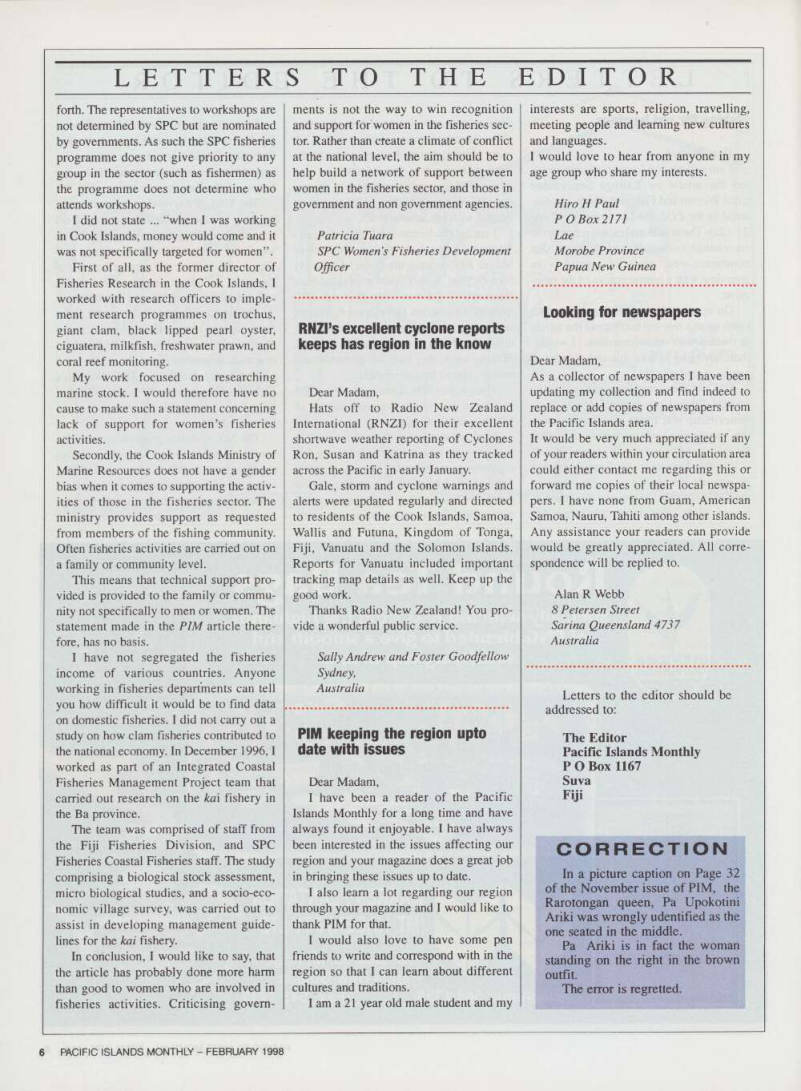
Dear Madam, I am still reeling from shock after read ing the article by Kalinga Seneviratne titled Women and Fisheries which was fea tured in the PIM for December 1997 (pp 21 - 22). The article makes reference to me on various occasions and suggests that comments were made by myself in an interview with a representative of the mag azine.
On reading the article, I managed to catch quite a few red herrings as the article is riddled with misinformation. I would, therefore, like to take this opportunity to set the record straight.
I do not recall speaking to a journalist of PIM. When I asked others who Kalinga Seneviratne was I was told that this was the gentleman who visited the SPC Noumea headquarters in February 1997. It is true that I spoke to Mr Seneviratne but he was not introduced to me or others in the SPC Fisheries Programme as a journal ist of PIM. We were told that Mr
Seneviratne was interested in learning about the programme activities of SPC. It is not unusual that we have members of the public dropping in for information and advice so I was only too happy to discuss the SPC Women’s Fisheries Development Project with Mr Seneviratne.
I am not the former head of the fisheries management section of the Ministry of Marine Resources in the Cook Islands. My former post was Director of Fisheries Research. I did not state that the SPC Women’s Fisheries Development Project was set up after many studies found that, although women were involved in fisheries in many ways, they were not given the nec essary support by governments.
The project was actually set up at the request of government representatives of SPC member countries.
I did not state that in countries such as Fiji, even the new canneries set up by for eign companies employ mainly women.
First of all, I have no knowledge of new canneries being set up by foreign compa nies in Fiji which employ mainly women.
Secondly, the only work I have done in Fiji has entailed my working with the Fiji Fisheries Division in carrying out a socio economic impact assessment of the kai fishery in the Ba province.
The kind of harvesting carried out by women in the fisheries sector differs according to the socio-cultural context in which the women live. Those who do har vest in the inshore area use a variety of methods, including gleaning for shellfish and crustaceans, netting, and handlining.
The needs of women in the sector differ from country to country, and as such you cannot, talk about the needs of Pacific fish erwomen in general terms.
I did not head the SPC Women’s Fisheries Development Project in 1991. I have only been with the p roject since February 1995.
The SPC fisheries programme provides a number of training courses based on requests from member countries. Training is provided in the areas of capture fish eries, post harvest techniques, safety at sea, seafaring, fisheries extension work and so
forth. The representatives to workshops are not determined by SPC but are nominated by governments. As such the SPC fisheries programme does not give priority to any group in the sector (such as fishermen) as the programme does not determine who
attends workshops.
I did not state ... “when I was working in Cook Islands, money would come and it was not specifically targeted for women”.
First of all, as the former director of Fisheries Research in the Cook Islands, I worked with research officers to imple ment research programmes on trochus, giant clam, black lipped pearl oyster, ciguatera, milkfish, freshwater prawn, and coral reef monitoring.
My work focused on researching marine stock. I would therefore have no cause to make such a statement concerning lack of support for women’s fisheries activities.
Secondly, the Cook Islands Ministry of Marine Resources does not have a gender bias when it comes to supporting the activ ities of those in the fisheries sector. The
ministry provides support as requested
from members of the fishing community.
Often fisheries activities are carried out on a family or community level.
This means that technical support pro vided is provided to the family or commu nity not specifically to men or women. The statement made in the PIM article there fore, has no basis.
I have not segregated the fisheries income of various countries. Anyone working in fisheries departments can tell you how difficult it would be to find data on domestic fisheries. I did not carry out a study on how clam fisheries contributed to the national economy. In December 1996,1 worked as part of an Integrated Coastal Fisheries Management Project team that carried out research on the kai fishery in the Ba province.
The team was comprised of staff from the Fiji Fisheries Division, and SPC Fisheries Coastal Fisheries staff. The study comprising a biological stock assessment, micro biological studies, and a socio-eco nomic village survey, was carried out to assist in developing management guide lines for the kai fishery.
In conclusion, I would like to say, that the article has probably done more harm than good to women who are involved in fisheries activities. Criticising govern
ments is not the way to win recognition and support for women in the fisheries sec tor. Rather than create a climate of conflict at the national level, the aim should be to help build a network of support between women in the fisheries sector, and those in government and non government agencies.
Patricia Tuara
SPC Women’s Fisheries Development Officer