Commercial fishing threatens sports fishing
p. 36 · Read in the full issue
By Giff Johnson
The Marshall Islands is
promoting sportsfishing
as one of its major tourist draws. But as both the number and size of marlin and tuna being caught around Majuro Atoll are on the decline, local fishermen and tourism officials are expressing increasing concern that the unprece dented expansion of commercial long line and purse seine fishing since 1993 is undermining this fledgling industry.
“Sportsfishing has been identified as one of three key niche markets for the Marshalls,” said the government’s tourism chief Benjamin Graham.
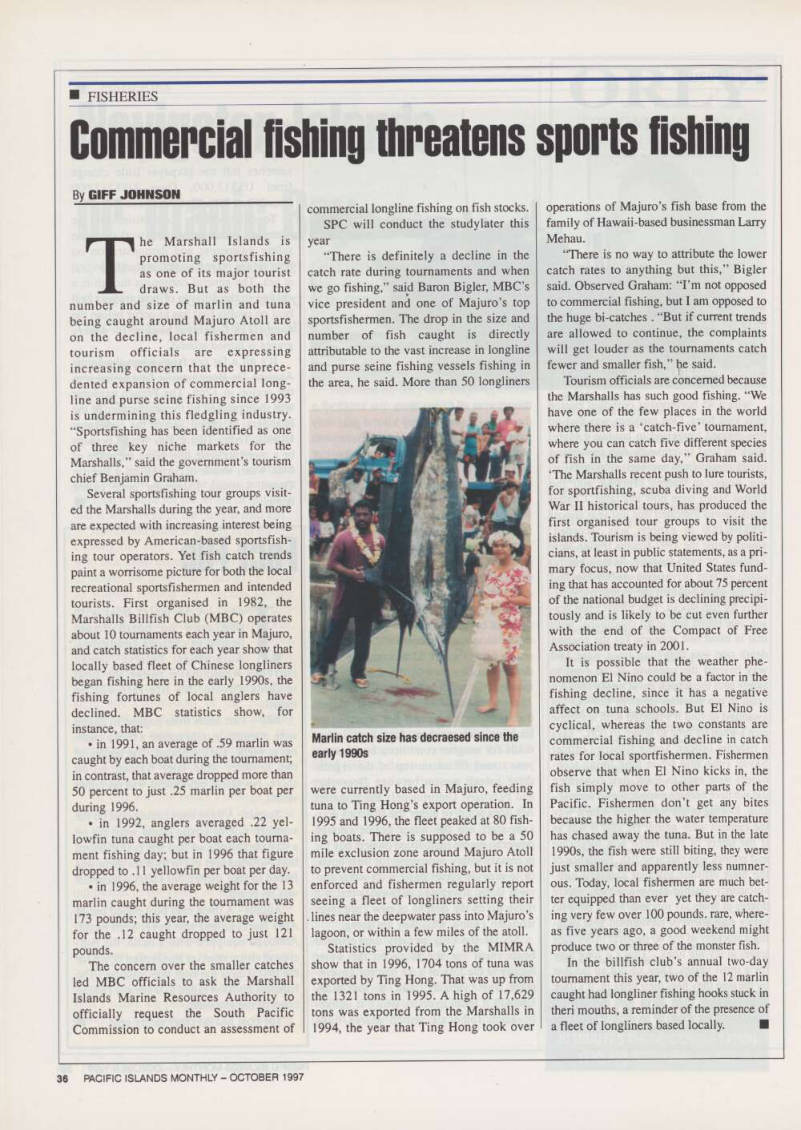
Several sportsfishing tour groups visit ed the Marshalls during the year, and more are expected with increasing interest being expressed by American-based sportsfish ing tour operators. Yet fish catch trends paint a worrisome picture for both the local recreational sportsfishermen and intended tourists. First organised in 1982, the Marshalls Billfish Club (MBC) operates about 10 tournaments each year in Majuro, and catch statistics for each year show that locally based fleet of Chinese longliners began fishing here in the early 19905, the fishing fortunes of local anglers have declined. MBC statistics show, for instance, that: • in 1991, an average of .59 marlin was caught by each boat during the tournament; in contrast, that average dropped more than 50 percent to just .25 marlin per boat per during 1996. • in 1992, anglers averaged .22 yel lowfin tuna caught per boat each tourna ment fishing day; but in 1996 that figure dropped to .11 yellowfin per boat per day. • in 1996, the average weight for the 13 marlin caught during the tournament was 173 pounds; this year, the average weight for the .12 caught dropped to just 121 pounds.
The concern over the smaller catches led MBC officials to ask the Marshall Islands Marine Resources Authority to officially request the South Pacific Commission to conduct an assessment of
commercial longline fishing on fish stocks.
SPC will conduct the studylater this year “There is definitely a decline in the catch rate during tournaments and when we go fishing,” said Baron Bigler, MBC’s vice president and one of Majuro’s top sportsfishermen. The drop in the size and number of fish caught is directly attributable to the vast increase in longline and purse seine fishing vessels fishing in the area, he said. More than 50 longliners
were currently based in Majuro, feeding tuna to Ting Hong’s export operation. In 1995 and 1996, the fleet peaked at 80 fish ing boats. There is supposed to be a 50 mile exclusion zone around Majuro Atoll to prevent commercial fishing, but it is not enforced and fishermen regularly report seeing a fleet of longliners setting their . lines near the deepwater pass into Majuro’s lagoon, or within a few miles of the atoll.
Statistics provided by the MIMRA show that in 1996, 1704 tons of tuna was exported by Ting Hong. That was up from the 1321 tons in 1995. A high of 17,629 tons was exported from the Marshalls in 1994, the year that Ting Hong took over
operations of Majuro’s fish base from the family of Hawaii-based businessman Larry Mehau.
“There is no way to attribute the lower catch rates to anything but this,” Bigler said. Observed Graham: “I’m not opposed to commercial fishing, but I am opposed to the huge bi-catches . “But if current trends are allowed to continue, the complaints will get louder as the tournaments catch fewer and smaller fish,” Ijie said.
Tourism officials are concerned because the Marshalls has such good fishing. “We have one of the few places in the world where there is a ‘catch-five’ tournament, where you can catch five different species of fish in the same day,” Graham said. ‘The Marshalls recent push to lure tourists, for sportfishing, scuba diving and World War II historical tours, has produced the first organised tour groups to visit the islands. Tourism is being viewed by politi cians, at least in public statements, as a pri mary focus, now that United States fund ing that has accounted for about 75 percent of the national budget is declining precipi tously and is likely to be cut even further with the end of the Compact of Free Association treaty in 2001.
It is possible that the weather phe nomenon El Nino could be a factor in the fishing decline, since it has a negative affect on tuna schools. But El Nino is cyclical, whereas the two constants are commercial fishing and decline in catch rates for local sportfishermen. Fishermen observe that when El Nino kicks in, the fish simply move to other parts of the Pacific. Fishermen don’t get any bites because the higher the water temperature has chased away the tuna. But in the late 19905, the fish were still biting, they were just smaller and apparently less numner ous. Today, local fishermen are much bet ter equipped than ever yet they are catch ing very few over 100 pounds, rare, where as five years ago, a good weekend might produce two or three of the monster fish.
In the billfish club’s annual two-day tournament this year, two of the 12 marlin caught had longliner fishing hooks stuck in theri mouths, a reminder of the presence of a fleet of longliners based locally. ■
Marlin catch size has decraesed since the early 1990s