Navigator Islands
pp. 34-35 · Read in the full issue
Fisheries
or Titanic Bay
...the increasing number of fishermen going missing at sea has called for more stringent rules regarding safety at sea
By Chris Peteru
Samoa’s budding long line
fishing industry is facing its most serious challenge - missing fishermen.
In 11 weeks, 13 long line fishermen have been lost at sea. The figure surpasses the total of three for the whole of last year, and is way ahead of the current road toll.
Authorities point to greedy boat owners chasing full nets at any cost, plus crews who lack experience. As the toll continues to mourn, the government has so far stood by without voiding any concern. Despite having one of the smallest economic fish ing zones in the world’s biggest ocean, police estimate the number of Samoan fishermen at the bottom of the Pacific shows no signs of slowing down. Inspector Lawrence Neru of the police marine divi sion, and commander of the Nafanua patrol boat said he had never seen anything like it in his nine years of service. His appraisal of what was happening was sim ple: “I can honestly say the owners do not care about the people on the boat.”
“If this attitude doesn’t change there will probably be (another) 20 in the next six months,” he told the Samoa Newsline.
Sources within the industry agreed.
They said boat owners, often prominent businessmen or community figures were indifferent to the safety of those working their vessels. Others openly flaunted the law knowing the odds of being prosecuted
by a legally underpowered police force
were pretty much zero. “I have just found out from the fisheries division that about 80 per cent of the boats are not registered.
That’s where the problem comes. Anyone thinks he can build a boat or a floating
craft and just put it out,” says Neru.
Significantly only one major operator, a foreigner was prepared to go on a record about the issue. New Zealander John Luff, director of Apia Export Fisheries said there was a desperate need for better safety fea tures. “If the problem is not addressed there will be more deaths,” he said.
Several fishermen say typically the employers attitude is akin to “Go and get the fish when I say so or go and get anoth er job.” For about US$l2 per day - consid ered top money on the cash strapped island, where the average wage is US$2l a week - fishermen are expected to clock up 14 hour five and six day weeks, in condi tions that are unsafe, backbreaking and arduous. Accompanying that was a certain element of bravado by locals - “we have this Samoan mentality that it won’t happen to me I’m strong.” Even things like taking on fresh water they say “we don’t need water we are only going out for a couple of hours,” says inspector Neru. Paytime sees boats hauling in a minimum US$425 (WS$ 1000) dollars a night. The most com mon catch, yellow fin tuna, fetch US 72 cents a pound.
With so much cash to be made, the local boat building industry has boomed.
“Every lawyer, doctor and member of parliament in town, now wants to own a fishing boat,” says the foreman at one of three small scale shipyards operating near Apia, the capital. All the yards have 12 month waiting lists on orders. Based around a traditional design the demand for the 15 meter long twin hulled aluminium boats, called alia has more than doubled to 142 in less than 12 months with new craft hitting the water regularly. Around US$l4,OOO will turn out a three men boat,
with a 45 horsepower outboard engine plus long lines. One problem was that no one seemed interested in buying a spare.
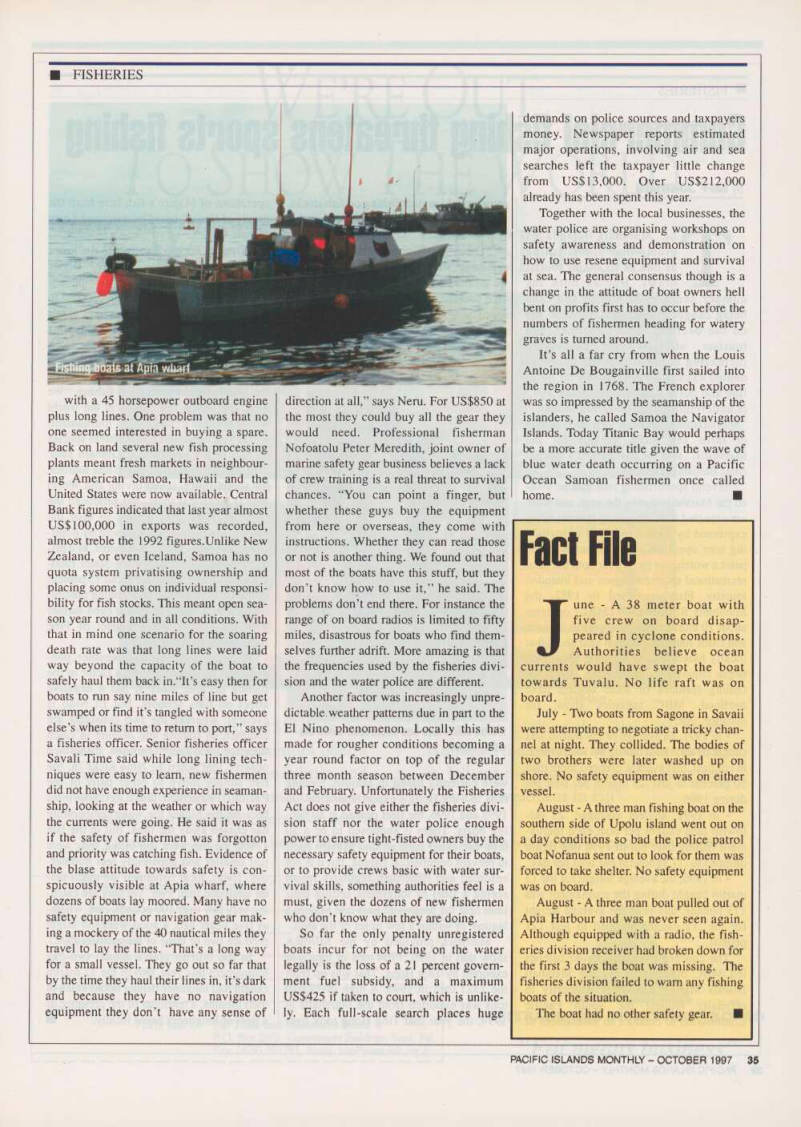
Back on land several new fish processing plants meant fresh markets in neighbour ing American Samoa, Hawaii and the United States were now available. Central Bank figures indicated that last year almost US$lOO,OOO in exports was recorded, almost treble the 1992 figures. Unlike New Zealand, or even Iceland, Samoa has no quota system privatising ownership and placing some onus on individual responsi bility for fish stocks. This meant open sea son year round and in all conditions. With that in mind one scenario for the soaring death rate was that long lines were laid way beyond the capacity of the boat to safely haul them back in.“lt’s easy then for boats to run say nine miles of line but get swamped or find it’s tangled with someone else’s when its time to return to port,” says a fisheries officer. Senior fisheries officer Savaii Time said while long lining tech niques were easy to leam, new fishermen did not have enough experience in seaman ship, looking at the weather or which way the currents were going. He said it was as if the safety of fishermen was forgotten and priority was catching fish. Evidence of the blase attitude towards safety is con spicuously visible at Apia wharf, where dozens of boats lay moored. Many have no
safety equipment or navigation gear mak
ing a mockery of the 40 nautical miles they travel to lay the lines. “That’s a long way for a small vessel. They go out so far that by the time they haul their lines in, it’s dark and because they have no navigation equipment they don’t have any sense of
direction at all,” says Neru. For US$B5O at the most they could buy all the gear they would need. Professional fisherman Nofoatolu Peter Meredith, joint owner of marine safety gear business believes a lack of crew training is a real threat to survival chances. “You can point a finger, but whether these guys buy the equipment from here or overseas, they come with instructions. Whether they can read those or not is another thing. We found out that most of the boats have this stuff, but they don’t know how to use it,” he said. The problems don’t end there. For instance the range of on board radios is limited to fifty miles, disastrous for boats who find them selves further adrift. More amazing is that the frequencies used by the fisheries divi sion and the water police are different.
Another factor was increasingly unpre dictable, weather patterns due in part to the El Nino phenomenon. Locally this has made for rougher conditions becoming a year round factor on top of the regular three month season between December and February. Unfortunately the Fisheries Act does not give either the fisheries divi sion staff nor the water police enough power to ensure tight-fisted owners buy the necessary safety equipment for their boats, or to provide crews basic with water sur vival skills, something authorities feel is a must, given the dozens of new fishermen who don’t know what they are doing.
So far the only penalty unregistered boats incur for not being on the water legally is the loss of a2l percent govern ment fuel subsidy, and a maximum US$425 if taken to court, which is unlike
ly. Each full-scale search places huge
demands on police sources and taxpayers money. Newspaper reports estimated
major operations, involving air and sea
searches left the taxpayer little change from US$l3,OOO. Over U 55212,000 already has been spent this year.
Together with the local businesses, the water police are organising workshops on safety awareness and demonstration on how to use resene equipment and survival at sea. The general consensus though is a change in the attitude of boat owners hell bent on profits first has to occur before the numbers of fishermen heading for watery graves is turned around.
It’s all a far cry from when the Louis Antoine De Bougainville first sailed into the region in 1768. The French explorer was so impressed by the seamanship of the islanders, he called Samoa the Navigator Islands. Today Titanic Bay would perhaps be a more accurate title given the wave of blue water death occurring on a Pacific Ocean Samoan fishermen once called home. ■
Fishing boats at Apia Wharf