Sailing the big canoes
pp. 51-52 · Read in the full issue
Yachting
Story and photography by SALLY ANDREW
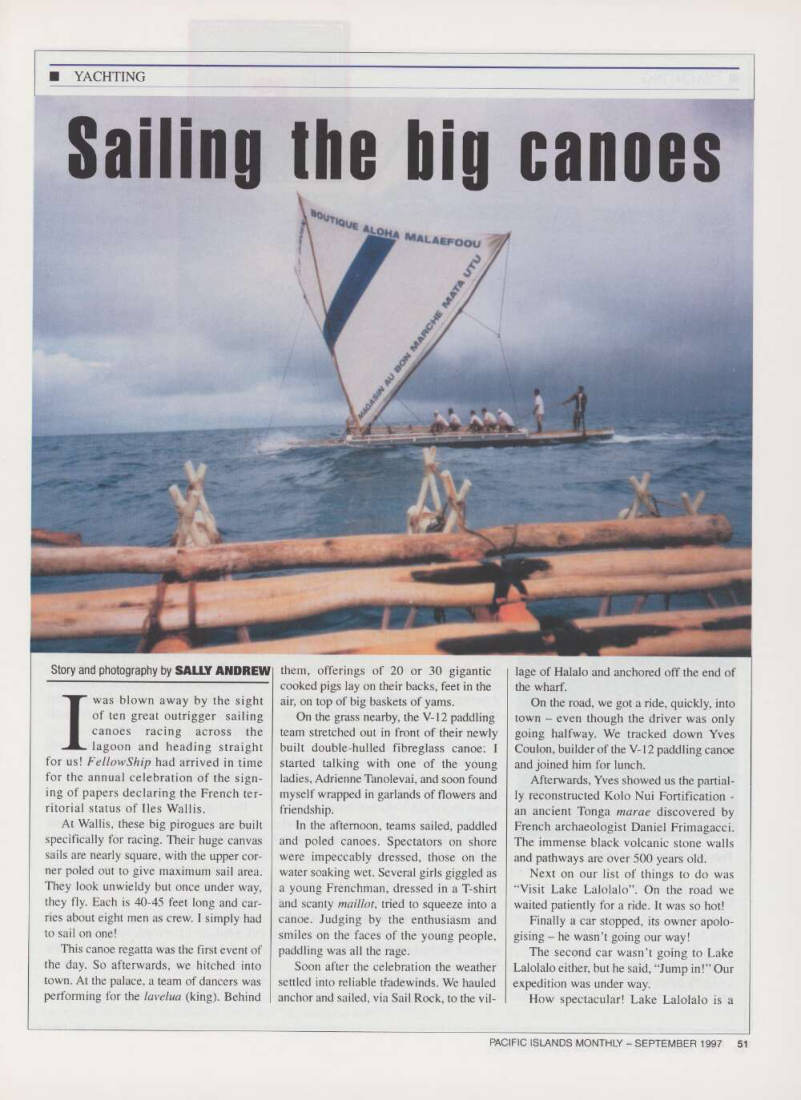
Iwas blown away by the sight of ten great outrigger sailing canoes racing across the lagoon and heading straight for us! Fellowship had arrived in time for the annual celebration of the sign ing of papers declaring the French ter ritorial status of lies Wallis.
At Wallis, these big pirogues are built specifically for racing. Their huge canvas sails are nearly square, with the upper cor ner poled out to give maximum sail area.
They look unwieldy but once under way, they fly. Each is 40-45 feet long and car ries about eight men as crew. I simply had to sail on one!
This canoe regatta was the first event of the day. So afterwards, we hitched into town. At the palace, a team of dancers was performing for the lavelua (king). Behind
them, offerings of 20 or 30 gigantic cooked pigs lay on their backs, feet in the air, on top of big baskets of yams.
On the grass nearby, the V-12 paddling team stretched out in front of their newly built double-hulled fibreglass canoe: I started talking with one of the young ladies, Adrienne Tanolevai, and soon found myself wrapped in garlands of flowers and
friendship.
In the afternoon, teams sailed, paddled and poled canoes. Spectators on shore were impeccably dressed, those on the water soaking wet. Several girls giggled as a young Frenchman, dressed in a T-shirt and scanty maillot, tried to squeeze into a canoe. Judging by the enthusiasm and smiles on the faces of the young people, paddling was all the rage.
Soon after the celebration the weather settled into reliable tfadewinds. We hauled anchor and sailed, via Sail Rock, to the vil
lage of Halalo and anchored off the end of the wharf.
On the road, we got a ride, quickly, into town - even though the driver was only going halfway. We tracked down Yves Coulon, builder of the V-12 paddling canoe and joined him for lunch.
Afterwards, Yves showed us the partial ly reconstructed Kolo Nui Fortification an ancient Tonga marae discovered by
French archaeologist Daniel Frimagacci.
The immense black volcanic stone walls and pathways are over 500 years old.
Next on our list of things to do was ‘‘Visit Lake Lalolalo”. On the road we waited patiently for a ride. It was so hot!
Finally a car stopped, its owner apolo gising - he wasn’t going our way!
The second car wasn’t going to Lake Lalolalo either, but he said, “Jump in!” Our expedition was under way.
How spectacular! Lake Lalolalo is a
large and deep circular lake surrounded by high red cliffs - sheer volcanic walls with oxidized iron and streaks of red rock that drop to the waters edge and then down, down, down.
At lake level, there is a small shelf.
Thick green vegetation makes the lake nearly inaccessible but we perservered and
found a path (marked with painted red blazes) and followed it to the bottom.
The water was pea-soup green, thick with plankton, very warm, with tropic birds flying over head. According to the Wallisians there are big eels in the water des anguilles. These creatures are blind due to the acidity of the water in the lower layers.
We didn’t see (or feel) any of the blind eels but it was creepy anyway. Trees over hang the shore and you have to swim out from underneath to get a view. The Americans dumped their ammunition here after the war. Later, local fishermen retrieved the explosives, using them to blow up fish in the lagoon.
Eventually, we hoofed it back down the red dirt road to the main road, passing houses, scores of banana trees, a school where an old US Navy bell hangs outside to call the kids to class. A car stopped and two lady teachers gave us a ride. They wouldn’t let us work. It was too hot, they said.
Two weeks later, another festival.
Again, the lavelua and assorted dignitaries sat under the eaves on the palace porch, facing nearly 40 large cooked pigs and assorted baskets of yams, taro, sugar and flour.
Two big ‘trees’ were erected on the malae with colourful lavalava attached to
each branch. These hung limply all morn ing, but by afternoon
they resembled
psychedelic streamers flapping in the rain squalls.
An elaborate kava ceremony with almost religious overtones transpired. Rituals, for malities and protocol were strictly followed.
Chants accompanied each swoosh of the kava around the bowl, then cups were present ed to each of the digni taries, one at a time.
After everyone was served, the entertain ment began.
Four different groups sang. Large denomina tion bills were dropped
into baskets laying on the grass and tucked into performers’ floral headdresses.
According to the local newspaper, Te Fenua Foou, more than $U545,000 was collected in a few hours. I’d never seen so much cash. Donations would support the learning disabled, a church-related over seas trip and two village projects.
Afterwards, a crowd gathered down at the wharf for the start of the canoe race.
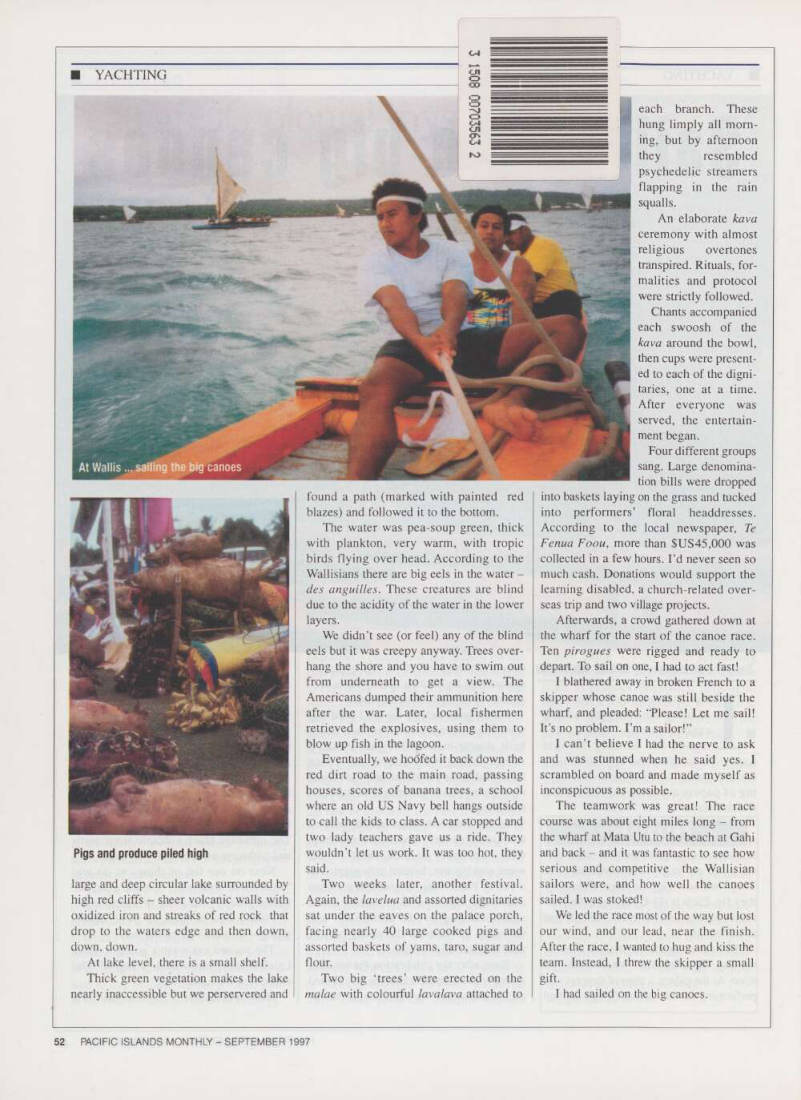
Ten pirogues were rigged and ready to depart. To sail on one, I had to act fast!
I blathered away in broken French to a skipper whose canoe was still beside the wharf, and pleaded: “Please! Let me sail!
It’s no problem. I’m a sailor!’’
I can’t believe I had the nerve to ask and was stunned when he said yes. I scrambled on board and made myself as inconspicuous as possible.
The teamwork was great! The race course was about eight miles long - from the wharf at Mata Utu to the beach at Gahi and back - and it was fantastic to see how serious and competitive the Wallisian sailors were, and how well the canoes sailed. I was stoked!
We led the race most of the way but lost our wind, and our lead, near the finish.
After the race, I wanted to hug and kiss the team. Instead, I threw the skipper a small
gift.
I had sailed on the big canoes.
Pigs and produce piled high
At Wallis...sailing the big canoes