Economic concerns
pp. 40-41 · Read in the full issue
South Pacific Forum
Region’s economic wellbeing to dominate talks
By Bernadette Hussein
The 28th South Pacific Forum in Raratonga, Cook Islands, this month will have at the top of its list the region's economic situation and what can be done to improve it, with leaders from the 12 Forum island countries elaborating on the action plan prepared by their economic min isters at the Forum Economic Ministers Meeting in Cairns, Australia, in July.
And, according to Forum Secretary- General leremia Tabai, the FEMM action plan will be the most important issue to be discussed at the Sepotember meeting. The action plan outlines economic reform, pub lic accountability, investment policies, tar iff policies and multilateral trade issues.
"The FEMM action plan focuses on key issues which we believe will help trace and find solutions to the economic problems which many of our members are facing,”
Tabai said. "Unfortunately, our members are facing major financial difficulties - not all - and during the meeting we will dis cuss how to boost the economy in the region.” Tabai said there was no set agenda for the meeting. The forum is a meeting of leaders and, like past meetings, what the leaders discuss at the retreat are what could
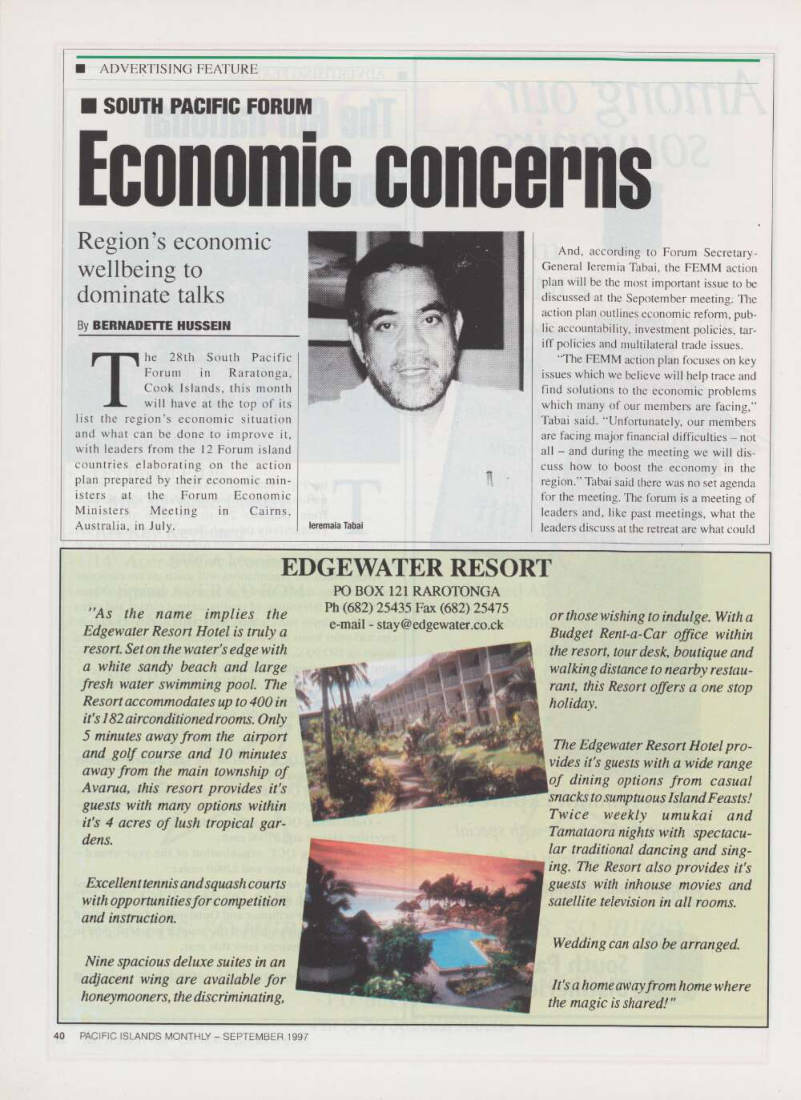
leremaia Tabai
make the agenda,” he said. "We do acknowledge that when members are in such a situation ways should be discussed on how these can be improved.”
As for the controversial AUSTEO (Australian Eyes Only) reports, Tabai said the Forum agenda was very broad and would allow for anything the leaders want ed to talk about. “I do not know if they will raise the issue or not,” he said.
But as for placing Australia in a tight spot, Tabai said he hoped that this would not happen. I hope it does not complicate the Forum relationship because I think, as a region, we can try and help ourselves and work together.”
As for Australian Prime Minister John Howard attending, Tabai said it would be good if he did because the South Pacific Forum was an annual event and it would be a good time for the leaders to get togeth er and talk things over. Tabai added that another issue of equal importance had to do with the high-level fisheries meetings in the Republic of the Marshall Islands in June. "Issues raised at the meeting greatly affect our members. This meeting, for the first time, allowed our members to meet with distant fishing nations and discuss how to manage the resources, the needs of fishermen and fishing countries,” he said.
The Forum will also talk about the pos sibility of opening a trade office in Beijing, China, similar to the one opened in Tokyo,
Japan, last year. "There will also be a report on the progress of the trade office in Japan and how it has fared over the past year. The office is working well but it is the first year and people are not fully aware of it. But give it another year, and it should produce the result which everyone is expecting it to. ■'Like anything else, we are trying to improve it all the time. Japan will come to the Forum as a post-Forum dialogue part ner and hopefully we will discuss how we can further improve the performance of the office.”
This year will also see Malaysia attend the meeting as a post-Forum dialogue part ner. "Malaysia is very keen in this part of the world. And Malaysia, as everyone knows, is an aggressive investor in this part of the world and that would be a good starting point. "Also, Malaysia is a very important international player and we have a lot of issues on which we want support from the international community.”
Tabai added that one important issue which was going to come up with post- Forum dialogue partners was how they were going to support the reform agenda of the region. A new secretary-general will also be appointed at this year's meeting.
"We do not know who is applying because the applications have all gone to the cur rent chairman,” he said.
Tabai added that he would not be apply
ing for another term and was getting ready to go bqck home. He said this year would once again see the leaders getting together in their retreats and discussing issues in a less formal atmosphere. "The discussions are quite serious but in a less formal atmo sphere. Our experience in the past has shown us that retreats are usually the time when leaders meet and make decisions.
"A lot of decisions come out of the retreats and are accepted and these are done as a group so it's the decision which is more important than who said what.
"Such environments really help. You see, the meeting has changed over the years. In the beginning, the leaders would spend hours behind closed doors deliberat ing. But it is no longer like that. In fact, organisers have realised that a relaxed atmosphere is needed to encourage the leaders to open up even more. In the retreat when they meet, there is no agenda, but the chairman has a fair idea of what he wants to raise with his colleagues. But then, any body can raise an issue. In my view, these retreats are very important mechanisms to raise issues.”
Prior to the summit, will be -the offi cials' meeting where we will discuss the finer points of the meetings and make last minute changes. Tabai added that prepara tions for the summit were well under way with the hosts more than eager to welcome the leaders to their shores. ■