NZ-big brother or best friend?
Dear Sir.
Having recently returned from a goodwill visit to five countries in the South Pacific, I would like to consider one important question which very rarely gets asked: how important are the Pacific countries to New Zealand?
Aside from a great place to take a trop ical holiday, is there another relationship between New Zealand and the South Pacific?
In my role as the minister of foreign affairs and trade and the minister for Pacific Island affairs, I have visited the countries of our home region numerous times, but what struck me this time was the dynamic political atmosphere which I encountered in the region, as a whole, and in each of the five countries I visited - con stitution review in Fiji, questions of nation al identity in Tonga, concerns about eco nomic viability in Niue, issues of sovereignty and good governance in Samoa, indigenous rights to independence in New Caledonia. Whoever said nothing happens in the Pacific?
Unfortunately, a trip involving a 37member delegation which takes in five countries - Fiji, Tonga, Niue, Samoa and New Caledonia - in 10 days does not allow for more than the briefest taste of these issues; hardly enough time to unpack the suitcases, but just long enough to impress upon me once again the importance of the South Pacific to New Zealand.
This is New Zealand’s home region.
Our countries share many characteristics and historical experiences which should be considered and which can serve as impor tant lessons for the future.
New Zealand is an island and is linked
to the other islands by the waters of the Pacific Ocean. It took only three hours to fly to Suva, and Noumea is even closer.
During my discussions with both mem bers of governments and opposition parties in each of the five countries, I was struck by how closely our countries were linked through history - through our shared expe riences of colonisation and decolonisation.
Most importantly still, immigration throughout the Pacific has linked the coun tries in the region with ties that are as thick as blood and many New Zealanders proud ly identify themselves as Pacific Islanders.
Not surprisingly, agendas for political dis cussions frequently include social issues; for a country the size of Niue, whose expa triate population in Auckland is larger than that on the island, has its future inextrica bly linked to that of New Zealand.
Even in my randomly selected 37-mem ber delegation there were two people with Niuean ancestry, five of Samoan extrac tion, one each from Tokelau, Cook Islands and Solomon Islands, and three Maori. In this respect. New Zealand has a role to play in the Pacific because the policies which New Zealand implements domestically in the areas of health, education, foreign affairs and regional security, directly or indirectly, affect the future of the other countries of the South Pacific.
New Zealand simply has to be engaged in the Pacific because it influences the political environment of the Pacific region.
While this is inevitable, the role that new Zealand plays is subject to choice.
Should New Zealand be 'big brother’ and dictate developments?
When one considers fragile economies whose GDP is directly influenced by a sin gle export product, as is the case with Tonga or Niue which has to maintain eco nomic viability with a population of only about 2000, this would certainly be an easy option. And yet, let us not forget that each of the countries in our region has sovereignty and is in control of its political and social destiny.
One sentiment which was frequently expressed to me was that of preserving
national identity.
The struggle was often between the realisation that their country depended on foreign aid and technical expertise to main tain certain living standards, and the free dom to make decisions that would lead towards true independence. In its position of a large donor in the Pacific region, New Zealand should be very sensitive to senti ments such as these. For let us not forget that, although our economy is strong, New Zealand is a small island in the world of global economy. Issues such as sovereign ty, national identity, land ownership and indigenous rights are as topical for New Zealand as they are for Fiji, Tonga, Niue, Samoa and New Caledonia.
I am convinced that, while encouraging and supporting positive political, econom ic and social developments in the region, New Zealand can, in turn, learn valuable lessons for its present and future.
New Zealand will do well to recognise the importance of the South Pacific region.
And, as we consider these issues, there is one more reason to value our relationship with the Pacific - where would New Zealand rugby or many sporting codes be without team mates from the Pacific
region?
The Pacific Islanders are now and will always be part of our larger whanau.
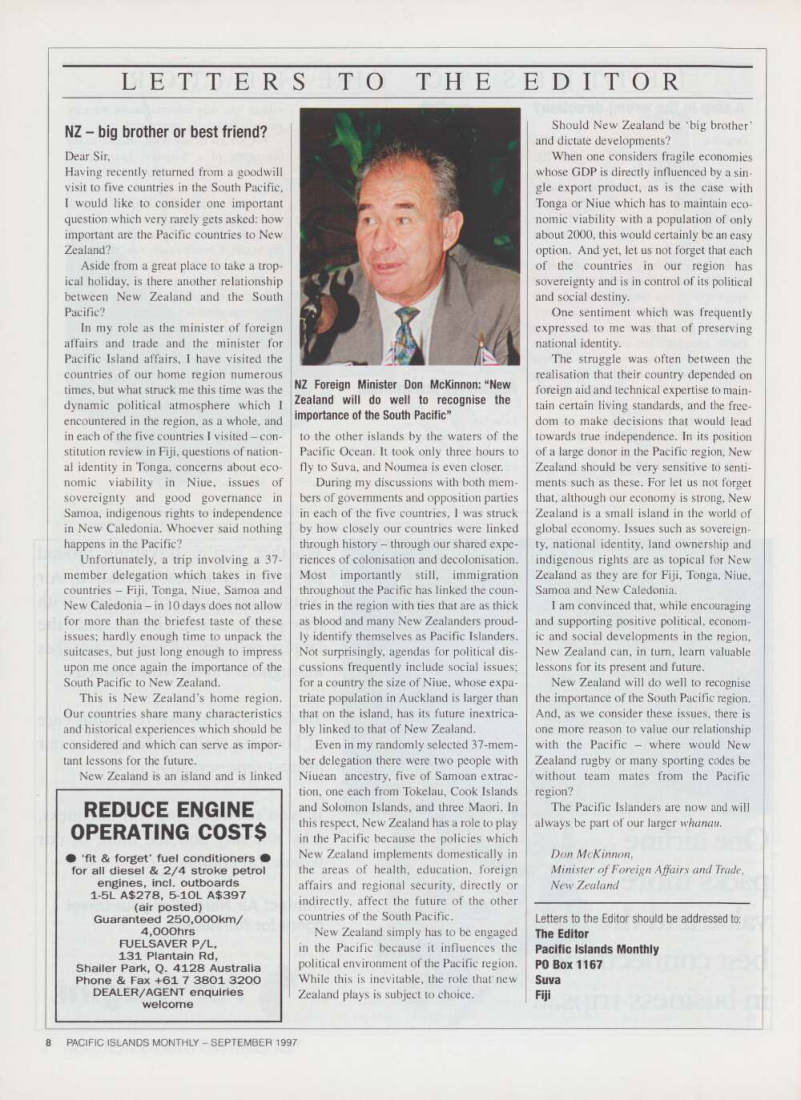
Don McKinnon,
Minister of Foreign Affairs and Trade, New Zealand
Letters to the Editor should be addressed to: The Editor Pacific Islands Monthly PO Box 1167 Suva Fiji
NZ Foreign Minister Don McKinnon: “New Zealand will do well to recognise the importance of the South Pacific”