passport scandal
pp. 15-17 · Read in the full issue
Cover Stories
Western Samoan passport scandal
Jailed Chinese businessman Jin Jipei will want to forget April 7, the day he flew into Western Samoa’s internation al airport carrying a local passport as identification. Police arrested him for holding fraudulent documents - and
unlocked the scandal of the year.
Since the 45-year-old’s arrest and pend ing court case, five immigration depart ment officers have been suspended in con nection with a racket involving the sale of Samoan passports for up to $26,000 each in Hong Kong and possibly the Apia head office. Politically, the controversy has land ed squarely at the door of 72-year-old
Prime Minister Tofilau Eti Alesana, who since 1991 has held the immigration port folio. His response, so far, has been any
thing but prime ministerial.
Within days of the Jipei incident, the national daily, the Samoa Observer, claimed Samoan passports had been adver tised in several Chinese newspapers, including the Macao Daily and the Hong Kong East, and sold for thousands to any one needing one. Permanent residency sta tus and work permits were offered.
Those claims were backed by another Hong Kong businessman. Michael Zhou arrived in the country with a local passport shortly after Jipei. He confirmed the Samoa Observer's version of events. Zhou, who came looking for business opportunities, said that after phoning the Samoa consul general’s office in Hong Kong, he was told by an unidentified person to contact a com pany called Pacific Life International for further details. Upon doing so, he was sup plied by the company with prices in US dollars for passports, permanent residency and work permits. Zhou and at least seven other Chinese nationals with Samoan doc uments have been forced to return to Hong Kong in the wake of the scandal going pub lic.
The newspaper also published corre spondence from the New Zealand High Commission in Apia to the immigration department in March querying whether government authorisation to issue visas by another Hong Kong-based company, Chi Hang International Investments, late last year were in order. It is not known how the immigration department responded.
The government, however, quickly dis tanced itself from the Samoa Observer ver sion of events, saying they had never authorised the sale of passports or visas to any Chinese nationals or delegated compa nies to act as distribution agents.
Deputy PM Malielegaoi suspects the Hong Kong advertisements to be the work of professional criminals. Even so, the con sul-general for Hong Kong, Tuigamala Anetipa, was on a flight home within 48 hours of the story hitting news stands. He then held several private meetings with the PM.
Also puzzling is the total silence by Alesana as immigration minister. Normally outspoken, the PM has quietly removed himself from the spotlight since the first
Chinese began arriving, fueling specula
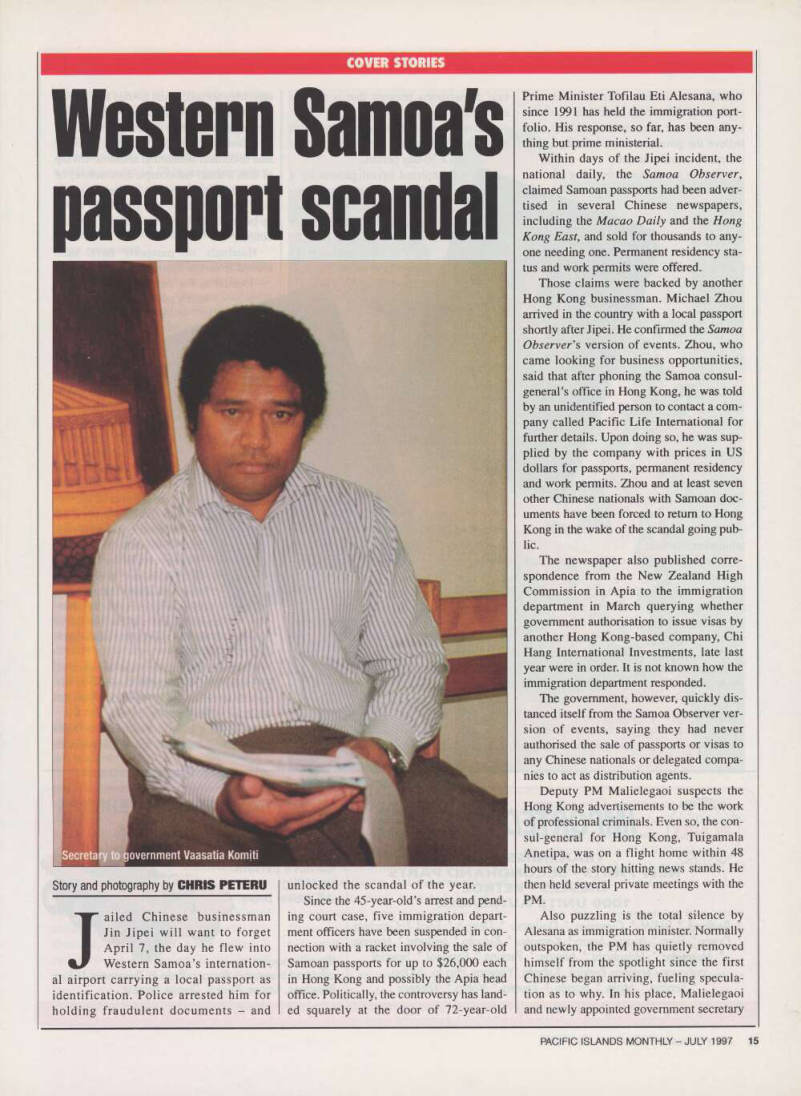
tion as to why. In his place, Malielegaoi and newly appointed government secretary
Story and photography by CHRIS PETERU
Vaasatia Komiti have been left to do the explaining. Both men have defended the leader’s failure to comment publicly, and believe the government’s credibility inter nationally remains intact.
“If there are disputes involving the government, then we wait for investi gations, find out who or what is \ involved n before making \ any announce ments - not just jump stupidly into it,” said \ Malielegaoi.
On state-run televi sion, Komiti took pains to disclaim any top-level n involvement while calling
media reports irresponsible \
and sensational. \ “Maybe people think that if the PM goes on air then the thing will die away, but it could also work the other way - it could be interpreted by the papers as an admission,” he said.
Malielegaoi dismissed notions that Anetipa was in any way involved in the passport sales, contradicting Zhou’s claims to the Samoa Observer. “My understand ing is he is not implicated. There is no involvement by the government at top level.”
Komiti is adamant the HRPP has noth ing to hide. “I can only say, as far as the government is concerned, we are not sell ing passports to people who are not citi zens of this country. It is unfortunate there are impressions of a country condoning the
sale of passports because that is not the case, that is absolute rubbish.”
Current laws allow travellers with ongoing tickets to stay in Western Samoa
on a 30-day permit.
Completed investigations by a
three-man government com » mission of inquiry has indicat- Hk ed that dozens of passports have gone missing from as early as 1994, although the newspaper now claims 1700
passports have disap peared.
The five
suspended immigration
staff include chief immigration officer Tuipoloa Suisala, who headed the office since 1979. A press release from the PM’s department indicated that charges could be laid soon.
Suspicions that something was amiss should have been raised earlier. Despite meagre salaries - the 1995 budget had the chief officer earnings about $19,000 a year - flash lifestyles that included late model
cars, trips abroad, rental houses and invest ments that went way beyond the officers’ earnings were never investigated. Police have frozen several officers’ bank accounts said to contain substantial amounts. On top of that, a small but conspicuous number of Chinese have been able to somehow nego tiate residency laws and find work or set up businesses, often restaurants or catering outlets.
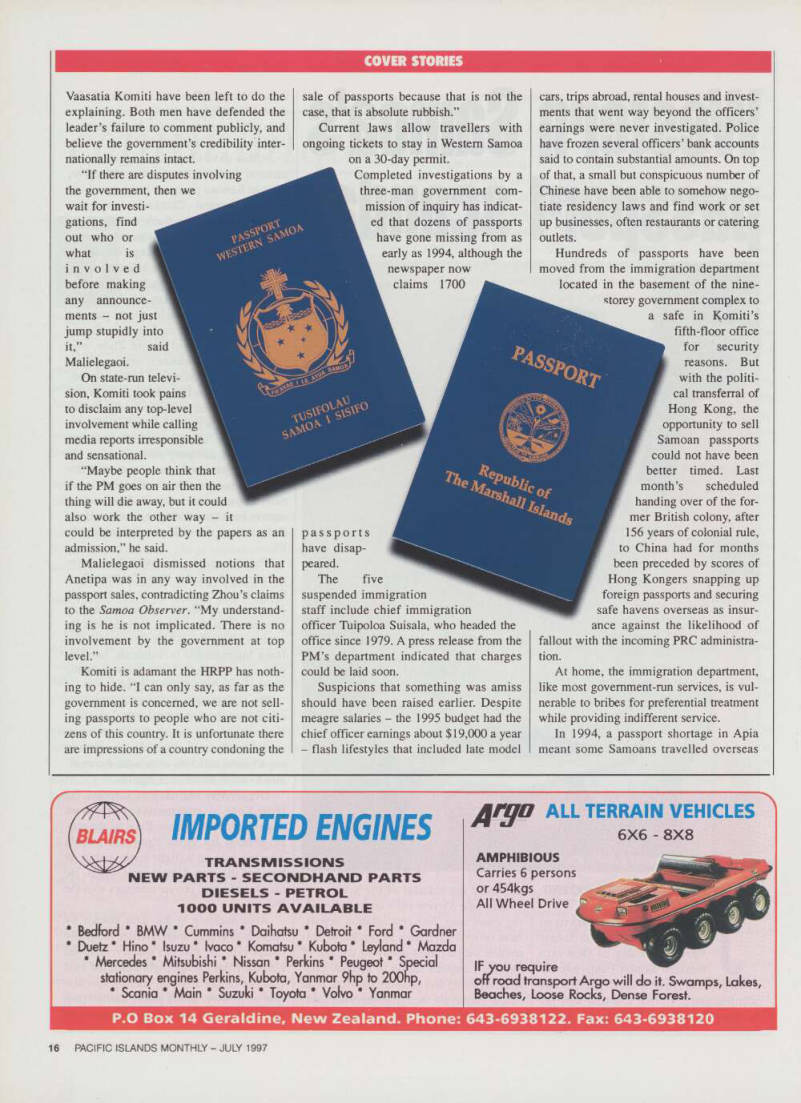
Hundreds of passports have been moved from the immigration department located in the basement of the nine- I storey government complex to a safe in Komiti’s fifth-floor office for security H reasons. But V with the politi- Wf cal transferral of V Hong Kong, the opportunity to sell Samoan passports could not have been better timed. Last month’s scheduled handing over of the for mer British colony, after 156 years of colonial rule, to China had for months m been preceded by scores of
Hong Kongers snapping up
foreign passports and securing
safe havens overseas as insur ance against the likelihood of fallout with the incoming PRC administra tion.
At home, the immigration department, like most government-run services, is vul nerable to bribes for preferential treatment while providing indifferent service.
In 1994, a passport shortage in Apia meant some Samoans travelled overseas
using flimsy sheets of paper while awaiting a fresh batch to be printed and flown in from Britain months later. It has been alleged by a government source that, in 1995, diplomatic passports were issued to a visiting group of Chinese businessmen.
One of the group was made honorary con sul to Kyrgyzstan, on the northern border of China and Russia. Promises by the group to set up a bank and airline in Samoa never eventuated.
Komiti, who was on the inquiry team, says the findings would completely exon erate the government. “We are confident we will get to the bottom of this and the person responsible, whether here or over seas, will be brought to face the music.
Notices have been sent to people we sus pect are involved to cease from such prac tices.”
The public feeling, though, is that the inquiry is little more than an exercise to clear the PM of any wrongdoing, while finding suitable scapegoats. Few are hold ing their breath in anticipation of the probe revealing anything more than that it was somebody else’s fault. The HRPP govern ment has gained a reputation for having a soft spot for loyal bureaucrats with shady backgrounds. For instance, former Minister of Post and Telecommunications Tolofuavalelei Leiataua who was found guilty of corruption during last year’s elec tions has been given a senior post with state-run Polynesian Airlines. Airline sec retary Muliaumasealii Leaupepe was the country’s attorney-general until charged by New Zealand police with stealing over $lOO,OOO of clients’ money while practis ing as a lawyer there. The list goes on.
Legal action against the Samoan Observer could be taken by the govern ment if sufficient grounds for a libel action are established.
“When the police investigations have been completed then the hammer will strike the nail on the head,” says Malielegaoi. “Those newspaper stories are so inflated they have almost touched the sky.” But publisher Savea Sano Malifa says the papier is standing by what it believes is a “watertight” story.
In an editorial, he said his newspaper “would not be a party to this blatant attempt to cover this monstrosity with eva siveness, fabrications and half truths”. It called on the government to resign and
urged suspended immigration officials to
disclose details of the scan to the public.
Relations between China and Western
Samoa have, in the 90s, come increasingly close, in part due to the amount of aid China has provided. During the past four years, the $25-million-dollar government complex, a $2.5-million-dollar Women’s Convention Centre plus the renovation of Apia Park, the home ground of the nation al rugby team, were provided for by the Chinese government. Western Samoa regu larly sends delegations on trade and good will visits.
Given the current controversy, an index on corruption in last October’s Asian Wall Street Journal is interesting. Comparing
corruption in 53 countries on a scale rang ing from 0 (totally corrupt) to 10 (totally clean), New Zealand came out as the clean est country in the world (9.43); Hong Kong came a credible 18 (7.01); and China (2.43) rolled up in 49th spot, five from the bot tom.
“The chaos, corruption and lawlessness of China are Hong Kong’s real worries after 1997,” concluded the journal.
How that analysis of China will affect Western Samoa in the future is something the Tofilau government may now want to consider more carefully. ■
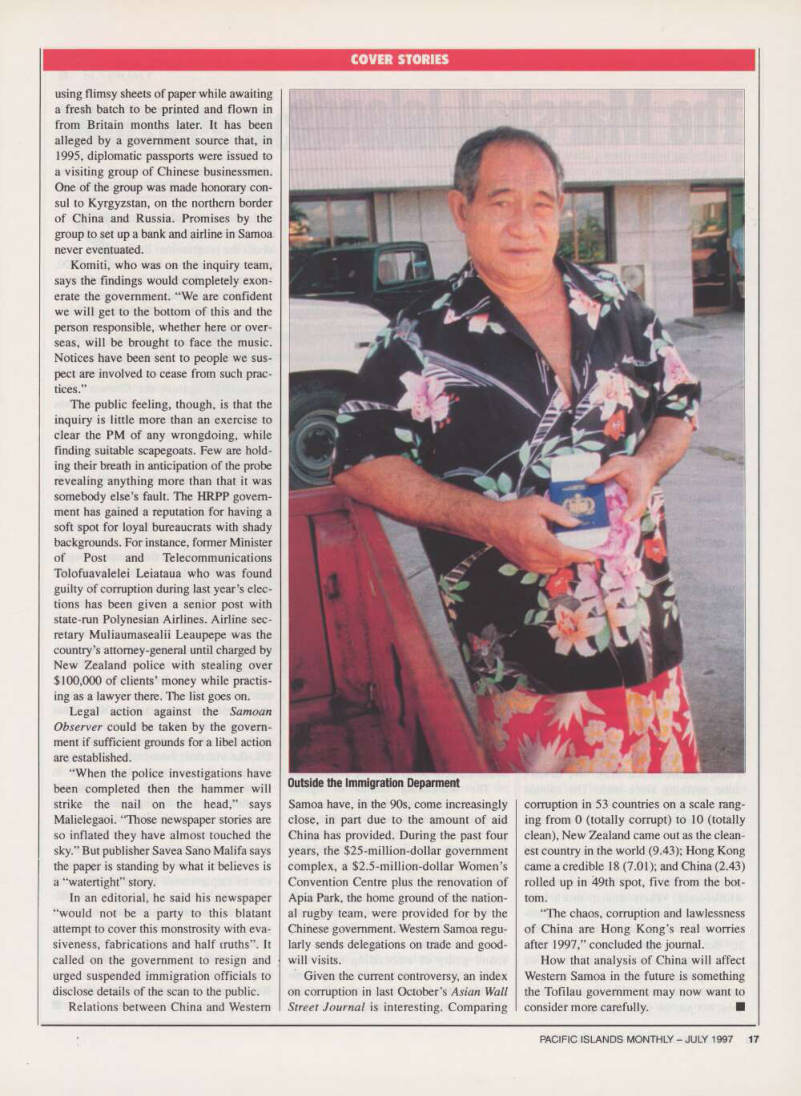
Outside the Immigration Deparment