United we stand
pp. 12-13 · Read in the full issue
Special Report
MSG leaders seek solidarity for success
Reports by BERNADETTE HUSSEIN
The focus of the 11th summit of the Melanesian Spearhead Group, hosted by Fiji in May, lay largely on trade and economy in the region issues pertinent to the Pacific as it heads towards the new millennium - and the need for solidarity and unity between the island countries. Small island nations
could achieve their goals through this unity and use it to secure their needs and aspirations, Fiji Prime Minister Sitiveni Rabuka said in his welcome address as chairman of this year’s
meeting.
Rabuka reminded the delegates that, as small island nations, they had to keep pace with the rest of the world and look ahead with a clear sense of vision. “The Lome Convention with the European Union, to which all of us are parties as members of the ACP [African,
Caribbean and Pacific] group of states, will expire in February, 2000. So, we must look beyond this to the 21 st century and prepare ourselves to grapple with the realities of the new era.”
He reminded the leaders that since the end of the Cold War, the West had lost interest in the Pacific because it was no longer regard ed as strategically important. Because of this, the South Pacific was being treated and regarded as among the least important parts of the world market economy, the PM said. “In the last seven years or so, we have seen the withdrawal of Great Britain from the South Pacific Commission, the closure of the United States embassy in the Solomon Islands, the USAID offices, Asia Foundation and Peace Corps offices in Fiji and other Pacific countries,” Rabuka said, pointing to these as examples of the decline in interest in the region.
He asked the leaders to keep in constant touch with policies and developments in overseas markets.
“The free trade rules of the General Agreement on Tariff and Trade [GATT] agreed to in 1993 are beginning to govern our trade
policies and relations through our membership with the World Trade Organisation [WTO]. We are told GATT has the promise of opening up new market opportunities for small developing countries and the new GATT rules impress on us that we have to trade to be competi tive and to effectively take advantage of the opportunities.
“This requires us to have domestic policies that free up and deregulate our economies, policies on human resources develop ment, wages and salaries, exchange rates and general costs of pro duction that will all help to raise the level of our international com petitiveness. Competitiveness means price competitiveness as well as quality and supply reliability of our exports.
“We have to secure our markets as well as identify new markets for what we can produce. This requires a level of sophistication in inter national market research in our private sectors as well as trade departments and our embassies overseas.”
He said there was no morality or good will when countries had to compete for international export markets. Rabuka said the region should keep in mind that the world economy was shaped and controlled by the interests of powerful
trading nations and, at every international gathering, the endless clamour was to liberalise trade and open the market to reduce and ultimately remove tariffs. “Yet, the same big countries are busy forming themselves into trading blocs, such as the European Economic Community, the North American Free Trade Area (NAFTA) and other looser groups of nations.”
Rabuka said these countries were organised to promote and pro tect their interests collectively under the new trading regime which is why the region had to seek cooperation with those nations which had similar interests. These, he said, were the African and Caribbean nations in the ACP partnership and the European Union through the Lome Convention. And, as Asian nations forge ahead on the path to economic success, Rabuka suggested the need to ensure the region’s voice was heard in forums such as APEC and ASEAN. Fiji Foreign Affairs Minister Filipe Bole had earlier, at the MSG foreign ministers’ meeting, had talked of the importance of trade over aid and about what he referred to as misconceptions about
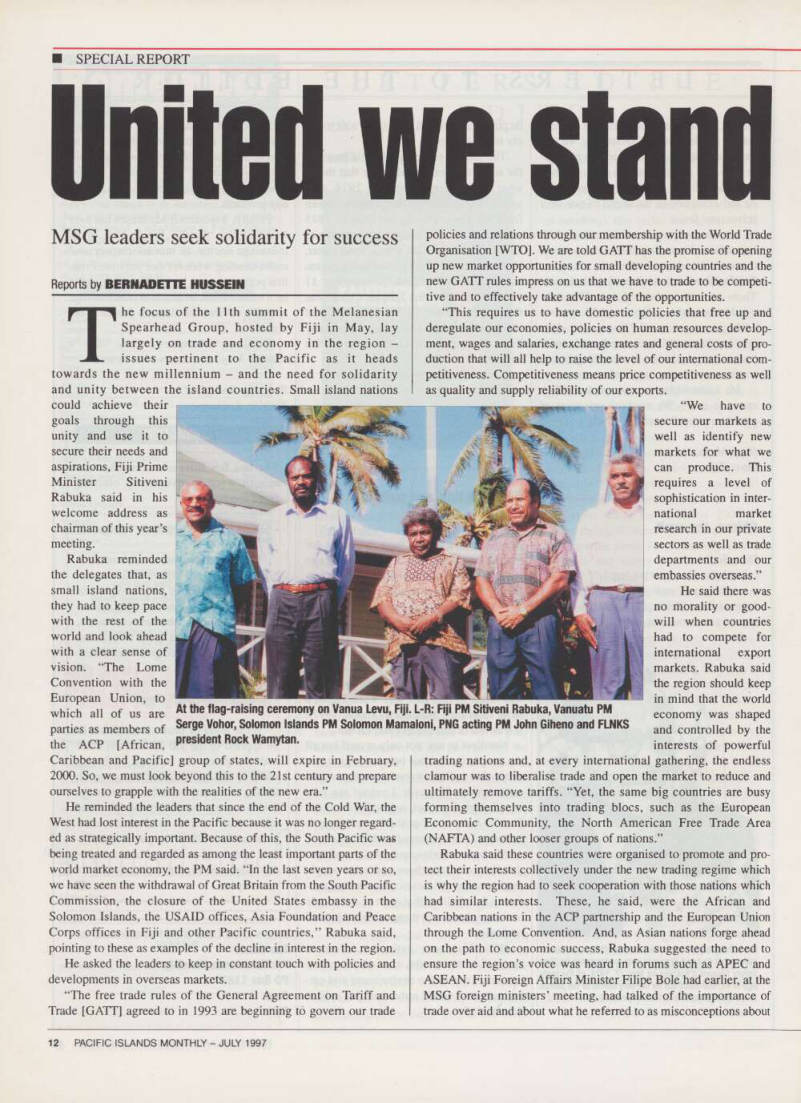
At the flag-raising ceremony on Vanua Levu, Fiji. L-R: Fiji PM Sitiveni Rabuka, Vanuatu PM Serge Vohor, Solomon Islands PM Solomon Mamaloni, PNG acting PM John Giheno and FLNKS president Rock Wamytan.
the region and its resources. The islands in the region had to contin ually improve relations with each other, Bole remarked, adding that this could be done by encouraging trade and other economic rela tions and mutual assistance with each other in programmes which were practical, transparent and sustainable.
He did not give examples. He added that trade was the most important ingredient of international relations and aid, if available, should only supplement it. “Take away trade and we return to colo nial dependence, economically and politically, on more advanced economies,” he said.
Bole added that there were a number of misconceptions about Melanesia that were not true - that it was underdeveloped, small and isolated. Another theory, he said, which should be discarded was the contention of economists and academics, who declared them
selves neutral and unbiased, that these countries had scarce resources. “All Melanesian countries are rich in minerals, timber and larger land areas for agriculture and other development.” Melanesia was neither small nor iso lated, he said. There were other nations which were small er and more isolated. He said island nations of Melanesia comprised the major landmass of the Pacific and had the highest concentration of people, claiming an abundance of land and marine resources.
Rabuka, however, while not disputing that the Pacific had many resources at its disposal, highlighted the importance of being wary of exploitative measures. “We are in the middle of the Pacific Ocean and our natural resources, such as our fisheries, and unexplored potential resources, such as minerals, have been and will continue to be of interest to our more advanced neighbours.”
But, the Fiji PM cautioned, while the region was moving in the path of economic growth it was important that sus tainable development be kept in mind. “This is because it may lead only to depletion of our natural resources such as our forests, fisheries, and the degradation of our envi ronment.
“There are benefits in increased trade for our people but the consequences can also be costly.” He added that as they advanced into the next millennium, they had to keep their eyes wide open to take advantages of the benefits of modernisation that will strengthen our commu nities. Rabuka told the delegates that, as members of the MSG, they had to commit themselves anew to the princi ple of promoting increased economic and technical coop eration. “We must make full use of our partnership in the MSG to explore all avenues of collective cooperation to further the economic interests of our countries, both with in our region and beyond.
As outgoing chairman, the acting prime minis ter of PNG at the time, Giheno, referred to Fiji’s inclusion in the MSG as crucial to the enhancement of regional cooperation in politics, economy and cultural exchanges.
Solomon Islands PM Solomon Mamaloni said Fiji was one of the more advanced countries in the region and expressed the hope that his country could leam a lot from it. Fiji played a leading role in international affairs and had a strong and steady economy like PNG, Mamaloni said. So, together, they would make a difference and be able to take an important role, especially on the interna tional scene. Mamaloni said his country could take its cue
from Fiji’s tourism industry. He said tourism in Fiji was one of the most thriving industries in the region and to understand how this was achieved would be of tremendous help. In return, he said, Fiji could cash in on the Solomon Islands’ lucrative tuna industry, which has managed to earn millions of dollars in revenue.
The MSG was formed in 1986 after heads of the Melanesian states of Vanuatu, Solomon Islands and PNG met in Goroka, PNG.
At this meeting, the leaders considered Melanesian solidarity as necessary at state-to-state level to effectively work on developmen tal issues in the region which had a direct, special and related rele vance to Melanesia. This includes the Kanaky cause for indepen dence in New Caledonia as represented by the Front Liberation National Kanaks Socialist. Rock Wamyton of the FLNKS from New Caledonia attended as observer. ■