Understanding insurance
pp. 44-46 · Read in the full issue

Insurance
Understanding insurance coverage in the Pacific
By Bernadette Hussein
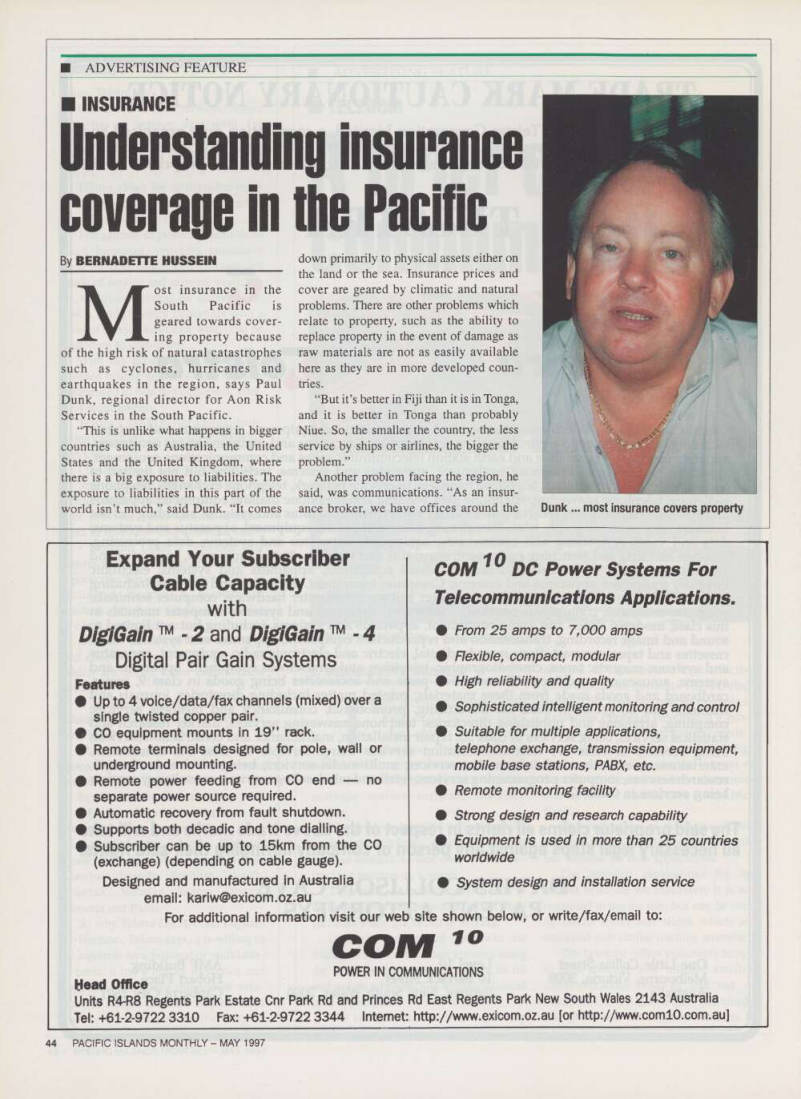
Most insurance in the South Pacific is geared towards cover ing property because of the high risk of natural catastrophes such as cyclones, hurricanes and earthquakes in the region, says Paul Dunk, regional director for Aon Risk Services in the South Pacific.
“This is unlike what happens in bigger countries such as Australia, the United States and the United Kingdom, where there is a big exposure to liabilities. The exposure to liabilities in this part of the world isn’t much,” said Dunk. “It comes
down primarily to physical assets either on the land or the sea. Insurance prices and cover are geared by climatic and natural problems. There are other problems which relate to property, such as the ability to replace property in the event of damage as raw materials are not as easily available here as they are in more developed coun tries.
“But it’s better in Fiji than it is in Tonga, and it is better in Tonga than probably Niue. So, the smaller the country, the less service by ships or airlines, the bigger the
problem.”
Another problem facing the region, he said, was communications. “As an insur ance broker, we have offices around the
Dunk ... most insurance covers property
Understanding insurance coverage in the Pacific
Pacific. Say, for instance, if our comput ers break down in the Solomon Islands, basically, we have to send them down to Australia to get them fixed.
“So, operating an office becomes more difficult because your availability of ser vices and trained staff isn’t as good.”
Aon also deals in medical insurance but, Dunk says, this becomes difficult when these insurances are in countries which do not have regular airline services.
We are insuring people for health in the Solomon Islands where medical services are nowhere near to what is available in Fiji - so, there is a greater need to evacu ate. “Sometimes we are in a situation where people need to be evacuated as soon as possible and the next flight is not due out for the next three days. So what we have to do here is hire a plane which comes equipped with medical facilities.
But these don’t come cheap and we have to pay so much more for these facilities compared to how much it would cost us to fly these people out.”
He said he found that in the Pacific there was a great reliance on the sea.
“The boats sailing in the South Pacific
are mostly inter-island trading vessels which are often in far more hazardous waters because there are so many reefs.”
One problem you will find in the Pacific is overcrowding of boats. What we find is that if someone owns a boat, he tends to take about 100 people when his boat only has the capacity to carry 50. Sometimes, these boats are not in very good condition and insurance companies don’t insure them for much. In cases where boats do not have a proper survey report, some insurance companies will not insure them at all.”
Dunk explained the procedure of marine insurance, saying most shipping companies insured their crew in case of mishaps. “First, what the insurance com panies do is look at the boat and then the survey reports if there are inadequacies.
Then, chances are these boats will not be insured. All this is done to ensure that the boat is as safe as possible.”
Aon prides itself on being one of the largest insurance brokers in the world and has been operating in the South Pacific for over 13 years with offices throughout the
region. ■