style option
pp. 26-28 · Read in the full issue
New Caledonia
A S African style option
Reports and photographs by
Kalinga Seneviratne
in New Caledonia / / f our leaders,
• • I Flnks And Rpcr,
want no self-inde- M pendence in 1998 but carry on for another 20 years or something like that - I don’t know how many years - then they must tell the people. The problem is they organise secret meetings - we don’t know what happens, the people are confused,” says Nicole Waia, man ager of the Kanak-run Radio Djiido here.
Waia’s comments perhaps reflect the mood of most New Caledonians today, as the French colony approaches the deadline set in the 1998 Matignon Accord to hold a referendum on idepen dence in 10 years.
All parties which signed the accord - the Kanak Independence movement, the Front de Liberation Nationale Kanak et Socioaliste (FLNKS), the pro- French right-wing party Rassemblement pour Caledonie dans la Republique (RPCR) and the French government - are now reluctant to go for the independence vote as agreed to in the 1998 referendum.
“If we go through this vote, there is a risk for the population ... we can go into a cycle of violence,” Rock Wamyton, the president of FLNKS told Pacific Islands Monthly.
RPCR’s National Congress member, Jean Claude Briault, agrees. “If the ref erendum is held, there will be probably 60 to 70 per cent of voters in favour of maintaining New Caledonia in the French Republic; only 30 to 40 per cent for independence. My thought is that it will be a step back,” he told PIM.
This is a view Wamyton seems to share. Even though he believes 80 per cent of the Kanak population support independence from France, he admits that the FLNKS has not been able to
AS African style option
convince the others. “The problem is the electoral role because the electoral role of 1998 is not beneficial to the independence movement,” he says. “That’s why we decided two or three years ago to try and find a solution that avoids this referendum of self-determination.”
This solution which the FLNKS is look ing for seems to be something similar to the power-sharing arrangement South Africa’s Nelson Mandela’s African National Congress (ANC) was able to work out with the then president F W de Klerk’s National Party.
A National population survey conduct ed last year by the Institu Territorial de la
Statistique et des Etudes Economiques (ITSEE) found that 44.1 per cent of New Caledonia’s population of 196,800 were of Kanak (Melanesian) descent, 34.1 per cent European, nine per cent Wallisan (Polynesian), 2.6 per cent Tahitian, 2.5 per cent Indonesian and 1.4 per cent Vietnamese. While many Kanaks seem to support the FLNKS, most others - who make up the majority - are believed to be aligned with the RPCR.
“I think we can compare the model we are going to settle here with the model in South Africa,” says Wamyton. But Briault thinks “it will be more correct to say that South Africa reached a solution like in New Caledonia”. Briault argues that they
already have democracy in New Caledonia “with everybody having the same rights”, and two of the three provinces - estab lished by the Matignon Accord - are already ruled by the FUNKS.
FUNKS leadership’s reluctance to push for an independence vote in 1998 and their willingness to enter into negotiations with RPCR about a possible coalition govern ment, perhaps in “Free Association” with France, has angered many Kanak national ists whose militant action in the early 1980 s was instrumental in pushing France and the RPCR onto the negotiating table with the FUNKS.
“For me, as a Kanak woman, as a Kanak journalist, as a Kanak militant, how can I explain to the people, ‘Uisten Kanak peo
ple, the strategy is changing’? It’s too diffi cult here for us,” complains Waia, adding that the FUNKS leadership is not making an effort to use the media like Radio Djiido to explain their strategy to the people.
“We are here because of the people ... we can’t ignore the people, especially the militants,” warns Waia.
“When the FUNKS signed the Matignon Accord, they wanted a referendum in 10 years because they were sure that within 10 years they would be able to convince the non-Kanak population to support indepen dence. What has happened since is that the FUNKS has been in power and left out the people who voted for them. Now they realise by referendum they won’t obtain
independence, so they are talking with RPCR to set a vote for independence,” observes Pierre Chauwat, an executive board member of USTKE, New Caledonia’s biggest labour union.
USTKE was a member of FUNKS when the Matignon Accord was signed but pulled out of it in 1989. Chauwat argues that the FUNKS and RPCR should not try to work out a deal on their own and force it on the people through what they call a vote of rat ification. “You must not do things like that, you have to consult the people in debate and share the position,” he says.
Chauwat adds that even many Kanaks are not keen on independence because there has not been much public debate about the issue here. “If you want people to support independence, you have to state what is contained in independence,” he argues. “It’s just a word today and people are very scared when they hear it because the right-wing parties have scared the peo ple by saying, ‘Well, if you become inde pendent, it will be chaos.’”
This is a view shared by Josuah, a Papua New Guinean expatriate working here.
“Some of the Kanaks are happy with what they’ve got here,” he observed. “The French media here always show the nega tive side of life in the neighbouring coun tries - financial scandals in Vanuatu, gov ernment servants’ pay cuts in Cook Islands, and people living behind barbed wire in Port Moresby. So the idea given is - this is what they’ll get if independence is given.”
When PIM spoke about independence to some middle-class Kanaks playing the French sport petanque on a Saturday after noon in the Anse Vata beachfront in Noumea, most of them reflected this view point.
“We will not be ready for independence until 2050 because we need to educate our people to run the government service and business. They need to get jobs and have experience before running the country,” said Apen Bone, a sports administrator and trainer. “I went to Vanuatu, our closest neighbour, before independence and found the living conditions, the social conditions were better there. But now, after indepen dence, they are coming here to find a better life.”
As “the deadline for independence approaches, people are (becoming more) conscious that independence is difficult”, said Gerald, a psychiatric nurse. “People who had a strong opinion on independence are now getting soft. The French govern ment leaders were clever by giving money
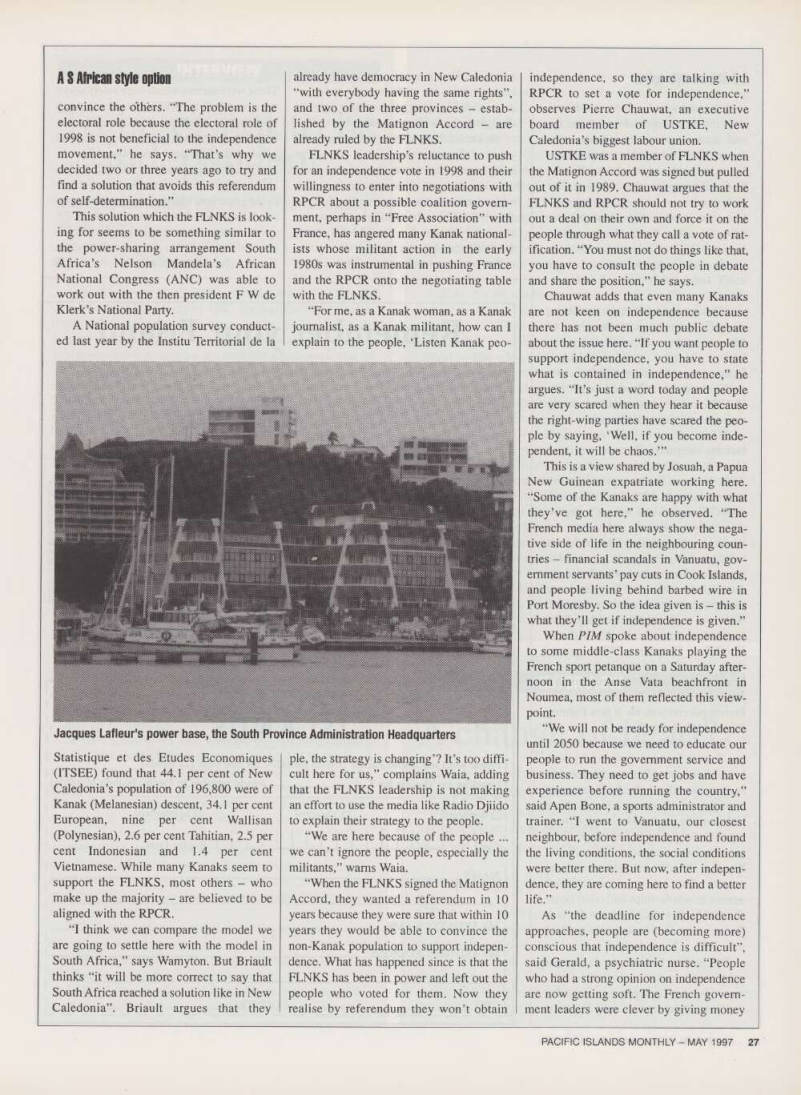
Jacques Lafleur’s power base, the South Province Administration Headquarters
A S African style option
to independence leaders; it softened their mind on independence. Now, the real issue is not independence even though they pretend that independence has to be [achieved] by the deadline.”
Gerald argues that because the ‘independentists’ have softened their line, the ‘anti-independentists’ are doing the same. “Both sides are soften ing and a kind of balance is coming in to negotiate independence - but we don’t know what type of indepen dence.”
“This vision of Kanaks not being ready for independence is the vision of France,” argues Aloision Sako, the leader of Rassemblement Democratique Oceanien (RDO), a new political party aligned with the FLNKS, which has attracted strong support from young Wallisians.
“They (France) say you can’t become independent because you don’t have doctors, engineers, and so on.
True, because France opened Kanak schools only in 1956,” he observed.
“FLNKS says when we get indepen dence it’s not Kanaks only, there are Wallisians, Vietnamese, French. So, we will have many Europeans who want to stay here, Vietnamese would want to do business here. So, independence means a government of many colours.”
It was with this vision that Sako decided to throw in his lot with the FLNKS in December, 1994 - some thing for which he may have paid a heavy price. He was sacked from his job as a policeman in Noumea by the French government. He is now fighting this in a tribunal in Paris.
“Many of my people are afraid of the French because they hold power here,” Sako says. Peter, a 23-year-old sports personality in the Wallisian com munity here, who has represented New Caledonia in international competition, says: “I don’t like the FLNKS. They believe New Caledonia is only for Kanaks. We also helped to build the country but we are discriminated against in scholarships and other bene fits given after the Matignon Accord.
Kanaks think they have a right to all of it.”
While the FLNKS is facing an uphill battle in convincing other com munities that independence is for everyone, there are also deep divisions
within the Kanak community on what real ly constitutes the path towrads indepen dence. But Wamyton believes their political struggle today is also an economic one.
He knows that you cannot dismantle 140 years of French colonial rule where the indigenous people were denied an educa tion and a share of the country’s wealth without creating the economic structures to absorb them into the country’s mainstream activities. Thus today, the FLNKS, using funds allocated to the two provinces con trolled by them, has bought a direct stake in
the nickle mining and tourism sectors.
These were sectors which were solely under the control of the RPCR, mainly through investments made by its leader, Jacques Lafleur - the richest man in New Caledonia - before the Matignon Accord was signed.
The challenge facing the FLNKS leader ship today is to convince its socialist-ori ented grassroots that getting into business sometimes even doing deals with the RCPR in the process - is not a sell-out of its social ist egalitarian vision for an independent Kanaky (New Caledonia). ■