Sr Julius
pp. 15-16 · Read in the full issue
just where did he go wrong?
By Sam Vulum
Papua New Guinea erupted in jubilation following Prime Minister Sir Julius Chan’s announcement to step aside on March 26 while a com mission of inquiry he established investigates any wrongdoing in the Sandline International contract.
Henganofi member of parliament and Pangu’s deputy leader for the Highlands region, John Giheno, was appointed acting Prime Minister on March 27. He was forced to make the difficult decision to defuse tensions outside Parliament House where soldiers and anti-government protesters staged an all-night vigil, forcing several MPs to spend the night in parlia ment while others escaped by jumping over the fence with the help of police personnel.
The announcement ended almost 10 days of chaos and anarchy sparked by the
sacking of PNGDF commander Brigadier-
General Jerry Singirok for spilling the
beans over the government’s engagement of Sandline. Soldiers, who were at the fore front of the mercenary crisis, returned to their barracks after their vigil outside the parliament house as guards for about 2000 protesters were welcomed like heroes from battle.
Crowds stood on street comers waving and cheering, drivers sounded their car horns and flashed their headlights and small children were held aloft as the men in jungle greens, some with their faces painted in camouflage colours, celebrated their victory. They trundled home from the picket line and the barricade, most of them on the back of open trucks, returning the greetings with gusto and squirting mouth fuls of red betelnut juice over the side.
They stopped short of firing their guns into the air, but only just. The soldiers’ joy at Sir Julius’ departure from office was
matched by that of the thousands who had camped outside Parliament House in Port Moresby. They were listening to the parlia mentary broadcast on radio and as Sir Julius uttered the words they had demand ed - that he would step aside - an almighty cheer rang out. What followed were unbri dled expressions of joy culminating in the mass singing of Papua New Guinea’s national anthem.
In tok pisin, the lingua franca of Papua New Guinea, it was “mi amamas tru ” (“I am very happy”) as the locals made it over whelmingly clear that they really don’t like Sir Julius much at all.
Although, in the fluid world of PNG politics, the time of day can have a large bearing on political affiliations. The main thing they dislike about the man, whose second stint in the country’s top office may well have ended on March 26, is that he is of mixed race. Another is that he is extraor dinarily wealthy. Neither are reasonable grounds for uncharitable feelings but, in an
economically ravaged environment, they
are more than sufficient.
He argued long and hard that he had done the right thing and that he had always had the good of his country at heart. But he has ended up a long way from the hearts of his countrymen.
Sir Julius’ style comes across as pater nal and condescending, and on March 26 it was also extremely contradictory. He began by saying that the parliament had twice voted in his favour on the stand down issue in the past two days. It had, in fact, voted only once.
He went on to stress that he was not bowing to outside pressure or Opposition calls. But he later said he was. For 20 min utes he wandered around in circles and two-thirds of the way through he said he was stepping aside until a commission of inquiry announced its findings on the mer cenary deal.
A day earlier he had said he had given the military its best chance ever by engag ing Sandline to provide men and machines to win the nine-year war on Bougainville.
But the way he went about it - not telling the Cabinet or anyone outside his purple circle - was, as Opposition stalwart Bernard Narakobi told him in the house, a “bikpela [big] mistake”.
Twenty-four hours later the prime min ister wasn’t agreeing, but he would stand down anyway because he heeded the voice of the people. Within a few hours, those people were throwing parties. Meanwhile,
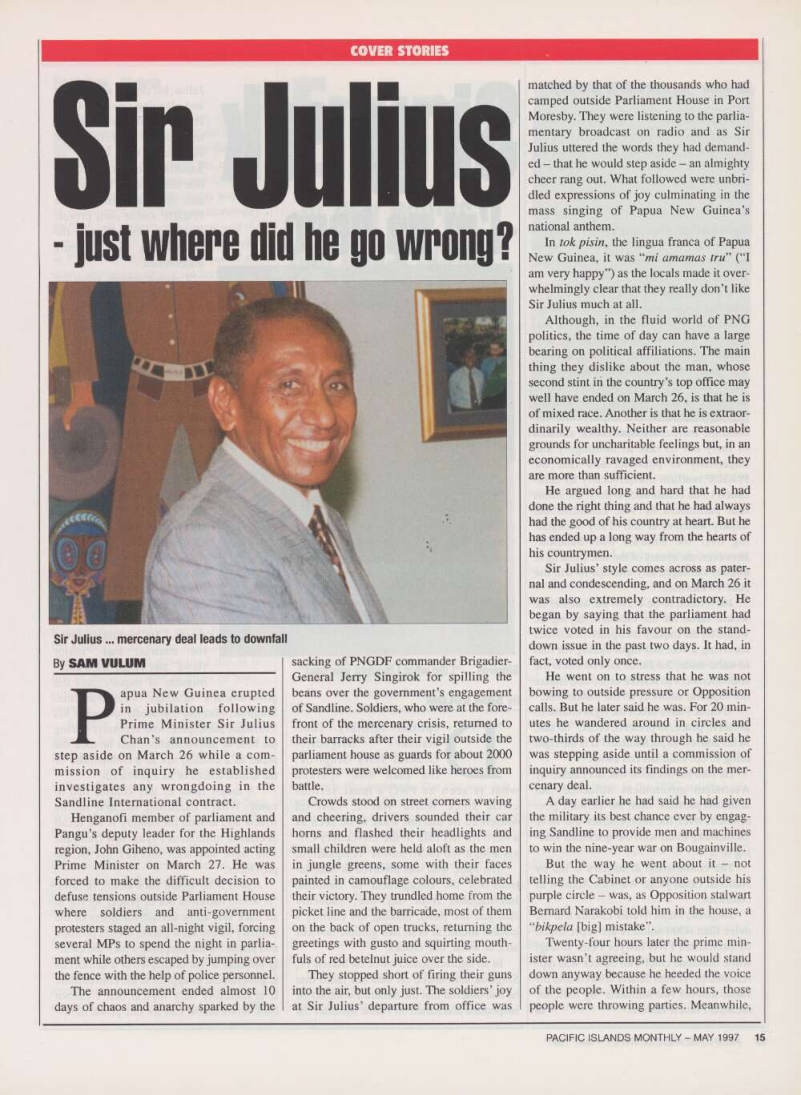
Sir Julius ... mercenary deal leads to downfall
Sir Jiius - just where did he go wrong?
Commonwealth Secretary-General
Emeka Anyaoku said he had secured a commitment from Singirok to uphold the PNG constitution. “His (Singirok’s) response was very positive,” Anyaoku said.
“He’s very keen to accept what the constitutional requirements are, namely that he has given up the command, but he has tremendous influence over the troops.
He has great loyalty from them.”
Anyaoku said all concerned needed to take that loyalty into account in decisions about Singirok’s future. He said he had expected troops would adhere to the con stitution and was greatly relieved that they did just that. Anyaoku returned to Canberra from PNG on March 25, where he made three proposals: immediate national elections; the inquiry into the Sandline mercenary contract be allowed to carry out its task as thoroughly and impartially as possible; and that the PNGDF reaffirm unequivocally its dedi cation to its constitutional duty. Sir Julius told parliament he was confident the inquiry would clear him of any wrongdo ing over the contract with Sandline.
However, the events of the last week have already damaged any attempt to win the June 14 election.
He refused to be drawn on whether he would stand for the election, saying he would let the inquiry take place first. After surviving a vote last night calling for him to stand aside, Sir Julius said he made the announcement to restore order and ensure the supreme authority of the parliament.
“I think I have taken the right course to preserve peace, to preserve order,” he said in his address to parliament. “It is the right thing to do. I did not run away.”
He said his decision was not caused by Australian government influence, but admitted pressure from the Howard gov ernment over the mercenaries did have “something to do with the questions lead ing to it”.
The commission of inquiry is led by National Court judge Warwick Andrew as chairman.
Singirok, Major Walter Enuma and the more than 4000 soldiers are represented by prominent PNG lawyer Peter Donigi while Sandline chief Tim Spicer was rep resented by Warner Shand lawyers and Sir Julius and his two ministers by Solicitor General Francis Damen. ■