Signals to
pp. 44-45 · Read in the full issue
Media And Politics
Signals to the Pacific
Proposal to close down Radio Australia has been seen as a reflection of the Howard govt’s attitudes to its neighbours
By Lili Tuwai
Outrage, dismay, disgust, disbelief and betrayal are just some of the reactions from leaders and media organisations in the Asia-Pacific region to the recommendation concerning the ter mination of Radio Australia (RA) as con tained in the Mansfield Report.
In Sydney, hundreds of letters stacked high on RA’s South Pacific correspondent Richard Dinnen’s desk bear witness to the concern of kings, prime ministers, ambas sadors and listeners from all around Asia and the Pacific who say that RA is essen tial. In fact, a significant number of Asian and Pacific leaders have commented to the effect that “to close RA down would be seen as an insult to the region in which we live”.
Over the past 58 years, RA’s pro grammes have been heard thoughout the Pacific, since its humble beginnings in 1939; the service was then known as Australia Calling and was opened by Prime Minister Menzies. The name Radio Australia was officially introduced to mark the change from its war-time role. It has since come to be regarded as a vital communicaton service broadcasting in nine languages to the Asia/Pacific region on shortwave, satellite and cable. They also rebroadcast on local stations in Fiji, Vanuatu, Niue, Tokelau, Tonga, Tuvalu, the Federated States of Micronesia, Marshall Islands, Cook Islands, Norfolk Island, Palau, Solomon Islands, New Caledonia, Kiribati and French Polynesia.
Currently, RA and Australian Television (ATV) are under threat of being closed down following recom mendatons from businessman consultant Bob Mansfield to the Australian govern ment in late January.
From its inception, RA’s aim has been to develop regional and international awareness of Australia and an under standing of Australian attitudes to region al, Australian and world affairs. What has
become obvious to many leaders and lis teners overseas is that the John Howard government has a very different attitude toward relationships with its neighbours in the region from the previous Keating government. Media analysts in Australia claim the Howard government’s haste to slash the ABC budget, after taking up office last year, is a rash and unqualified decision. Analysts suggest the decision to slice SASS million (SUS4O.7 million) from the forecast budget was overzealous and motivated by treatment they feel they received from the ABC during their 13
years in opposition. Looking to identify
areas within the ABC to sacrifice, Mansfield conducted an inquiry and found some of ABC’s top managers had readily agreed to the axing of RA.
Clearly, neither Mansfield nor the man agers were prepared for the furious chal lenge they now face from those opposed to the closure.
Since the release of the recommenda tons, heavy ’criticism has flowed con demning the process that Mansfield undertook in evaluating Radio Australia’s
feasibility. Consulting people within
Australia and the ABC itself, he received strong opinions that “serving the Australian populous is what the ABC should be doing”. Very few of these peo ple mentioned serving Australians outside of Australia or serving Australia’s inter ests by promoting Australia in Asia and the Pacific, and around the world.
Responding to the possibility of RA being axed, letters of concern from around the globe continue to pour in to RA.
Speaking to Dinnen, Akilisi Pohiva, a leading figure in Tonga’s democracy movement, appealed to the Australian government to ensure RA continues its international broadcasts. Pohiva leads a campaign to increase democratic repre sentation but his mission is not welcomed
by Tonga’s government.lßA’s presence in
the Pacific region during times of change and controversy, he said, has had a bal ancing effect that must be allowed to con tinue. “If the Australian government makes a decision to close down RA, that would be very inconsistent with what your minister has said to the various lead ers in the South Pacific. To close down RA is to deprive the people in the South Pacific,” he stated.
Mansfield’s decision to close RA was based on sketchy figures collected in 1981 by the DIX Committee for previous government enquiries into the activities of the ABC. Colbert says, “Those figures were a huge miscalculation.” He expa lined to Pacific Islands Monthly that ABC’s inadequate research techniques of the past had misinformed the government and (DIX) committee that Radio Australia had an approximate ‘guesstimate’ audi ence of around 100 million. Acting on the premise that more sophisticated technolo gy, such as the Internet and satellite, has led to a marked decrease in RA’s audi ence, Mansfield’s paper argues that short wave is an old form of transmission which is in decline. His report found this form of international broadcasting to be out of date and drew the conclusion that
people are no longer listening.
Colbert claims the DIX Committee figures were not based on any hard evi dence. He said: “It was guess work based on the number of letters that Radio Australia received from listeners. Fifteen years ago, every letter was considered to equal 200 listeners; that was the form of research done in those days to estimate the audience.” During 1990, RA conduct ed some research to get a more accurate gauge of the listening audience. Based on random sample surveys in target coun tries, RA’s audience was estimated at around 20 million people. Colbert says Mansfield picked on these two figures
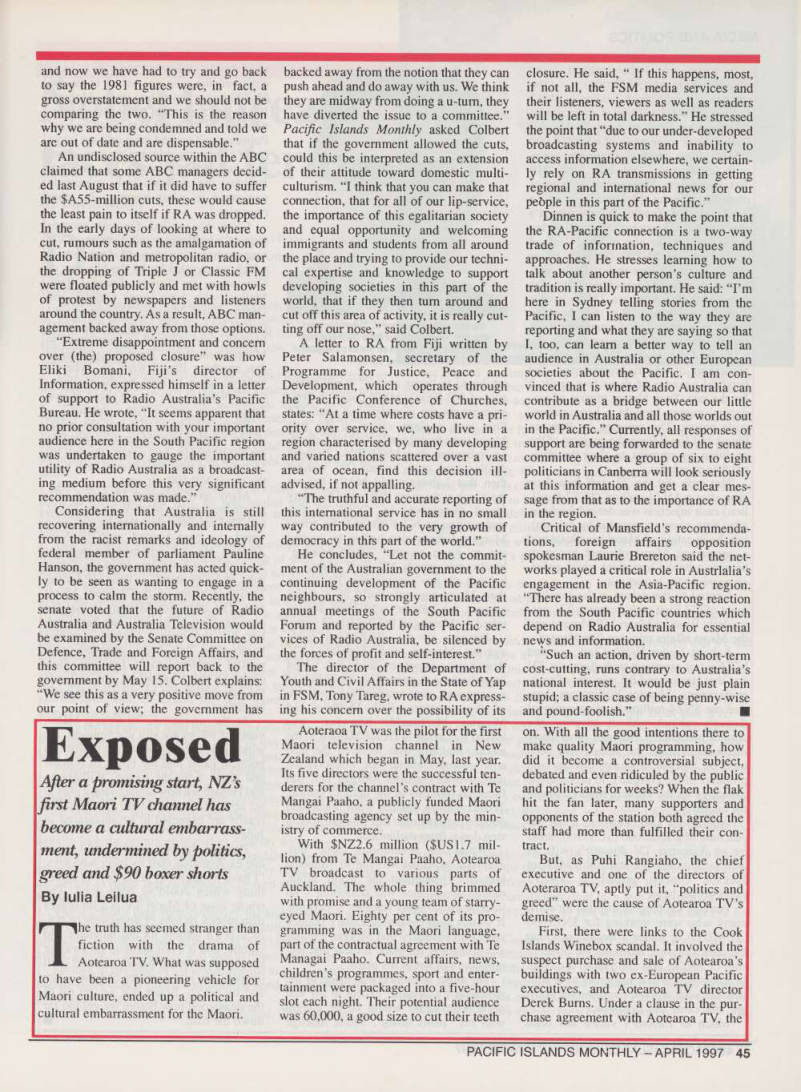
The team behind Radio Australia’s Pacific Beat, a 30-minute magazine programme for and about the region
and now we have had to try and go back to say the 1981 figures were, in fact, a gross overstatement and we should not be comparing the two. “This is the reason why we are being condemned and told we are out of date and are dispensable.”
An undisclosed source within the ABC claimed that some ABC managers decid ed last August that if it did have to suffer the SASS-million cuts, these would cause the least pain to itself if RA was dropped.
In the early days of looking at where to cut, rumours such as the amalgamation of Radio Nation and metropolitan radio, or the dropping of Triple J or Classic FM were floated publicly and met with howls of protest by newspapers and listeners around the country. As a result, ABC man agement backed away from those options.
“Extreme disappointment and concern over (the) proposed closure” was how Eliki Bomani, Fiji’s director of Information, expressed himself in a letter of support to Radio Australia’s Pacific Bureau. He wrote, “It seems apparent that no prior consultation with your important audience here in the South Pacific region was undertaken to gauge the important utility of Radio Australia as a broadcast ing medium before this very significant recommendation was made.”
Considering that Australia is still
recovering internationally and internally
from the racist remarks and ideology of federal member of parliament Pauline Hanson, the government has acted quick ly to be seen as wanting to engage in a process to calm the storm. Recently, the senate voted that the future of Radio Australia and Australia Television would be examined by the Senate Committee on Defence, Trade and Foreign Affairs, and this committee will report back to the government by May 15. Colbert explains; “We see this as a very positive move from our point of view; the government has
backed away from the notion that they can push ahead and do away with us. We think they are midway from doing a u-tum, they have diverted the issue to a committee.”
Pacific Islands Monthly asked Colbert that if the government allowed the cuts, could this be interpreted as an extension of their attitude toward domestic multi culturism. “I think that you can make that connection, that for all of our lip-service, the importance of this egalitarian society and equal opportunity and welcoming immigrants and students from all around the place and trying to provide our techni cal expertise and knowledge to support developing societies in this part of the world, that if they then turn around and cut off this area of activity, it is really cut ting off our nose,” said Colbert.
A letter to RA from Fiji written by Peter Salamonsen, secretary of the Programme for Justice, Peace and Development, which operates through the Pacific Conference of Churches, states: “At a time where costs have a pri ority over service, we, who live in a region characterised by many developing and varied nations scattered over a vast area of ocean, find this decision ill advised, if not appalling.
“The truthful and accurate reporting of this international service has in no small way contributed to the very growth of democracy in this part of the world.”
He concludes, “Let not the commit ment of the Australian government to the continuing development of the Pacific neighbours, so strongly articulated at annual meetings of the South Pacific Forum and reported by the Pacific ser vices of Radio Australia, be silenced by the forces of profit and self-interest.”
The director of the Department of Youth and Civil Affairs in the State of Yap in FSM, Tony Tareg, wrote to RA express ing his concern over the possibility of its
closure. He said, “ If this happens, most, if not all, the FSM media services and their listeners, viewers as well as readers will be left in total darkness.” He stressed the point that “due to our under-developed broadcasting systems and inability to access information elsewhere, we certain ly rely on RA transmissions in getting regional and international news for our people in this part of the Pacific.”
Dinnen is quick to make the point that the RA-Pacific connection is a two-way trade of information, techniques and approaches. He stresses learning how to talk about another person’s culture and tradition is really important. He said: “I’m here in Sydney telling stories from the Pacific, I can listen to the way they are reporting and what they are saying so that I, too, can leam a better way to tell an audience in Australia or other European societies about the Pacific. I am con vinced that is where Radio Australia can contribute as a bridge between our little world in Australia and all those worlds out in the Pacific.” Currently, all responses of support are being forwarded to the senate committee where a group of six to eight politicians in Canberra will look seriously at this information and get a clear mes sage from that as to the importance of RA in the region.
Critical of Mansfield’s recommenda
tions, foreign affairs opposition
spokesman Laurie Brereton said the net works played a critical role in Austrlalia’s engagement in the Asia-Pacific region.
“There has already been a strong reaction from the South Pacific countries which depend on Radio Australia for essential news and information.
“Such an action, driven by short-term cost-cutting, runs contrary to Australia’s national interest. It would be just plain stupid; a classic case of being penny-wise and pound-foolish.” ■