The first Pacific
pp. 34-43 · Read in the full issue

tourism conference
Tourism Council of the South M Pacific will hold its inaugural ~M L South Pacific Tourism Conference in Tahiti on October 23 and 24 on board the luxury liner the Club Med 11.
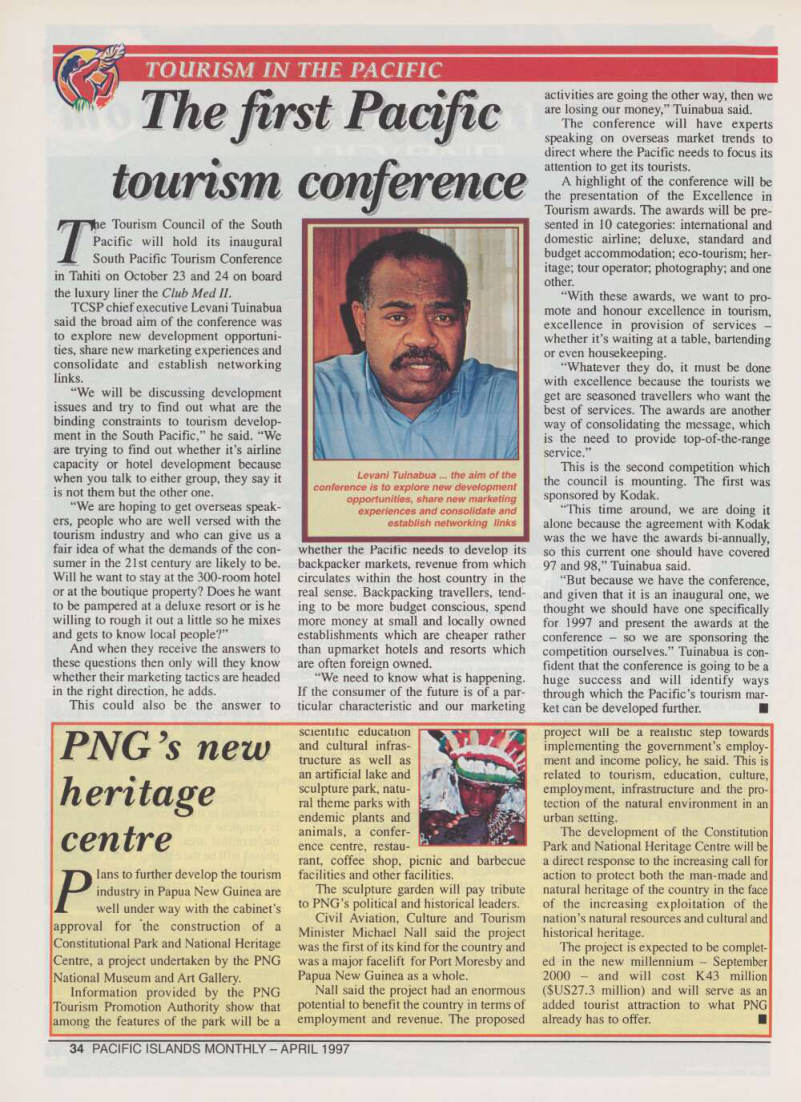
TCSP chief executive Levani Tuinabua said the broad aim of the conference was to explore new development opportuni ties, share new marketing experiences and consolidate and establish networking links.
“We will be discussing development issues and try to find out what are the binding constraints to tourism develop ment in the South Pacific,” he said. “We are trying to find out whether it’s airline capacity or hotel development because when you talk to either group, they say it is not them but the other one.
“We are hoping to get overseas speak ers, people who are well versed with the tourism industry and who can give us a fair idea of what the demands of the con sumer in the 21st century are likely to be.
Will he want to stay at the 300-room hotel or at the boutique property? Does he want to be pampered at a deluxe resort or is he willing to rough it out a little so he mixes and gets to know local people?”
And when they receive the answers to these questions then only will they know whether their marketing tactics are headed in the right direction, he adds.
This could also be the answer to
whether the Pacific needs to develop its backpacker markets, revenue from which circulates within the host country in the real sense. Backpacking travellers, tend ing to be more budget conscious, spend more money at small and locally owned establishments which are cheaper rather than upmarket hotels and resorts which are often foreign owned, “We need to know what is happening, If the consumer of the future is of a par ticular characteristic and our marketing
activities are going the other way, then we are losing our money,” Tuinabua said.
The conference will have experts speaking on overseas market trends to direct where the Pacific needs to focus its attention to get its tourists.
A highlight of the conference will be the presentation of the Excellence in Tourism awards. The awards will be pre sented in 10 categories: international and domestic airline; deluxe, standard and budget accommodation; eco-tourism; her itage; tour operator; photography; and one other.
“With these awards, we want to pro mote and honour excellence in tourism, excellence in provision of services whether it’s waiting at a table, bartending or even housekeeping.
“Whatever they do, it must be done with excellence because the tourists we get are seasoned travellers who want the best of services. The awards are another way of consolidating the message, which is the need to provide top-of-the-range service.”
This is the second competition which the council is mounting. The first was
sponsored by Kodak.
“This time around, we are doing it alone because the agreement with Kodak was the we have the awards bi-annually, so this current one should have covered 97 and 98,” Tuinabua said.
“But because we have the conference, and given that it is an inaugural one, we thought we should have one specifically for 1997 and present the awards at the conference - so we are sponsoring the competition ourselves.” Tuinabua is con fident that the conference is going to be a huge success and will identify ways through which the Pacific’s tourism mar ket can be developed further. ■
Levant Tuinabua ... the aim of the conference is to explore new development opportunities, share new marketing experiences and consolidate and establish networking links
\ Until about two years V, lago, fisheries was a f^jv iable and profitable People all / over the Pacific were moving into this business,
money was flowing in.
Japan was the biggest buyer of Pacific tuna and, with the high exchange rate of the Japanese yen, suppliers were getting a very good price for their fish.
But, as the yen dropped over the years, so has the profitability of the fisheries
industry.
The industry is in serious trouble and something needs to be done.
Fiji Fish, once a major supplier of Japan’s sashimi market, has stopped exporting to Japan. Company chairman Grahame Southwick said the yen had fall en 35 to 40 per cent over the past two and-a-half years and it wasn’t hard to work out what was happening.
The margins had never been as wide; it was always around 18 to 20 per cent, he said.
“The yen has never been this bad and if it goes down any further, we will suffer more.
Japan is the largest market and because we are not able to get much out of this market right now we have to look for alternative markets,” says lan Chute, managing director of Feeders Seafoods
(Fiji) Ltd.
“Currently, it amuses us to hear the kind of talk going around about other islands buying more boats and getting into this lucrative business,” Southwick said.
“If only people knew that there is hardly a boat making money in this whole industry at the moment.”
In terms of dollars, most companies are losing a $ 1 a kilo for every fish that is going into Japan at this point, Southwick stressed.
The sentiment was shared by Solander (Pacific) Limited’s director, Captain David Lucas.
The fall of the yen was a major blow to
companies exporting tuna to Japan, Lucas
said.
“We have stopped exporting to Japan because we are not making much and, with the high cost of fuel and freight, we are looking at other viable markets.”
Both Fiji Fish and Solander are exporting fish to other Asian markets and North America.
The two companies export yellowfin, big eye and albacore tuna.
The situation last year was very bad because companies were not getting much out of their exports and this year could be the same, Lucas warned.
Southwick couldn’t agree more, say
ing there was going to be a severe shake out in the next 12 months and this was going to see a lot of casualties. “The smaller and newer will probably go down and the bigger ones are going to be great ly affected as well.”
However, while most fisheries compa nies may have stopped exporting to Japan, some are still continuing to do so; something neither Southwick nor Lucas can understand the logic behind, they say.
As if the fall of the yen was not enough, companies in Fiji are also suffer ing from what they consider are very high fuel and freight costs.
Southwick, Lucas and Chute said these problems were close to breaking the back of the fisheries industry.
According to Lucas, because of the high cost of fuel, they are unable to take their fishing boats out too far. The further the boats went, the more fuel they used, said Chute.
“The government should remove the duty on fuel because we are paying so much more than our competitors to stay in the business,” Chute added.
“It is absolutely ridiculous because the Fiji fishing industry is paying double the amount of fuel compared to anyone else,”
\ Southwick said. \ “This is happening hg] because the govern ment refuses to fry/ recognise this as an export industry. The government charges very
high duty on fuel and this is one of the reasons why we can’t make as much prof it. It is killing us.”
Fisheries will never become a seri ous and viable industry in Fiji, Southwick said, “while the government is trying to throttle it”.
“We have said to them on many occa sions that we need some sort of conces sion but they want to harvest and benefit from the industry even before it’s on its feet.”
Southwick added that there was a vast misconception over the profitability of the industry.
“People look at the numbers coming in but they don’t see the expenses and the high price we have to pay for fuel and freight and, after all that is done, there is not much left on the table. This is where the crunch is.”
However, the Forum Fisheries Agency assures that this problem has been identi fied and work is about to commence on a joint study with the Forum Secretariat to
review fuel distribution and pricing sys tems in the region.
Fuel is a significant cost component of all commercial fishing operations and the FFA recognises that the current high costs of fuel in its member countries is a signif icant deterrent to locally based investors from establishing new fishing enterpirses.
Similarly, this works against island countries’ attempts to encourage existing foreign-based fleets to base their opera tions in the region.
The study will apply a regional per spective to identify the options available to FFA member countries to reduce fuel costs borne by locally based fishing ves sels.
The successful implementation of this would identify opportunities for FFA member countries to obtain their fuel sup plies at a lower price.
Such a result will provide a real impe tus not only to the local fishing industry but to the overall economies of FFA mem ber countries.
“So, when you look at the situation in Fiji, where freight is double our competi tors’ and the fuel price is double, you have to be a magician to stay in the game,” said Southwick.
“Not only that, but you have govern ment fiscal policies which seem to be
The fisheries industry is facing difficult times and it will take awhile before the situation starts improving, says Solander Pacific Limited’s director, Captain David Lucas (pictured above)
working against you.
“One wonders what the hell it is we are doing in this business.
“All you hear is politicians standing up in parliament and saying we are sur rounded by fish and we should be exploit ing our resources but, at the same time, they are chopping our hands off - and the very fact that we are still managing to survive is a miracle.
“We have made submission after sub mission to the government for about five years and there has been no positive response; we get promises, but no action whatsoever.
“We know that the government is short
of money - and they have their own rea sons for that - but if they intend on drag ging the industry down with them, it’s
very disappointing.
The industry has a lot of potential but, so long as it is being held back in this manner, it’s very difficult to move ahead.”
He added that, previously, the industry had enjoyed very good communications with the fisheries ministry and depart ment, but, recently, some “unbelievable” decisions had been made that have placed the industry in its “current strife” - the kind of decisions which allowed the industry to be dominated by foreign-
The ‘catch’ ... despite being surrounded by the ocean, one of the islands’ largest resources, there are numerous other factors at play where the fisheries industry is concerned. Solander Pacific’s operations have been affected by the fall of the yen and high fuel and freight costs
owned vessels.
“The government has allowed main land Chinese boats to come in here and fish in our waters and then export. There has been a lot of talk about these boats.
They have been in all the northern areas
in the Pacific and have been thrown out of all these areas.
“For a long time, they have eyed Fiji and, for a long time, we managed to keep them out, but not any more.
“The Taiwanese and Korean vessels
are on the same cost structure as us and, in order for them to survive, they put the prices up which is beneficial to everyone.
“But the Chinese are operating at half the cost and they have the effect of driv ing the prices down - and that’s not ben-
Feeders Seafood will be moving its operations to bigger premises, confident that the economic climate will improve and the industry will get back on its feet
\eficial to anyone,” i I Southwick said. %t) Both Southwick and y Lucas agree that the situation is the same all over the Pacific and, of
course, this is largely to do with the drop of the yen because Japan is the biggest buyer of tuna from the Pacific.
Lucas said the situation was very difficult and it would take some time before it got better. “But the question is: when will the yen return to normal? Right now, there is no profit in the industry and, in Fiji, there would hardly be a company breaking even at the moment.
“It is going to be this way for the next 12 months,” Southwick predicts.
However, despite the problems plagu
ing the industry, it seems that all hope is not lost with the number of fisheries com
panies still holding on.
How? Why?
“Because this is everything we do.
Everything we have has been invested in this business,” said Southwick.
“It’s not the sort of thing you walk away from. We have vessels, factories, machinery and people in it.”
Lucas said he was still here because of job satisfaction and, of course, there were so many locals for whom they provided jobs. And Chute is confident his company
will survive and continue to do well again. His optimism goes hand in hand with the company’s move to a new site.
Feeders will be moving its operations to where the Ports Authority of Fiji is mak ing extensions at one of the wharves to accommodate more vessels.
“This wharf is for the local fishing industry and involves the extension of present jetty facilities,” Chute said.
“There is a need for this because,
despite the problems, the industry is
expanding.” The new jetty will be able to accommodate up to 18 boats.
The FFA is trying its best, Andrew Richards, manager monitoring, control and surveillance, says, to develop initia tives which will assist in increasing eco nomic benefits to its member countries from the tuna industry. The agency says that its work programme, which was determined by its members, was becom
ing increasingly involved in identifying
options to attract more investment in the local industry. One of the FFA’s missions will be to reduce the number of foreign bilateral licences.
Starting this month, a number of FFA member countries will implement a 10 per cent cut in the number of bilateral access licences available to the foreign based purse seine fleet.
This cut has been implemented under
the Palau Arrangement for the Management of the Western Pacific Purse Seine Fishery and will limit the number of such vessels being licensed in the waters of the parties to the arrangement.
According to the Richards, these fore gone bilateral licences had been made available to locally-based vessels, thereby keeping overall vessel numbers intact but altering the numbers more favourably towards locally based fleets. The strength of FFA countries’ development aspira tions are indicated by their decision to impose alO per cent cut on the number of US vessels licensed under the multilateral treaty, which also becomes effective this month.
The FFA Secretariat has the overall responsibility for a joint FFA-South Pacific Commission project designed to improve national capacity building in fisheries. In particular, individual projects have focused on laying the groundwork for the development of viable, locally based tuna industries.
Throughout the above project, empha sis has been placed on private-sector involvement, including assistance to small-scale entrepreneurs. The role of governments has been promoted as one of the stewardship towards the resource and facilitator of a sound investment climate in fisheries. ■