In God’s hands
p. 62 · Read in the full issue
Irfaan’s lessons in the mosque has nothing to do with the growth of Islam; it is a chance to escape the claws of poverty
By Yunus Rashid
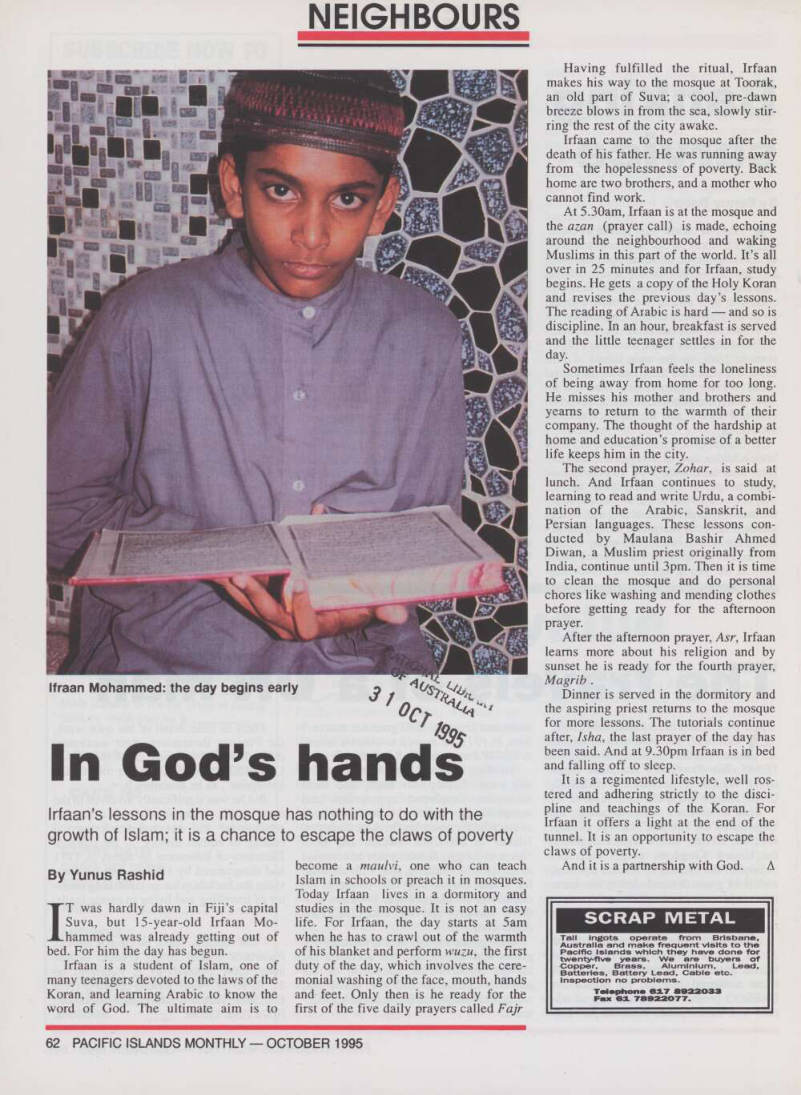
IT was hardly dawn in Fiji’s capital Suva, but 15-year-old Irfaan Mo hammed was already getting out of bed. For him the day has begun.
Irfaan is a student of Islam, one of many teenagers devoted to the laws of the Koran, and learning Arabic to know the word of God. The ultimate aim is to
become a maulvi, one who can teach Islam in schools or preach it in mosques.
Today Irfaan lives in a dormitory and studies in the mosque. It is not an easy life. For Irfaan, the day starts at sam when he has to crawl out of the warmth of his blanket and perform wuzu, the first duty of the day, which involves the cere monial washing of the face, mouth, hands and feet. Only then is he ready for the first of the five daily prayers called Fajr
Having fulfilled the ritual, Irfaan makes his way to the mosque at Toorak, an old part of Suva; a cool, pre-dawn breeze blows in from the sea, slowly stir ring the rest of the city awake.
Irfaan came to the mosque after the death of his father. He was running away from the hopelessness of poverty. Back home are two brothers, and a mother who cannot find work.
At 5.30 am, Irfaan is at the mosque and the azan (prayer call) is made, echoing around the neighbourhood and waking Muslims in this part of the world. It’s all over in 25 minutes and for Irfaan, study begins. He gets a copy of the Holy Koran and revises the previous day’s lessons.
The reading of Arabic is hard and so is discipline. In an hour, breakfast is served and the little teenager settles in for the day.
Sometimes Irfaan feels the loneliness of being away from home for too long.
He misses his mother and brothers and yearns to return to the warmth of their company. The thought of the hardship at home and education’s promise of a better life keeps him in the city.
The second prayer, Zohar, is said at lunch. And Irfaan continues to study, learning to read and write Urdu, a combi nation of the Arabic, Sanskrit, and Persian languages. These lessons con ducted by Maulana Bashir Ahmed Diwan, a Muslim priest originally from India, continue until 3pm. Then it is time to clean the mosque and do personal chores like washing and mending clothes before getting ready for the afternoon prayer.
After the afternoon prayer, Asr, Irfaan leams more about his religion and by sunset he is ready for the fourth prayer, Magrib .
Dinner is served in the dormitory and the aspiring priest returns to the mosque for more lessons. The tutorials continue after, Isha, the last prayer of the day has been said. And at 9.30 pm Irfaan is in bed and falling off to sleep.
It is a regimented lifestyle, well ros tered and adhering strictly to the disci pline and teachings of the Koran. For Irfaan it offers a light at the end of the tunnel. It is an opportunity to escape the claws of poverty.
And it is a partnership with God. A
Ifraan Mohammed: the day begins early