Logging
pp. 57-58 · Read in the full issue
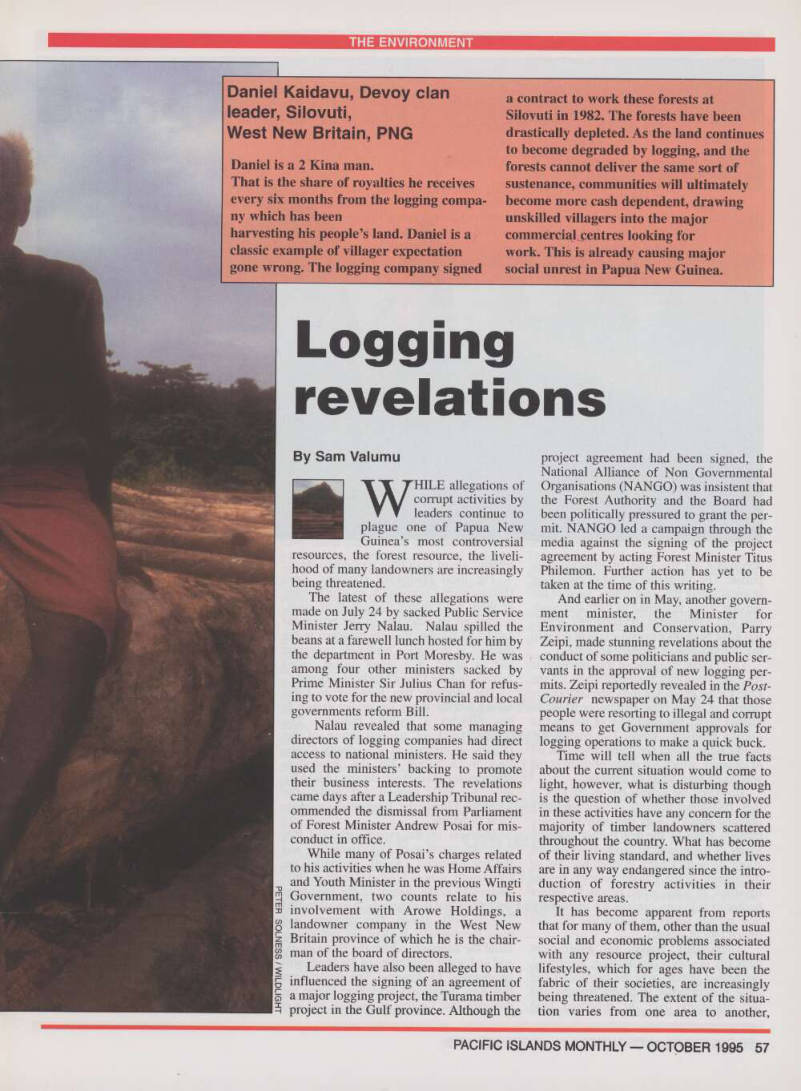
revelations
By Sam Valumu
WHILE allegations of corrupt activities by leaders continue to plague one of Papua New Guinea’s most controversial
resources, the forest resource, the liveli hood of many landowners are increasingly being threatened.
The latest of these allegations were made on July 24 by sacked Public Service Minister Jerry Nalau. Nalau spilled the beans at a farewell lunch hosted for him by the department in Port Moresby. He was among four other ministers sacked by Prime Minister Sir Julius Chan for refus ing to vote for the new provincial and local governments reform Bill.
Nalau revealed that some managing directors of logging companies had direct access to national ministers. He said they used the ministers’ backing to promote their business interests. The revelations came days after a Leadership Tribunal rec ommended the dismissal from Parliament of Forest Minister Andrew Posai for mis conduct in office.
While many of Posai’s charges related to his activities when he was Home Affairs and Youth Minister in the previous Wingti Government, two counts relate to his involvement with Arowe Holdings, a landowner company in the West New Britain province of which he is the chair man of the board of directors.
Leaders have also been alleged to have influenced the signing of an agreement of a major logging project, the Turama timber project in the Gulf province. Although the
project agreement had been signed, the National Alliance of Non Governmental Organisations (NANGO) was insistent that the Forest Authority and the Board had been politically pressured to grant the per mit. NANGO led a campaign through the media against the signing of the project agreement by acting Forest Minister Titus Philemon. Further action has yet to be taken at the time of this writing.
And earlier on in May, another govern ment minister, the Minister for Environment and Conservation, Parry Zeipi, made stunning revelations about the conduct of some politicians and public ser vants in the approval of new logging per mits. Zeipi reportedly revealed in the Post- Courier newspaper on May 24 that those people were resorting to illegal and corrupt means to get Government approvals for logging operations to make a quick buck.
Time will tell when all the true facts about the current situation would come to light, however, what is disturbing though is the question of whether those involved in these activities have any concern for the majority of timber landowners scattered throughout the country. What has become of their living standard, and whether lives are in any way endangered since the intro duction of forestry activities in their respective areas.
It has become apparent from reports that for many of them, other than the usual social and economic problems associated with any resource project, their cultural lifestyles, which for ages have been the fabric of their societies, are increasingly being threatened. The extent of the situa tion varies from one area to another,
depending on the kind of lifestyle they pursue. The influences are more damaging in areas where the landowners’ view of the outside world is limited to their surround ings and government and economic activi ties have been poor or non-existent prior to the introduction of forestry activities.
One classic example of this situation is the case involving the landowners of the Lolo timber project in the Cape Gloucester district of West New Britain province, a district under the electorate of the sacked Forests Minister, Posai. The landowners in this project area are going through a lot of changes, which for many of them is the way to go after years of struggle.
However, the danger lies in the loss of their traditional lifestyle as they are being dragged quickly into the cash economy brought about by the new timber industry.
Many of them used to produce cocoa and copra. Now they have stopped because of the money being earned through timber royalties. In some areas, people no longer bother to cultivate gardens for the family, now relying solely on goods like rice and tinned fish in shops.
Additionally, respect for government authority is slowly diminishing. Evidently, the heated debate over the provincial and local governments in recent months and the wrangling over the proposed land
reforms are of very little concern to them.
The local landowner company, Lolo Development Corporation, to which many of them hold shares through their clans, centres all its activities in the provincial capital of Kimbe. Its only presence in the districts is through a wholesale operation and as agent of a small airline called Airlink and the Copra Marketing Board.
The company has, however, to some extent, helped many landowner groups to buy vehicles, a wasteful initiative. The people’s lack of understanding of the impacts of the project was clearly identi fied in a report by the Australian International Assistance Bureau (AIDAB), now AusAID, carried out under the Kandrian Gloucester Integrated Develop ment Program.
Excerpts of the report indicated that with the exception of a few university and tertiary educated locals, including the community school teachers, there is little awareness in the district of the long-term environmental damage which uncontrolled logging will cause. The villagers, and even the political leaders, do not under stand the degree to which the fauna, flora, soil and water conditions of the forest will be changed by logging. The report says that now people are beginning to see the damages that logging is causing, but it is
too late. The landowners, local company officials and politicians do not have access to information on the environmental impli cation of logging, of alternative methods of logging, of their environmental and company law and of alternative means to their land and their communities.
Says the report: “They have been offered one model of development by the foreign logging contractor. This model dis advantages them financially, and will damage their resources the ones avail able to them for development the land and the forest on it.” A
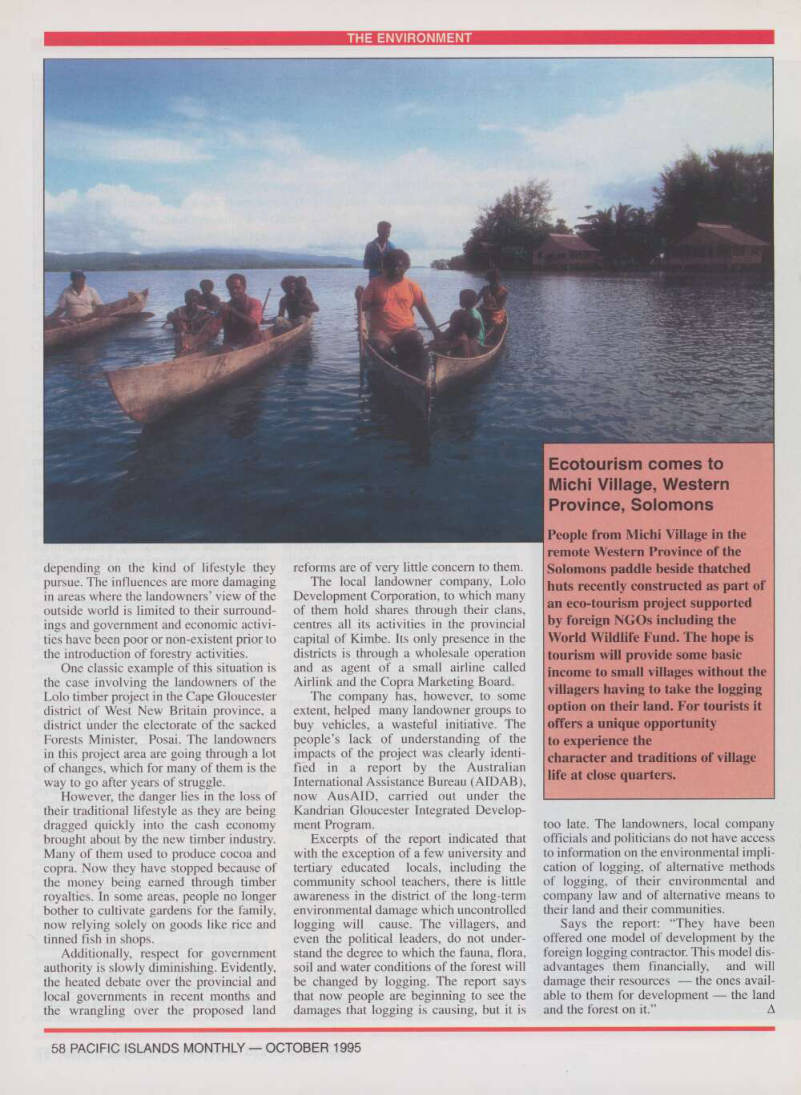
Ecotourism comes to Michi Village, Western
Province, Solomons
People from Michi Village in the remote Western Province of the Solomons paddle beside thatched huts recently constructed as part of an eco-tourism project supported by foreign NGOs including the World Wildlife Fund. The hope is tourism will provide some basic income to small villages without the villagers having to take the logging option on their land. For tourists it offers a unique opportunity to experience the character and traditions of village life at close quarters.