A remarkable collection
p. 40 · Read in the full issue
PAPUA New Guinea lies barely south of the Equator, just north of the Australian continent. It is the last of a string of islands spilling down from South-East Asia into the Pacific. Apart from the mainland, Papua New Guinea comprises a remark able collection of islands, atolls and coral reefs scattered around its coastline.
The mainland is divided by the Owen Stanley Range a rugged central spine with peaks over 4000 metres high. Great rivers begin their journeys to the sea from these mountains among them the mighty Sepik and Fly waterways. Below the mountain chain, fertile coastal plains, flooded delta region and mangrove swamps exist alongside broad sandy beaches, sheltered bays, and dense rain forest.
It is probable that the first human set tlers reached Papua New Guinea by island-hopping down the Indonesian arch ipelago from mainland Asia some 50,000 years ago. Although Papua New Guinea was never physically linked to a land mass in the west, human migration would have been relatively easy due to lower sea lev els caused by an ice age.
The first European sighting of Papua New Guinea on record took place in 1512 when two Portuguese explorers sailed by.
The first landing was also Portuguese.
Jorge de Meneses named the country “llhas dos Papuas” Land of the Fuzzy Hairs. In the following centuries various European nations sailed past, but an inhospitable country and savage warriors kept them from seriously considering a permanent landing. Finally, in 1660, the Dutch decided to claim the territory, which they named New Guinea.
It wasn’t until the 1870 s that the inevitable traders, adventurers and mis sionaries arrived. Towards the end of the century, the country had been divided into three zones Dutch, German and British. In 1906, British New Guinea became known as Papua and the adminis tration was taken over by Australia.
In 1920 the League of Nations handed control over to Australia as the Territory of
Papua and New Guinea. Progress towards independence escalated in the 1960 s and in 1973 internal self-government came into effect. On September 16, 1975, full inde pendence was declared, and the country became known as Papua New Guinea.
Papua New Guinea’s art forms are as diverse as they are distinctive. In a country where language varies from village to vil lage, it can be expected that artistic expression will differ in style just as dra matically. Pottery, weapons, carvings, bas ketwork, musical instruments produced by different people in different places, according to their traditional skills and beliefs.
Papua New Guinea artefacts and handicrafts can be purchased from individ
ual artists and retail outlets in towns and villages. The Faculty of Creative Arts UPNG at Waigani is also an excellent source of paintings, pottery and etchings.
Artefacts can also be found for sale at most high schools, teachers’ colleges and galleries.
Bilums are natural fibre string bags made in most province. They are very strong bags used for everything from stor ing food to carrying a baby. Most provinces specialise in different kinds of weaponry.
Bows and arrows, are traditional in sever al areas. Shields have a decorative and spiritual role just as important as their defensive purposes. The Chambri Lake carvers in the East Sepik region decorate their spears to match their masks.
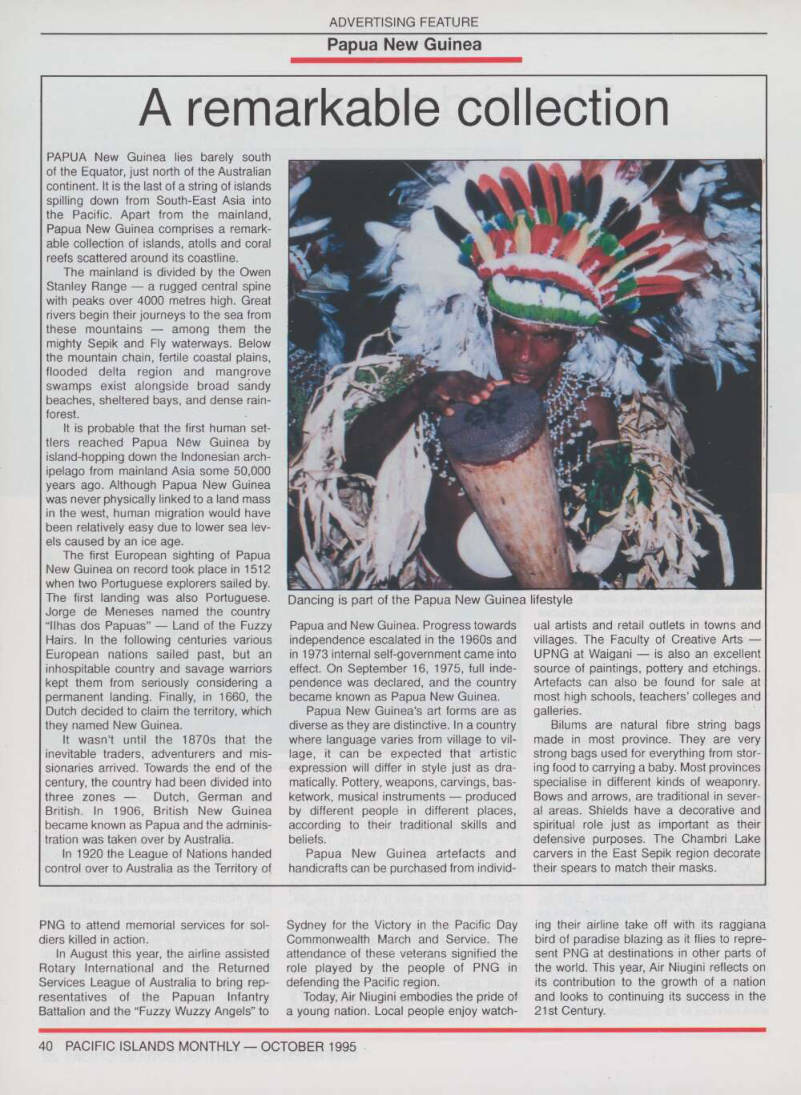
Dancing is part of the Papua New Guinea lifestyle