A different kind
p. 35 · Read in the full issue
of Burton
A move has started top tag United States aid to the support it gets in the United Nations
By David North
CONGRESSMEN Burton was a familiar name to the US flag islands until his death a dozen years ago a swashbuckler, a liberal Democrat, and very generous to the islands. He was Phil Burton of cosmopolitan San Francisco.
The current Congressman Burton is also important to the islands, but 'in a dif ferent way a piece of his legislation just passed by the House of Representatives in Washington threatens to eliminate the flow of US funds to the independent island nations and reduce that flow to the Associated States. Congressman Daniel Burton is a different kind of guy, too, a very conservative Republican from that squares! of American cities, Indianapolis.
Many Republicans have never quite accepted the United Nations; that the US often does not get its way in UN votes ran kles them. Daniel Burton decided to do something about it, so he tacked an amendment on the foreign aid authorisa tion bill which said that none of those funds would go to countries whose dele gates to the UN vote against the US more than 25 per cent of the time. The authori sation bill with Daniel Burton’s amend ment passed the House of Representatives and has been sent to the US Senate.
Daniel Burton’s provision, if it is not removed by the more internationalist upper body, would wipe out US foreign aid to Fiji, PNG, and the Solomons (not that the US is spending much in this cate gory in the Pacific anymore.) The provision would also reduce, by several million dollars a year, the US pay nents to the Associated States of federated States of Micronesia, the darshalls and probably Palau. (Most US funds for those three entities flow through the Department of Interior, and are not
covered by the pending legislation).
The amount of money at stake, in fiscal year 1995, and the percentage of the times that the island nations voted against US positions can be seen in the chart. Palau does not appear on the list because it did not have a seat in the United Nations General Assembly during 1994.
Western Samoa and Vanuatu are miss ing, too; they have UN delegations, and probably vote like most of the islands, but
they apparently did not have bilateral funding from the US during fiscal year 1995.
The range of island nation opposition to US positions in the UN ranged from a low of 31 per cent for FSM to a high of 59 per cent for PNG. None of the island nations were even close to meeting Daniel Burton’s stringent standard.
Washington observers think that: • overseas aid will be cut sharply by the
Republicans, generally; and
• that Daniel Burton’s provision now that he has made his point will quietly die when the House and the Senate ver sions of the legislation go to conference some weeks or months hence.
But in the meantime, it did revive some talk in island circles in Washington about the late, not
always-lamented Phil Burton.
Phil Burton was a power to be reckoned with. He made his mark by crafting dis tricting bills that preserved Democratic majorities in both the legis lature and in
the Congres-sional delegation. As a matter of fact he once did something in the dis
tricting process that probably never hap
pened before in American history; his brother, John, another Democrat, was also in the Congress at the time and brother Phil gave brother John some of Phil’s very best Democratic precincts, to assure John’s re-election.
In the islands, Phil Burton was both powerful and generous; he was chair of the insular affairs subcommittee of the then House Interior Committee for over a decade, and saw to it that substantial chunks of money were sent to American Samoa, Guam, land to what was then the Trust Territory of the Pacific (now FSM, the Marshalls and Palau.) It was with his encouragement that the House voted to seat delegates from Guam, American Samoa and the US Virgin Islands (in the Caribbean).
While the delegates cannot vote on the House Floor, they can in committees, and the delegates are sturdy lobbyists for their islands in Washington. Further, each office is funded by about $1 million in federal funds.
Phil Burton was generous, but there was a bit of a colonial attitude as well; he enjoyed being the power broker who made major decisions about island affairs.
Phil Burton reached the peak of his power in January 1977 when he came within one vote of becoming the Democratic leader in the House, losing to Jim Wright of Texas, who went on to be the Speaker (the most powerful member of the House in the American system.) The island delegates all voted for Phil Burton in that caucus election.
By the time of Phil Burton’s death, his brother John (rumoured to have had drug problems) had dropped out of the House.
But even after his death the Phil Burton influence lingered. His widow, Sala, held his seat for a while, until she, too, died.
And, even to this day, a former Phil Burton staff member serves in the House of Representatives. He is Congressman Eni Hunkin Faleomavaega of American Samoa. A
United States aid funds and votes against US position in the United Nations
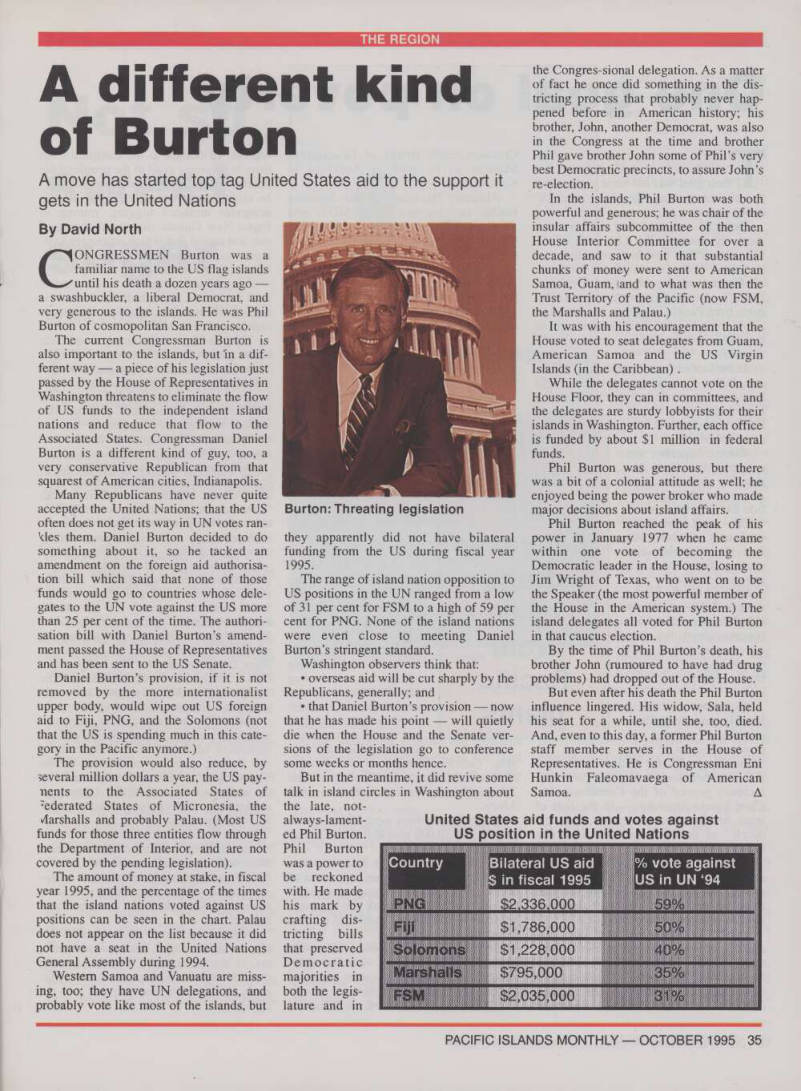
Burton: Threating legislation
——— —I iCountry
Png
$2,336,000 59% Fiji $1,786,000 50% Solomons $1,228,000 40% Marshalls $795,000 35%
Fsm
$2,035,000 31%