New horizons
pp. 29-31 · Read in the full issue
The Region
The shadow of East Timor is cast aside as Australia charts a new partnership with Indonesia
By Robert Simms
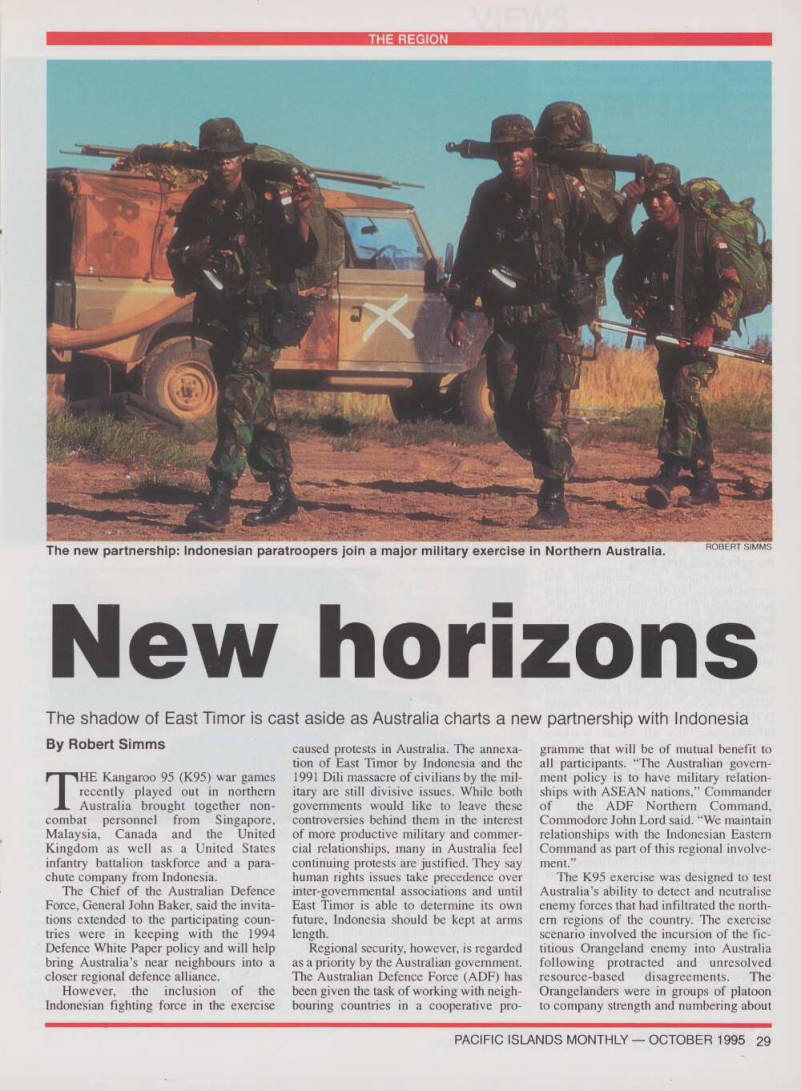
THE Kangaroo 95 (K 95) war games recently played out in northern Australia brought together non combat personnel from Singapore, Malaysia, Canada and the United Kingdom as well as a United States infantry battalion taskforce and a para chute company from Indonesia.
The Chief of the Australian Defence Force, General John Baker, said the invita tions extended to the participating coun tries were in keeping with the 1994 Defence White Paper policy and will help bring Australia’s near neighbours into a closer regional defence alliance.
However, the inclusion of the Indonesian fighting force in the exercise
caused protests in Australia. The annexa tion of East Timor by Indonesia and the 1991 Dili massacre of civilians by the mil itary are still divisive issues. While both governments would like to leave these controversies behind them in the interest of more productive military and commer cial relationships, many in Australia feel continuing protests are justified. They say human rights issues take precedence over inter-governmental associations and until East Timor is able to determine its own future, Indonesia should be kept at arms length.
Regional security, however, is regarded as a priority by the Australian government.
The Australian Defence Force (ADF) has been given the task of working with neigh bouring countries in a cooperative pro
gramme that will be of mutual benefit to all participants. “The Australian govern ment policy is to have military relation ships with ASEAN nations,” Commander of the ADF Northern Command, Commodore John Lord said. “We maintain relationships with the Indonesian Eastern Command as part of this regional involve ment.”
The K 95 exercise was designed to test Australia’s ability to detect and neutralise enemy forces that had infiltrated the north ern regions of the country. The exercise scenario involved the incursion of the fic titious Orangeland enemy into Australia
following protracted and unresolved
resource-based disagreements. The Orangelanders were in groups of platoon to company strength and numbering about
Robert Simms
The new partnership: Indonesian paratroopers join a major military exercise in Northern Australia.
1200 in total. Their aim was to attack ADF
facilities, disrupt high profile economic
targets, mine approaches to port installa tions, and generally embarrass the Australian government.
Opposing these aggressors were approximately 11,000 Australian, US and
Indonesian military personnel assisted by
local police and coastal surveillance air craft. Ships of the Australian navy patrolled the coast between Darwin and Bamaga on the tip of Cape York Peninsula.
A Papua New Guinean patrol craft was to join this group as part of their training but was withdrawn for undisclosed reasons prior to the start of the exercise.
Indonesian involvement in Australian military training programmes is not new but this is the first time their commitment has been so extensive. During the K 95 exercise, the Indonesian 502nd Airborne company was integrated into the 3rd
Battalion Royal Australian Regiment
(3RAR). Two weeks’ training in Sydney with the 3RAR prior to K 95 was followed by two joint operations in northern Australia.
During the first at Wyndham in north west Western Australia, approximately 350 paratroopers were deployed to dislodge the Orangeland forces who had taken over the town. The second attack was in response to enemy activity in the Gulf country where they were occupying McArthur River mine and the towns of
Booroloola and Bing Bong.
In this attack, 152 Indonesian and approximately 160 Australian paratroopers jumped from five Hercules 130 C aircraft, landing in a drop zone a kilometre wide and three kilometres long. The forces
regrouped then proceeded to Bing Bong
where they drove out the enemy forces.
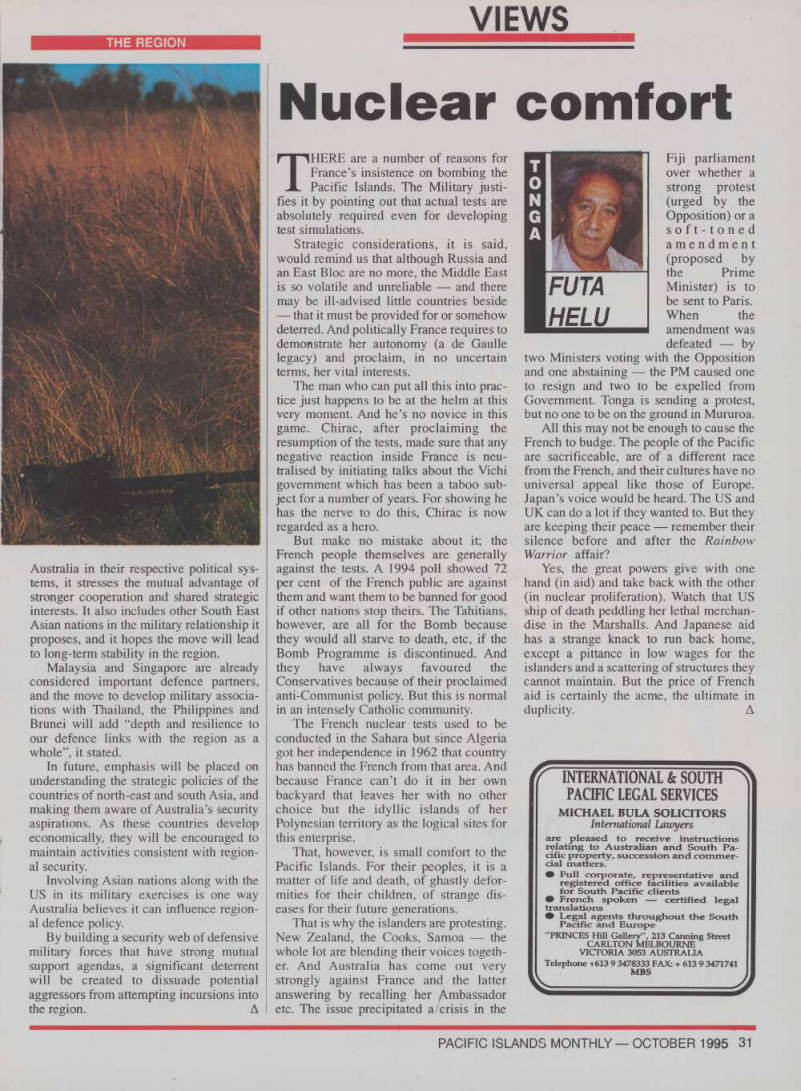
“This type of operation builds com radeship between the 3rd Battalion and 502nd Airborne,” said Brigadier Adrian D’Hage, ADF Director General Public Information. “It’s all about working together to make the region safer.” He agreed that instability in East Timor was a concern but said it should be dealt with at a political level. Colonel Agung Revoluton, the commander of the Indonesian company would not be drawn on these issues. His comments, through an interpreter, were restricted to the increas ing cooperation between Australian and Indonesian forces and the similarity of their operational approach in the field.
Although no plans have been made regarding foreign involvement in future military exercises in Australia, the 1994 Defence White Paper states that increasing priority will be given to strategic exchanges, combined exercising and train ing cooperation with countries in the
region. Australia’s continuing military
relationship with Indonesia is regarded as most important to its security. The Indonesian archipelago forms part of the barrier to the north of Australia through which any invasion force would have to pass. Stability in that country and friendly ties with Australia will contribute signifi cantly to Australia’s and the region’s secu rity.
As Indonesia’s economy grows and its military capability improves, Australia’s
security will be further enhanced, on con dition that the positive nature of the rela tionship with its northern neighbour is maintained. Given this situation, it’s no surprise the Australian government wants to strengthen bilateral ties and increase joint participation in naval, land and air forces exercises.
While the Defence White Paper acknowledges the differences in the roles of the defence forces of Indonesia and
Robert Simms
Robert Simms
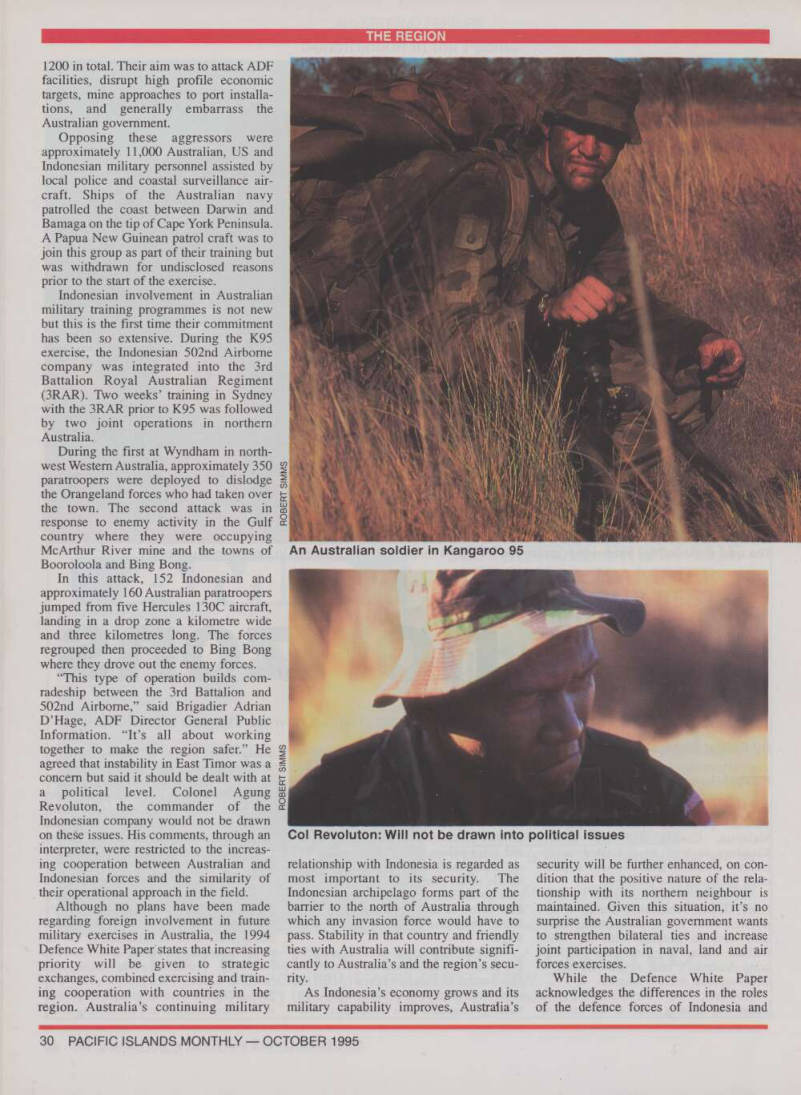
An Australian soldier in Kangaroo 95
Col Revoluton: Will not be drawn into political issues
Australia in their respective political sys tems, it stresses the mutual advantage of stronger cooperation and shared strategic interests. It also includes other South East Asian nations in the military relationship it proposes, and it hopes the move will lead
to long-term stability in the region.
Malaysia and Singapore are already considered important defence partners, and the move to develop military associa tions with Thailand, the Philippines and Brunei will add “depth and resilience to our defence links with the region as a whole”, it stated.
In future, emphasis will be placed on
understanding the strategic policies of the
countries of north-east and south Asia, and making them aware of Australia’s security aspirations. As these countries develop economically, they will be encouraged to maintain activities consistent with region al security.
Involving Asian nations along with the US in its military exercises is one way Australia believes it can influence region al defence policy.
By building a security web of defensive military forces that have strong mutual support agendas, a significant deterrent will be created to dissuade potential aggressors from attempting incursions into the region. A