The code for survival
pp. 21-23 · Read in the full issue

Advertising Feature
Construction in the Pacific
By Yunus Rashid
CYCLONES have a liking for the Pacific Islands. They dance through the ocean and land on our shores as uninvited guests and leave in their wake losses accumulating to millions of dollars. It also kills a lot of peo pie. Time and again structural damages have been blamed on architectural flaws. It is with this in mind that the Australia International Development Assistance Bureau, now AusAID, funded a pro gramme whereby Kris Ayyar of Kerela, India, was hired to head the Pacific Building Standards Project. The project upon com pletion was expected to come up with codes for building in the South Pacific so that cyclone damage to infrastructure would be minimal. However, not all coun tries opted for Ayyar’s recommendations, Some thought the implementation of Ayyar s report would mean extra building costs. But Fiji, which is an attraction for the
wandering cyclones (in 1986 Fiji was hit by seven cyclones within two weeks), decided to accept Ayyar’s report.
In his report, Ayyar said; “Houses have been built around the world for hundreds of years without the benefit of any formal structural analysis and design. It was only in the recent past, from about 20 years ago that many began to question the wisdom of this practice. Recurring cases of death and large-scale destruction of houses through natural disasters in many parts of the world began to demand urgent remedial action, There were two main reasons for the absence of any engineering design input for houses. Firstly, a house is an extremely complex structural system, far more complex than many other engineering structures. Secondly, the cost of performing the detailed structural design of an individual house is very substantial when compared to the rest of the cost.”
He added that “the structural complexity
of houses has been partially overcome by experimental research. Such research has progressively established a number of increasingly reliable mathematical relation ships between the forces (such as from cyclonic winds) acting on a house and the resulting effect on various components of the house. Further, it is possible to spread the cost of detailed structural design by performing the design for a variety of sys terns in terms of a limited number of modu lar sub-systems. We have taken advantage of these to produce this manual.”
Similar manuals have been prepared before in the Pacific and were commonly used in Australia and New Zealand. Fiji’s first such code manual was produced by Fiji Pine and was known as the Fiji Pine Code.
Ayyar said ideas had been borrowed from those manuals.
“However, this manual has for the first time in a single publication included exten
sive details of conventional timber and masonry construction, prepared to cater to the specific environmental constraints of Fiji.
“The manual fully conforms to the struc tural requirements of the National Building Code of Fiji. Ayyar said the manual takes into account current local building practices which means that the code would not mean an increase in building costs. And where there are marginal increases they are offset by the increased durability and safety of the
buildings.
He said the manual was intended for use by para-professionals in the building industry for the speedy design of simple houses which conform to the structural requirements of the National Building Code.
Apart from Fiji, the building code was intended for Tonga, Cook Islands, Vanuatu and Solomon Islands. Papua New Guinea had shown interest but was not eager when the time for consultation came. Western Samoa opted out of the programme because Ayyar’s office was not relocated in Apia. The reason Western Samoa gave for opting out was that Ayyar’s recommenda tions meant that people would have to pay
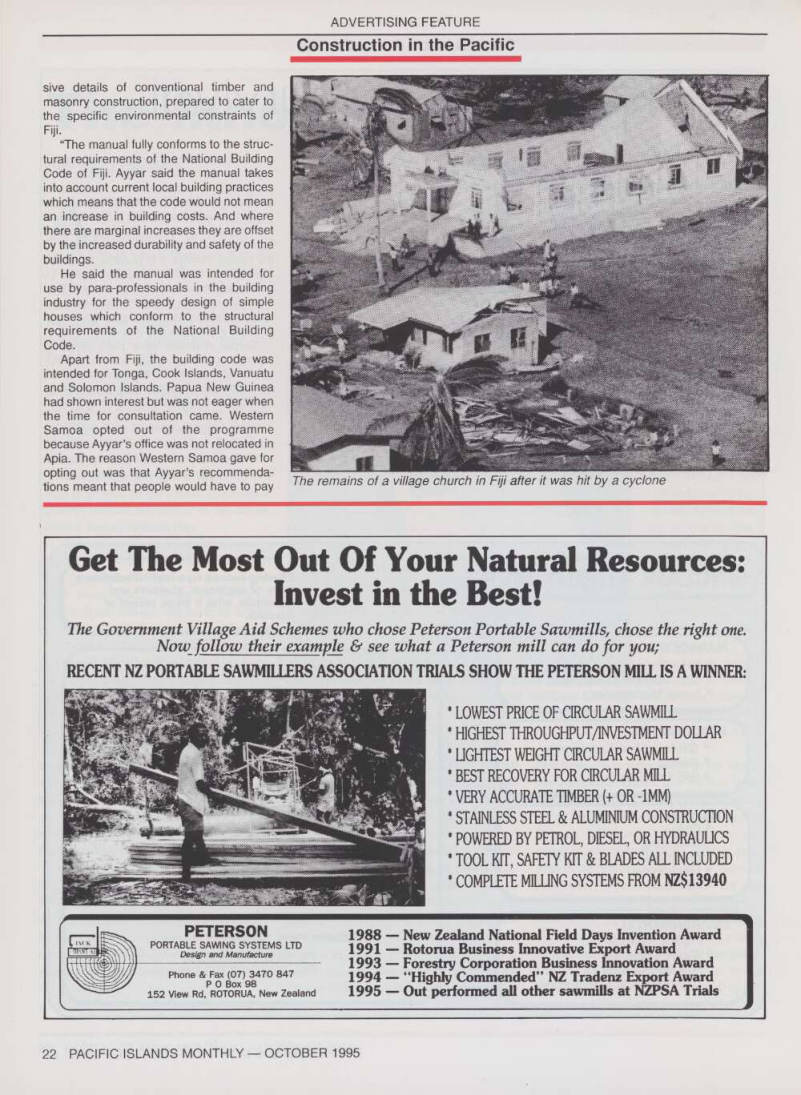
The remains of a village church in Fiji after it was hit by a cyclone
higher costs for building. Tonga pulled out of the programme when New Zealand fund ed an alternative project using a private consultant. Countries which now enjoy the use of the manual include Niue, Tuvalu, the Cook Islands and Solomon Islands. Fiji and Vanuatu have manuals which will help them cope with greater wind forces.
Ayyar’s view is that the island nations should wake up to the fact that many lives are lost and damage to homes is colossal during cyclones. He said countries would spend more money trying to repair dam aged homes than pay for initial safety mea sures in new homes.