US congressman
pp. 18-20 · Read in the full issue
When the French arrested a US congressman
By David North
PARLIAMENTARIANS from all over the world went to Tahiti the past month to protest French nuclear testing, but only two of them were arrested by the French navy. They were American Samoa’s Congressman, Eni Faleomavaega, and the French Polynesian opposition leader, Oscar Temaru. “We were held in house arrest by the French for 16 hours,” the Congressman told PIM upon his return to Washington.
Boat arrest, really; the two legislators had been arrested on board the Greenpeace vessel Rainbow Warrior after it broke the 12-mile limit around the test site location, Mururoa.
The French did not really turn aside the parliamentary protesters but Faleomavaega, Temaru and the accompanying European journalists were not subject to the
tear gas, stun grenades, and rubber bullets
subsequently employed by the French against
the protesters in Tahiti, which was burning as this was written.
The Congressman returned from his encounter deeply angry, and highly critical of the French Government. “Pure colonialism at its worst,” he said about the French nuclear blasts and France’s treatment of her
Polynesian citizens.
“It is outrageous that the home of the Enlightenment should treat the Polynesian people this way,” he continued. He also spoke of his “disappointment” with Gaston Flosse, whom he has known for years, who is both the President of Territorial Government in French Polynesia, and a political ally of explosions.
Faleomavaega arrived in Tahiti from Pago Pago on Wednesday, August 23; the US Congress was in recess, and he had gone to
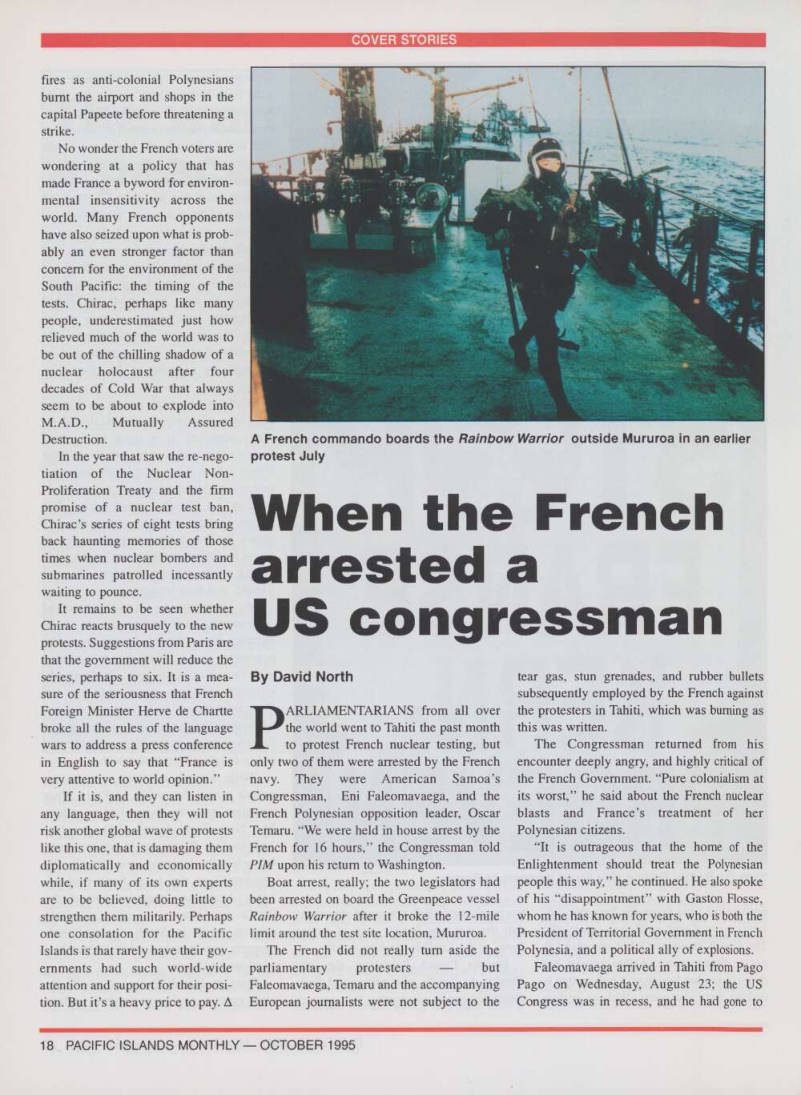
A French commando boards the Rainbow Warrior outside Mururoa in an earlier protest July
Tahiti to protest the planned nuclear exper iments. He paid a courtesy call on Flosse, which led nowhere, and then joined 5000 local protesters in front of the area’s largest LMS church.
Shortly thereafter he was invited to board a ketch along with some German journalists for a protest sail to Mururoa; tens of thousands of residents of Hamburg, Germany, had funded the ship and the Congressman was tempted to board it, but he could not be assured that it would return to port in time for him to catch his plane back to the first session of Congress fol lowing its summer break.
Then Greenpeace issued an invitation to Faleomavaega and to Temaru. Would they fly to Tureia, some 60 miles from Mururoa, and board the Rainbow Warrior there for a protest at the testing site?
The two Polynesian legislators accept ed and on August 30 they arrived on Tureia where they met with the local residents who have used Mururoa for fishing and for the harvest of coconuts for generations, and who regard themselves as owners of what previous to the nuclear testing had been an uninhabited island. “The people of Tureia invited us to visit their island,”
Faleomavaega told me.
The Rainbow Warrior left for Mururoa
that evening and by three in the morning of what would turn out to be a very long day it was being trailed by a French
warship.
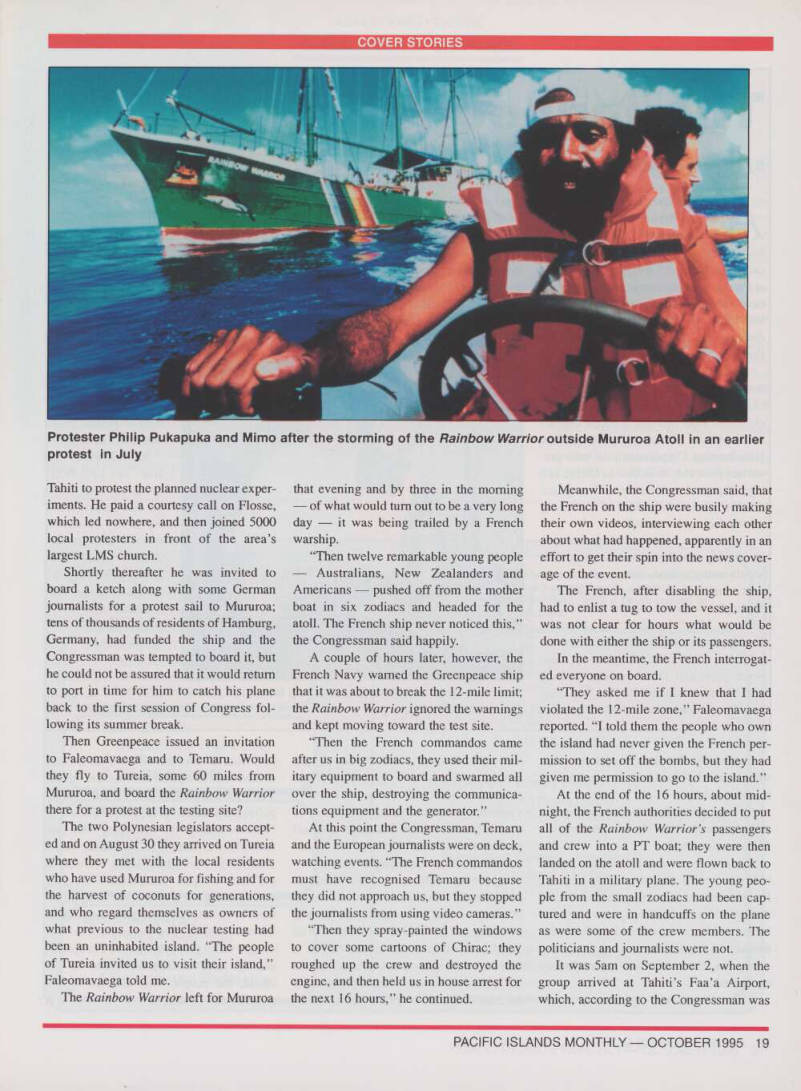
“Then twelve remarkable young people Australians, New Zealanders and Americans pushed off from the mother boat in six zodiacs and headed for the atoll. The French ship never noticed this,”
the Congressman said happily.
A couple of hours later, however, the French Navy warned the Greenpeace ship that it was about to break the 12-mile limit; the Rainbow Warrior ignored the warnings and kept moving toward the test site.
“Then the French commandos came after us in big zodiacs, they used their mil itary equipment to board and swarmed all over the ship, destroying the communica tions equipment and the generator.”
At this point the Congressman, Temaru and the European journalists were on deck, watching events. “The French commandos must have recognised Temaru because they did not approach us, but they stopped the journalists from using video cameras.”
“Then they spray-painted the windows to cover some cartoons of Chirac; they roughed up the crew and destroyed the engine, and then held us in house arrest for the next 16 hours,” he continued.
Meanwhile, the Congressman said, that the French on the ship were busily making their own videos, interviewing each other about what had happened, apparently in an effort to get their spin into the news cover age of the event.
The French, after disabling the ship, had to enlist a tug to tow the vessel, and it was not clear for hours what would be done with either the ship or its passengers.
In the meantime, the French interrogat ed everyone on board.
“They asked me if I knew that I had violated the 12-mile zone,” Faleomavaega reported. “I told them the people who own the island had never given the French per mission to set off the bombs, but they had given me permission to go to the island.”
At the end of the 16 hours, about mid night, the French authorities decided to put all of the Rainbow Warrior’s passengers and crew into a PT boat; they were then landed on the atoll and were flown back to Tahiti in a military plane. The young peo ple from the small zodiacs had been cap tured and were in handcuffs on the plane as were some of the crew members. The politicians and journalists were not.
It was sam on September 2, when the group arrived at Tahiti’s Faa’a Airport, which, according to the Congressman was
Protester Philip Pukapuka and Mimo after the storming of the Rainbow Warrior outside Mururoa Atoll in an earlier protest in July
blockaded by Temaru’s supporters, who were worried about his safety and that of
his companions.
“I have never seen such mean, deter mined people as those protesters,”
Faleomavaega said.
When Temaru learned that his people had surrounded the airport he told the French authorities that they had better take the handcuffs off the Greenpeace people or he and Faleomavaega would not leave the tarmac; the implied threat worked, and the young environmentalists were finally unchained.
The Greenpeace protesters were
relieved of their handcuffs at least partial ly because of a series of geographical and political coincidences. Temaru is not only a member of the territorial parliament,'he is also (in the French Mainland political parliament tradition) mayor of his home town, Faa’a. Faa’a, the largest municipali ty in French Polynesia, is the home of many displaced residents from the outer islands who tend to be among the poorest residents of the island of Tahiti. And Tahiti’s airport is in the middle of Faa’a.
Before the Congressman left Tahiti for the US mainland, he and Temaru, presumably the stars of the show, joined parliamentar
ians from all over the world in yet another demonstration against the nuclear blasts.
They were joined in this by the ranking politician present, the Japanese Minister of Finance, Masayoshi Takemura, who pre sumably was happy to be talking about something other than Japan’s financial problems. Upon his return the US Faleomavaega expressed his disappoint ment in one aspect of the press coverage of the controversy. “The press seems to have sought only the opinions of Europeans, and to have disregarded those of the island, the people most effected by the explosions,” he said. A