again,
pp. 14-18 · Read in the full issue
Cover Stories
Wrong again, Chirac
On September 5 France detonated a 20-kiloton nuclear device deep in the earth in French Polynesia. The explosion ignited violent protests in Tahiti and gained France much unpopularity
By lan Williams
ON August 21 New Zealand added to its grassroots protests by seek ing to reopen its old 1973 case against the tests in the World Court, adding new ground; the lack of an environment Impact Assessment for the impact of nuclear testing on the atolls. Paris main tained a disdainful silence, although it would almost have been in character with its recent behaviour to have sent a posse of gendarmes to flood the World Court build ing in the Hague with tear gas.
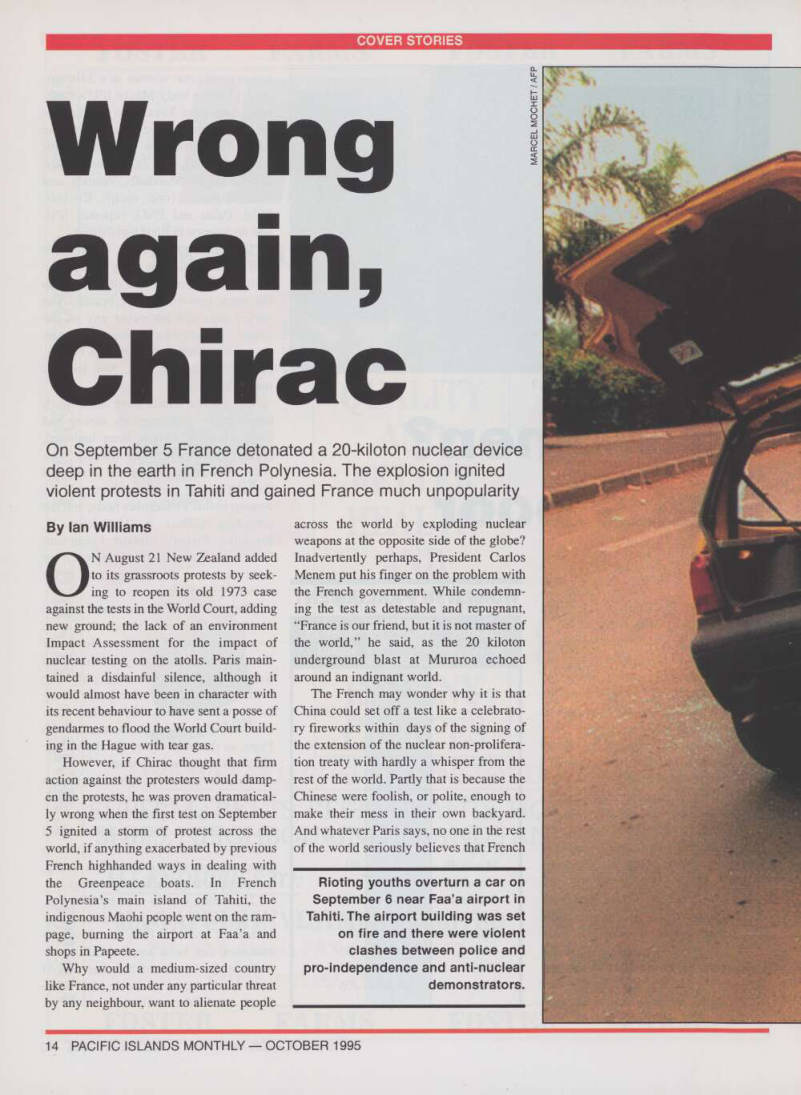
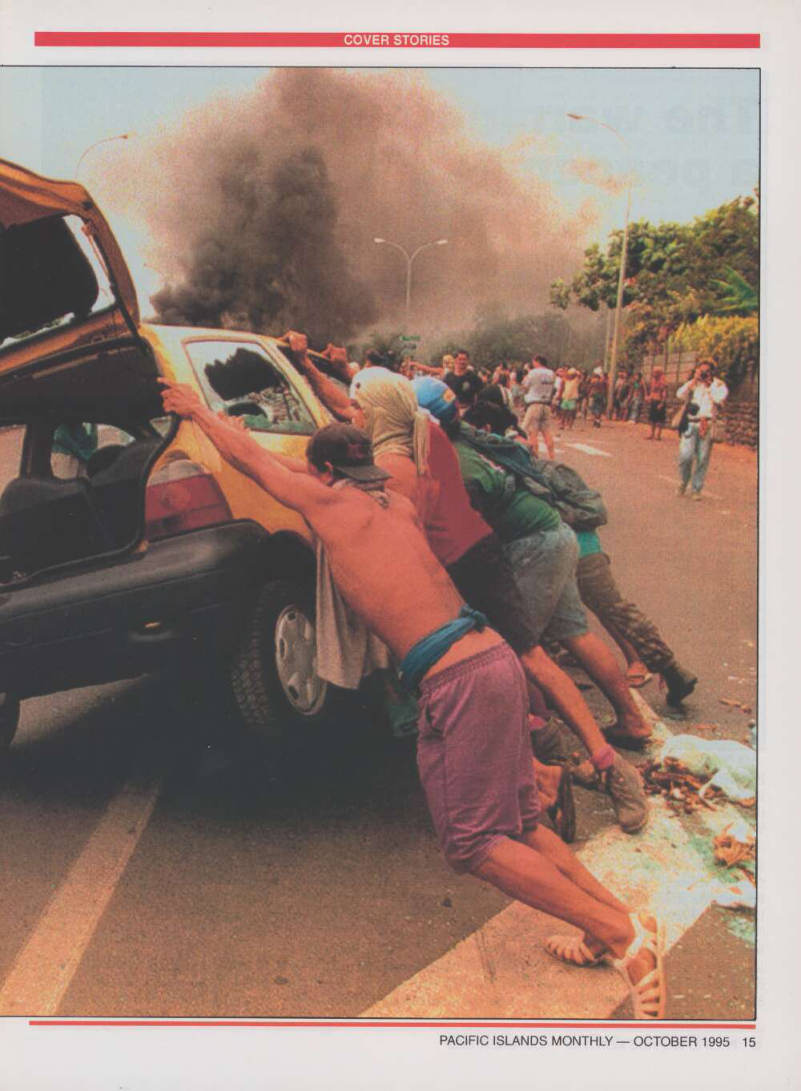
However, if Chirac thought that firm action against the protesters would damp en the protests, he was proven dramatical ly wrong when the first test on September 5 ignited a storm of protest across the world, if anything exacerbated by previous French highhanded ways in dealing with the Greenpeace boats. In French Polynesia’s main island of Tahiti, the indigenous Maohi people went on the ram page, burning the airport at Faa’a and shops in Papeete.
Why would a medium-sized country like France, not under any particular threat by any neighbour, want to alienate people
across the world by exploding nuclear weapons at the opposite side of the globe?
Inadvertently perhaps, President Carlos
Menem put his finger on the problem with the French government. While condemn ing the test as detestable and repugnant, “France is our friend, but it is not master of the world,” he said, as the 20 kiloton underground blast at Mururoa echoed around an indignant world.
The French may wonder why it is that China could set off a test like a celebrato ry fireworks within days of the signing of the extension of the nuclear non-prolifera tion treaty with hardly a whisper from the rest of the world. Partly that is because the Chinese were foolish, or polite, enough to make their mess in their own backyard.
And whatever Paris says, no one in the rest of the world seriously believes that French
Rioting youths overturn a car on September 6 near Faa’a airport in Tahiti. The airport building was set on fire and there were violent clashes between police and pro-independence and anti-nuclear demonstrators.
Marcel Mochet/Afp
Polynesia is really part of the French hin terland. In addition, it is something of a backhanded compliment to the French.
While most people have few expectations of the Chinese government, most people see France as a democracy which is dif ficult to reconcile with storm troopers behaving like pirates boarding and damag ing protest vessels.
Part of the problem is precisely that some French politicians have never accepted the declining position of the tri colour around the world. Their centuries old rivals, the British, were much more
pragmatic. Once the economic rationale for the empire disappeared, so did they, taking their Union Jack with them. Indeed, they left with almost indecent haste, pulling out of some places that would just have soon kept them.
But like aged parents in their decline, the British could take vicarious comfort from their children. Canada, Australia, New Zealand to some extent, but above all, the United States, the rising star to which the fading kingdom hitched its char iot. Between them the English speaking countries, without trying very hard, have a
massive, indeed one could say critical, cul tural mass that races away, engulfing the world.
English is spoken almost everywhere, despite a conspicuous lack of official encouragement by the Anglophone gov ernments. French is spoken less and less despite fanatic encouragement from Paris, which bombards agencies like the United Nations to ensure that the language has its due respect.
We all have sympathy with indigenous languages and cultures being swamped by Anglophone culture, but France has tradi-
tionally had little sympathy for other cul tures as any Kanak or Breton can testify.
The French chauvinist’s big complaint is not the disappearance of other cultures, but that it is another language, English, that is making them disappear. Without getting
too psychoanalytical, you could almost say that the test was Paris’s way of saying “non” to the English-speaking world.
Former French President, the late, Charles de Gaulle who epitomised these principles put it succinctly: “No country
without an atom bomb could properly con sider itself independent.” In his day, right across the political spectrum French vot ers, sandwiched between the Soviets on side and the British and Americans on the other, were unquestioning about their country’s need for nuclear weaponry.
Now even that has changed. Only 16 per cent of French voters totally support the tests, while almost 60 per cent of French people object to the new tests, and President Jacques Chirac’s standing has suffered as a result of a policy he made uniquely his own. Almost all the opposi tion parties have registered their objec tions. The ordinary French increasingly see no threat of war, and regard themselves increasingly as part of the European Union.
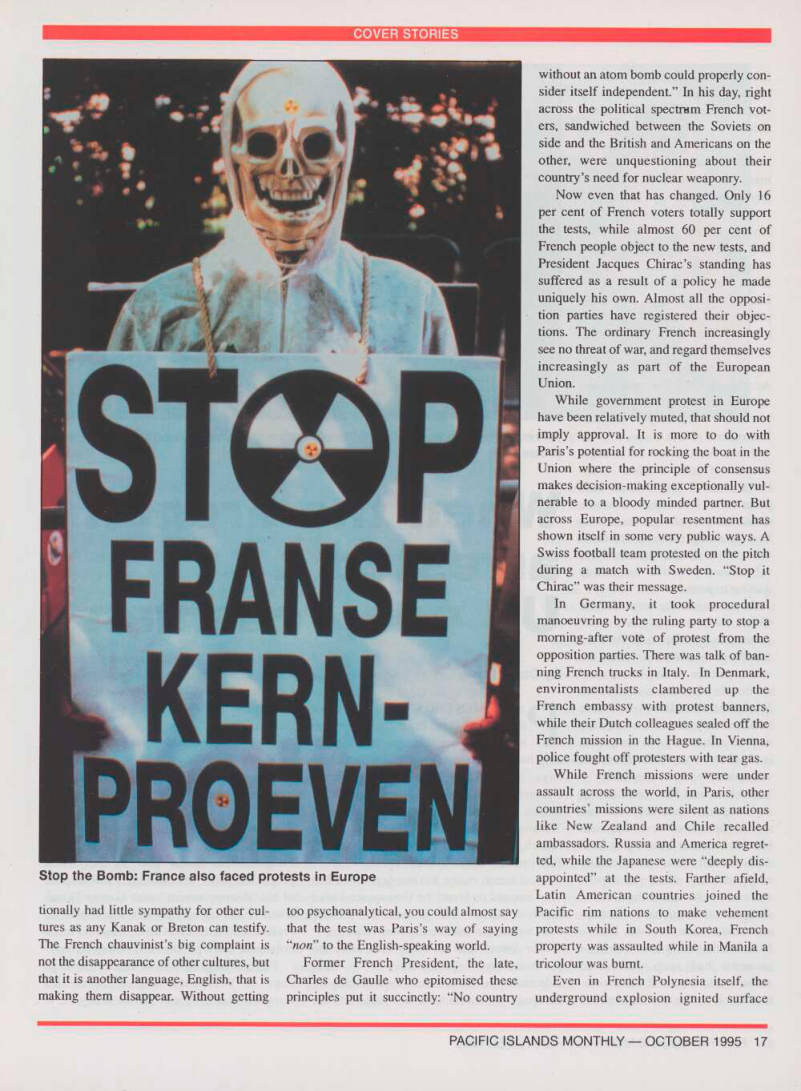
While government protest in Europe have been relatively muted, that should not imply approval. It is more to do with Paris’s potential for rocking the boat in the Union where the principle of consensus makes decision-making exceptionally vul nerable to a bloody minded partner. But across Europe, popular resentment has shown itself in some very public ways. A Swiss football team protested on the pitch during a match with Sweden. “Stop it Chirac” was their message.
In Germany, it took procedural manoeuvring by the ruling party to stop a moming-after vote of protest from the opposition parties. There was talk of ban ning French trucks in Italy. In Denmark, environmentalists clambered up the French embassy with protest banners, while their Dutch colleagues sealed off the French mission in the Hague. In Vienna, police fought off protesters with tear gas.
While French missions were under assault across the world, in Paris, other countries’ missions were silent as nations like New Zealand and Chile recalled ambassadors. Russia and America regret ted, while the Japanese were “deeply dis appointed” at the tests. Farther afield, Latin American countries joined the Pacific rim nations to make vehement protests while in South Korea, French property was assaulted while in Manila a tricolour was burnt.
Even in French Polynesia itself, the
underground explosion ignited surface
Stop the Bomb: France also faced protests in Europe
fires as anti-colonial Polynesians burnt the airport and shops in the capital Papeete before threatening a strike.
No wonder the French voters are wondering at a policy that has made France a byword for environ mental insensitivity across the world. Many French opponents have also seized upon what is prob ably an even stronger factor than concern for the environment of the South Pacific: the timing of the tests. Chirac, perhaps like many people, underestimated just how relieved much of the world was to be out of the chilling shadow of a nuclear holocaust after four decades of Cold War that always seem to be about to explode into M.A.D., Mutually Assured Destruction.
In the year that saw the re-nego tiation of the Nuclear Non- Proliferation Treaty and the firm promise of a nuclear test ban, Chirac’s series of eight tests bring back haunting memories of those times when nuclear bombers and
submarines patrolled incessantly
waiting to pounce.
It remains to be seen whether Chirac reacts brusquely to the new protests. Suggestions from Paris are that the government will reduce the series, perhaps to six. It is a mea sure of the seriousness that French Foreign Minister Herve de Chartte broke all the rules of the language wars to address a press conference in English to say that “France is very attentive to world opinion.”
If it is, and they can listen in any language, then they will not risk another global wave of protests like this one, that is damaging them
diplomatically and economically
while, if many of its own experts are to be believed, doing little to strengthen them militarily. Perhaps one consolation for the Pacific Islands is that rarely have their gov ernments had such world-wide attention and support for their posi tion. But it’s a heavy price to pay. A