‘Don’t mention Rainbow’
pp. 63-64 · Read in the full issue
Yachting
Wallis hosts Bastille Day celebrations
By Sally Andrew
“DON’T mention the Rainbow,” he told me, “even if you see one in the sky!”
Foster was referring, of course, to the Rainbow Warrior, flagship of the Green peace Organisation. The reason for his anxiety we had been invited for lunch aboard the French naval warship Jacques Cartier, tied up alongside Mata-Utu Wharf. The Jacques Cartier was in port to help celebrate Bastille Day at Uvea, in lies Wallis.
On the day of the fete, we struck up a conversation with a handsome man in white who we assumed was off the warship. Like us, he was ashore watching the traditional sailing pirogue races.
When I asked him what he did aboard the ship, he modestly said, “I am the captain”. I invited him to tour our
“ship”, and Captain Oger kindly re
ciprocated with an invitation to come for lunch and a tour aboard his. Starting with escargots and a glass of French wine, we conversed through french fries, prime rib, cafe noir, sorbet and biscuits without international incident.
Aboard the Jacques Cartier, the tri colour whipped in the wind. From the afterdeck, we could see Fellowship an chored three miles further south, off the village of Gahi, along with five other
boats Larocca (USA), Rino Atu
(New Zealand),
Quenah Guen (Can
ada), Hibiscus 111 (New Zealand) and Teal (France). All of us had come to Wallis to take part in the Bastille Day cel ebrations.
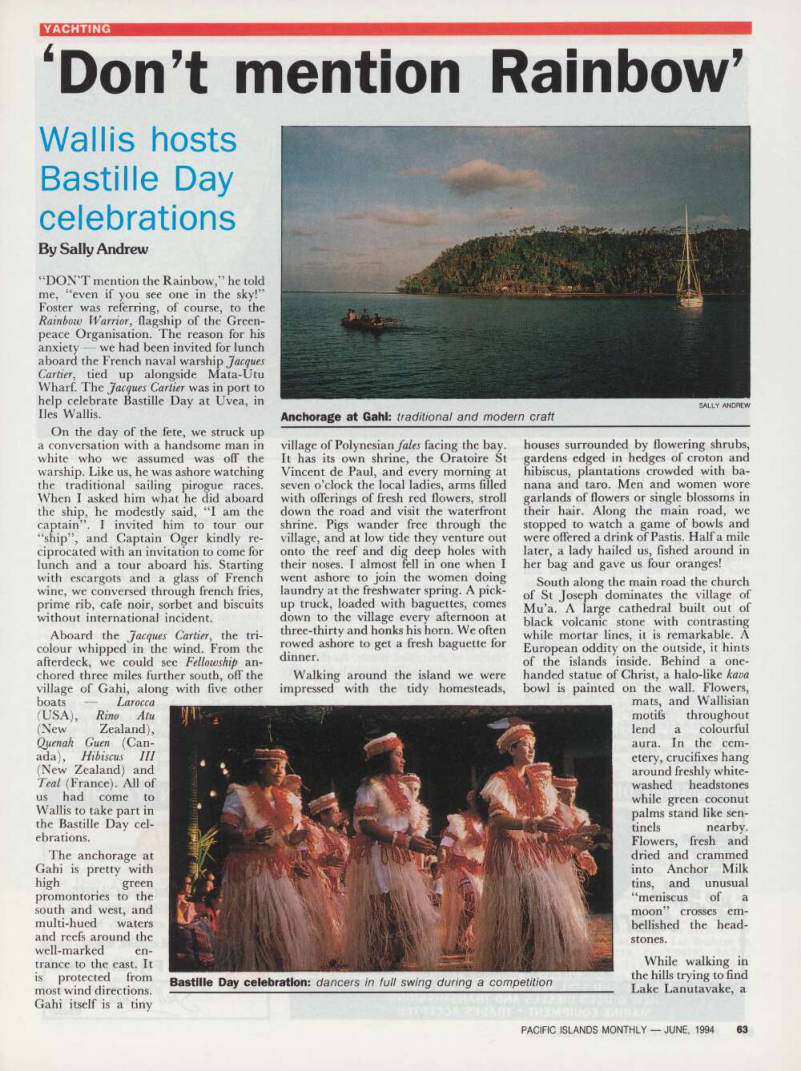
The anchorage at Gahi is pretty with
high green
promontories to the south and west, and multi-hued waters and reefs around the well-marked en trance to the east. It is protected from most wind directions.
Gahi itself is a tiny
village of Polynesian fales facing the bay.
It has its own shrine, the Oratoire St Vincent de Paul, and every morning at seven o’clock the local ladies, arms filled with offerings of fresh red flowers, stroll down the road and visit the waterfront shrine. Pigs wander free through the village, and at low tide they venture out onto the reef and dig deep holes with their noses. I almost fell in one when I went ashore to join the women doing laundry at the freshwater spring. A pickup truck, loaded with baguettes, comes down to the village every afternoon at three-thirty and honks his horn. We often rowed ashore to get a fresh baguette for dinner.
Walking around the island we were impressed with the tidy homesteads,
houses surrounded by flowering shrubs, gardens edged in hedges of croton and hibiscus, plantations crowded with ba nana and taro. Men and women wore garlands of flowers or single blossoms in their hair. Along the main road, we stopped to watch a game of bowls and were offered a drink of Pastis. Half a mile later, a lady hailed us, fished around in her bag and gave us four oranges!
South along the main road the church j ose pp dominates the village of Mu’a A large cathedral built out of bl ac k volcanic stone with contrasting w hile mortar lines, it is remarkable. A E uro pean oddity on the outside, it hints 0 f the islands inside. Behind a one handed statue of Christ, a halo-like kava bowl is painted on the wall. Flowers,
mats, and Wallisian
motifs throughout
lend a colourful aura. In the cem etery, crucifixes hang around freshly white washed headstones while green coconut palms stand like sen
tinels nearby.
Flowers, fresh and dried and crammed into Anchor Milk tins, and unusual “meniscus of a moon” crosses em bellished the head stones.
While walking in the hills trying to find Lake Lanutavake, a
Bastille Day celebration: dancers in full swing during a competition
Sally Andrew
Anchorage at Gahl: traditional and modern craft
church bell rang. The bell turned out to be a recycled World War II acetylene tank. By following the sound we found an open air chapel, Chapelle St Pierre Chanel, named for Polynesia’s only saint.
The view of Uvea’s blue lagoon and fringing reef was spectacular. The shrine was decorated with bright lavalavas and fresh flowers, the floor covered with mats.
I was dying of thirst and nearly crippled by blisters, so when two fellows invited us to sit down and join them, we did. Despite the heat of a noon day sun, they husked some coconuts. These were welcome it was a warm afternoon and we had become carried away in our explorations. We had a long walk back to the anchorage at Gahi and on the way we passed a chimerical church that, up close, looked like a wedding cake of many layers. From the lagoon we had mistaken it for a lighthouse.
On the evening of the fete we hitched a ride into town. On the waterfront at Mata Utu, across from the palace and the severe Church of Notre Dame and next to the Fale Fono Royal Handicraft Centre, a dance competition erupted between groups representing Hihifo in the north, Mu’a in the south and Mata Utu. Groups of dancers of up to 40 strong men and women entertained hundreds of onlookers. They were elaborately dressed and put on a good show. Food stalls were set up, and afterwards there was a concert of electrified music. As the night wore on, the music grew louder. We headed off back to the boat.
On Bastille Day, La Jour de la Fete, dancing groups performed on the wharf and aboard the ship. Young girls wearing tapa outfits, bodies smothered in oil and faces painted orange, descended the
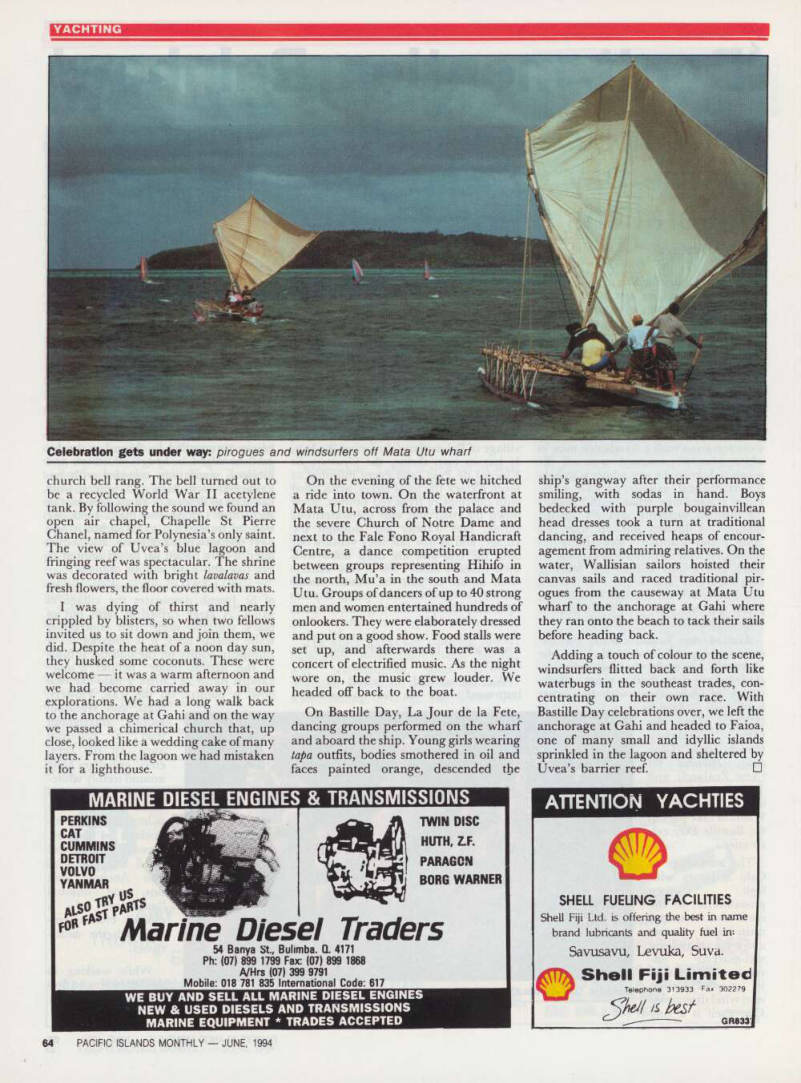
ship’s gangway after their performance smiling, with sodas in hand. Boys bedecked with purple bougainvillean head dresses took a turn at traditional dancing, and received heaps of encour agement from admiring relatives. On the water, Wallisian sailors hoisted their canvas sails and raced traditional pir ogues from the causeway at Mata Utu wharf to the anchorage at Gahi where they ran onto the beach to tack their sails before heading back.
Adding a touch of colour to the scene, windsurfers flitted back and forth like waterbugs in the southeast trades, con centrating on their own race. With Bastille Day celebrations over, we left the anchorage at Gahi and headed to Faioa, one of many small and idyllic islands sprinkled in the lagoon and sheltered by Uvea’s barrier reef. □
Celebration gets under way: pirogues and windsurfers off Mata Utu wharf