Cessna to celebrate with tour
p. 53 · Read in the full issue
THIS year is marking a very important milestone for US aircraft manufacturer, Cessna Aircraft Company. The company is celebrating 10 years since the introduction of its Cessna Caravan aircraft, and in conjunction with Flightline Aviation, will be bringing a special commemorative Cessna Caravan on tour throughout the South Pacific region.
“The first decade since FAA certification and launch of the Caravan has been very successful,” explains Brian
Sutherland, business development man-
ager for Flightline Aviation. “Over 600 Caravan aircraft have been sold worldwide with logged flight hours easily surpassing one million hours,”
Sutherland points out. ’ ™ „ . . , The Cessna Caravan is the world s arges sing e engine turbo-prop aircraft, an carries up to 14 people. Alternatively Carg ° , Capa ° ty of u P r to , , e Caravan s great versatility an rugged construction has made it very pqpu ar wi rp an > operators who do a wide variety of work, and who work out o an an m some rat er harsh and Suth rl §1 environments, says k u er an .
Flightline’s college earlier this year confirmed details of its new reduced hour commercial pilot licence syllabus and training programmes. The training programmes are for both aeroplane and helicopter pilot licences and can save students considerable time and money in their training. Flightline had NZ CAA dispensation for quite sometime, allowing it to offer the reduced 150-hour commercial pilot licence (aeroplane)
versus the normal requirement for 200 hours of flight time. Now the college is able to offer the achievement of a commercial pilot licence (helicopter) after 125 hours total flight experience compared to the normal requirement of 150 hours. Savings for students in both time and money are therefore significant.
“Over the years, many students have trained and graduated from Flightline professional pilot licences, and saved both time and money along the wa Y>” P oints out Michael Young, genman ager of the college. “Quite a number of these students have come from South Pacific region,” he adds. In act ’ Flightline has developed quite an international reputation for the training of student pilots from outside New Zealand.
“Part of the reason for our success internationally is our attention to detail for students who are non-native English speaking. We run specialist English language courses, and place great emphasis on cockpit management pilot decision-making and leadership,” says Young. In addition to professional flight crew n cenceS) t he college offers private pilot licence training for recreational aviators.
Meanwhile, revolutionising the helicopter industry, the result of 17 years of research and development, is McDonnell Douglas’ NOTAR (no tail rotor) system for anti-torque and directional control on helicopters. Put simply, the NOTAR system replaces the conventional tail rotor mechanism which is needed for stability and control. In its place, NOTAR uses clever engineering,
airflow, and the principle of lift (as
generated by an aeroplane wing) to
control the helipcopter. The result is impressive a helicopter which is safer (no tail rotor), up to 50 per cent quieter than conventional helicopters, more stable and easier to fly.
McDonnell Douglas have two NOTAR helicopters. The first is the MD 520 N, (a single turbine, five seater machine) which was launched through out New Zealand and Australia late last
year by regional distributor Flightline
Aviation. The first MD 520 N has just recently been sold to Queensland prop erty and construction company, Peachey Constructions. The helicopter will be used for a variety of tasks including power line survey and strinsrinar work.
“The stability and controllability of the helicopter, thanks to the NOTAR sys tern, makes it ideal for the sideward flight in stringing work,” explains Will Harvey, chief executive officer of Flightline Aviation. “With NOTAR it makes no difference where the wind is coming from,” he adds, The second and larger NOTAR heli copter from McDonnell Douglas is the MD Explorer. This is a twin turbine, eight-place helicopter which is due for launch in the US later this year following Federal Aviation certification, “We believe both aircraft will be very successful in the South Pacific region,”
points out Harvey. “The advantages of
the NOTAR system makes the helicop ters ideal for tourism, off-shore explo ration, law enforcement and emergency medical services, plus many other oper ators,” he says.
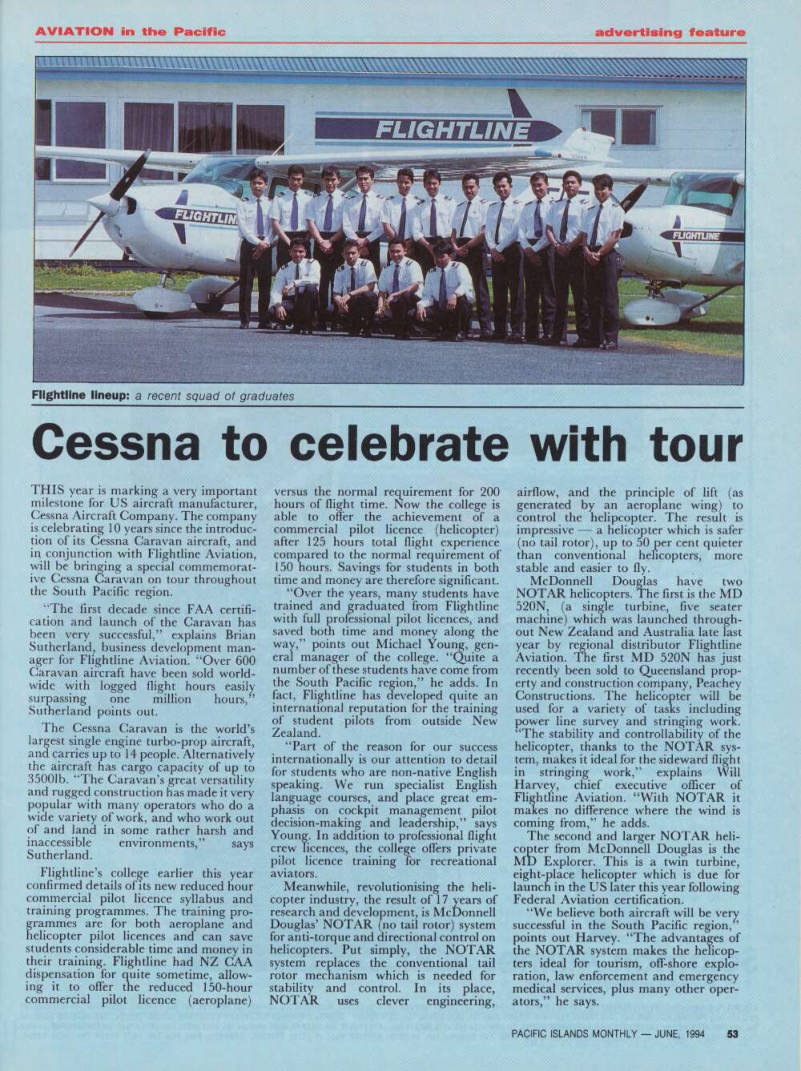
Flightline lineup: a recent squad of graduates