ties with the region
pp. 41-43 · Read in the full issue
Air New Zealand’s ties with the region
AVIATION in the Pacific
advertising feature
AIR New Zealand’s drive to establish the South Pacific on the international tour ism map reflects a long standing partner ship between the airline and Fiji. This association with Fiji’s tourism develop ment goes back to when the first New
Zealand National Airways Corporation
(NAC) aircraft began services to Fiji in 1947.
The development of the Coral route, first served by the Solent flying boats in the 19505, reflected Air New Zealand’s early commitment to assist tourism to the South Pacific. These links have been personified by chief executives like Kaiviti John Wisdom, who led the airline between 1981 and 1982, and was a long serving manager for Air New Zealand in
Fiji. While other air lines have come and gone, today Fiji re mains an integral part of Air New Zea land’s international network, bringing in thousands of tourists each year.
Air New Zealand’s belief in healthy competition in the
marketplace has
been matched by a commitment to co operation with Fijian airlines and tourist operators to promote development. A good example of this co
operation can be found in Nadi’s new airport hangar, where Air New Zealand engineers work regularly with Air Pacific technical crew to service the Fijian carrier’s leased 747 aircraft.
In August last year, Air Pacific leased an Air New Zealand 747 for three years.
An important part of the contract was an agreement to co-operate on aircraft maintenance and carry out the work in Nadi to better utilise equipment and infrastructure at the new hangar. Air New Zealand engineering teams work with Air Pacific crews to service the aircraft and provide certification checks.
Engineering co-operation is just one example of Air New Zealand’s commit ment to developing tourism in Fiji, says the airline’s regional manager Pacific Islands, Ric Macgillicuddy.
“We see Fiji as an important hub within the South Pacific, as well as a premier destination in its own right.” Air New Zealand’s Destination South Pacific strategy continues the airline’s commit ment to the region and is dedicated to developing the South Pacific as a leading international tourist destination. Tour ism is today the world’s largest industry, and largest generator of jobs. The industry is forecast to double in size by the year 2005, with the Asia Pacific region expected to be a focus of growth.
In 1992, tourism generated 5328.4 million in the Fijian economy, with indications that 1993 will surpass this.
The Fiji tourism industry currently employs about 40,000 workers. The
intensive labour requirements of the industry make it a growth area for new jobs. A 1990 report by the Tourism Council of the South Pacific confirmed tourism’s “highly positive” contribution to Fiji with a wide cross section of the economy benefiting from tourist expendi ture. As tourism’s contribution to Fiji’s economy becomes ever more vital, the industry and government policy-makers will need to give greater attention to policies which stimulate growth and attract visitors, says Macgillicuddy.
“Quality infrastructure like the new Nadi airport development is one import ant factor,” he says, “but just as important are liberal aviation policies that allow airlines to operate expand services.”
Air New Zealand is a major source of
tourists to Fiji from long haul markets like Europe and North America, as well as New Zealand, which is Fiji’s second largest tourist-origin market and is
enjoying steady visitor growth. Air New
Zealand’s services to Nadi bring in visitors from North America and Europe.
Air New Zealand is one of the largest international carriers at Los Angeles’s Tom Bradley international terminal with its North American services conveniently linked to its flights from London and Frankfurt. The Fiji government’s recent decision to allow Air New Zealand to launch three weekly services to Nagoya, Japan, will further boost arrivals from this important Asian market.
Macgillicuddy says that Fiji benefits
from Air New Zea land’s experience in international mar kets.
A former regional manager in North America and Eur
ope, Macgillicuddy
was instrumental in establishing Air New Zealand’s advanced,
computerised mar
keting system which enables the airline to target key travel agents and tailor its services to particular market niches. Ten years of experience in these markets makes
him adamant that Fiji can leverage off Air New Zealand’s investment in these markets by recognising the role which strategic partnerships with international carriers can play in developing tourism.
“Through Air New Zealand, Fiji’s travel trade has access to much bigger markets than it would otherwise have,” he says. “We’ve been in North America for 30 years and have a well-established distribution system in Europe and Japan.
We are actively promoting Fiji in those markets, which is bringing in additional visitors to the destination.” Promotions like ‘Project Pride’, which saw hundreds of European travel agents invited to Fiji on a familiarisation visit, represent Air New Zealand’s multi-million dollar mar keting investment in promoting Fiji as a destination.
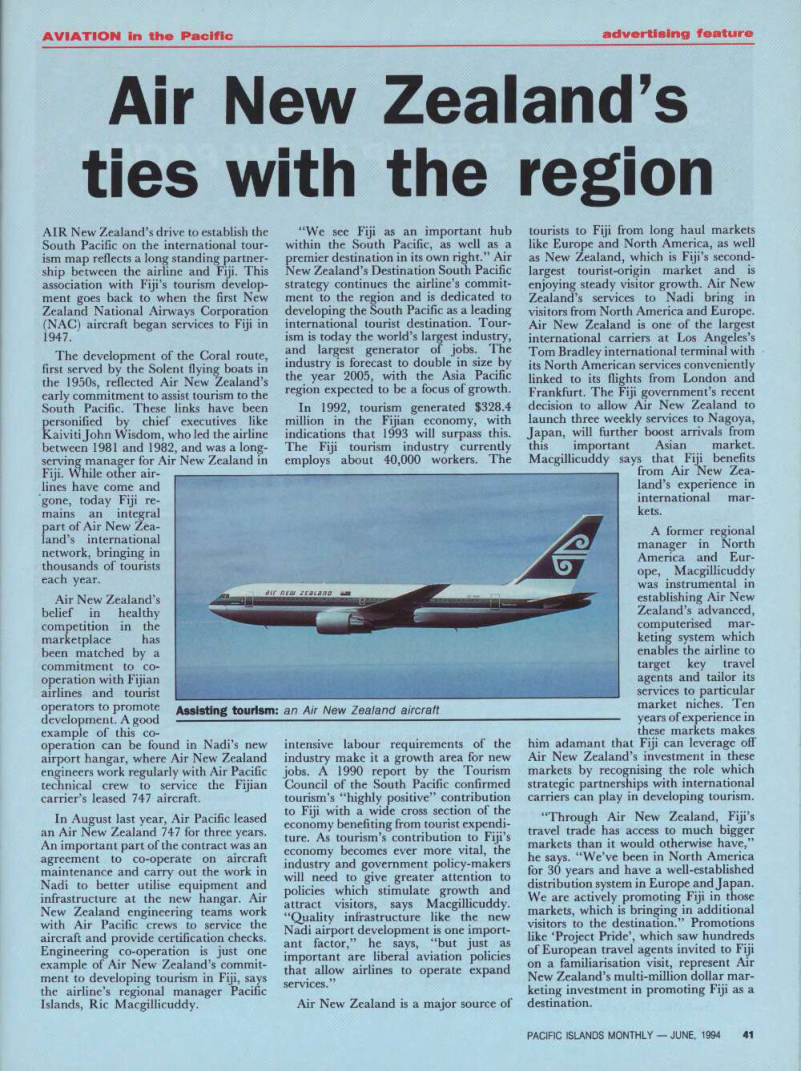
Assisting tourism: an Air New Zealand aircraft
The airline featured Fiji in five recent marketing initiatives conducted within New Zealand, including the SI million ‘Come and Get It’ campaign, the ‘ltchy Feet’ promotion, a direct mail cam paign, discounted fares and a special Visit Friends and Relatives’ package.
Fiji is also being promoted on Air New Zealand’s in-flight video show Blue Pacific. The programme Fiji Feast has been translated into Chinese and Japanese and will soon be shown on all Taipei and Japan services.
Macgillicuddy says it’s wrong to think that if Air New Zealand didn’t operate to these markets, another airline could bring in the visitors. “It’s not an ‘either/or’ situation,” he says.
“If we didn’t operate to Nagoya, for example, those visitors would oe lost because those slots and those rights don’t exist for other carriers.
“Aviation policy is not about divid ing up existing traffic, but about encouraging new players to tap new markets.” The 80,000 tourists which Air New Zealand brings into Fiji annually, represent an economic con tribution to Fiji’s economy of around $166,571,745. This translates into around 4516 full time jobs.
Given that 21 additional visitors support an additional job, Air New Zealand’s new services to Japan alone are likely to create nearly 300 ad ditional jobs, based on projections of around 6240 new visitors from Nagoya each year. Macgillicuddy says Nagoya is a distinct market within Japan,
currently untapped, and complements
Air Pacific’s flights to Osaka. Both carriers operate to Tokyo. “Nagoya accounts for about 5.5 per cent of Japan’s outbound traffic,” says Macgillicuddy. “It’s quite distinct from Tokyo or Osaka. Experience shows that holiday-makers want direct services to destinations.” Travel agents in Fiji and Japan have welcomed the Nagoya services as a chance to expand Fiji’s tourism opportunities in this huge market.
Macgillicuddy says Air New Zealand hopes the tourism industry and govern ment officials continue to expand opportunities for airlines in Fiji. “Inter national experience shows mat desti nations with liberal, open skies policies reap the benefits in terms of tourism growth.” Meanwhile, Air New Zea land’s Boeing 747-400 aircraft last month completed the fastest time crossing the Tasman in a record one hour 54 minutes. This beats the fastest time recorded almost three years ago by an Air New Zealand 8747-200 of one hour 57 minutes.
The crossing was aided by very strong winds of 190 knots. Cruising at an altitude of 39,000 feet the aircraft was able to travel in excess of 700 miles an hour. Commenting on the crossing, Captain Mike McLeay said it was not unusual to get exceptionally strong winds at this time of the year. □