aid to Pacific
p. 38 · Read in the full issue
Aust to maintain aid to Pacific
AUSTRALIA has no intention of shift ing its focus away from the Pacific. And neither will it follow the United State’s lead and axe aid projects in the region.
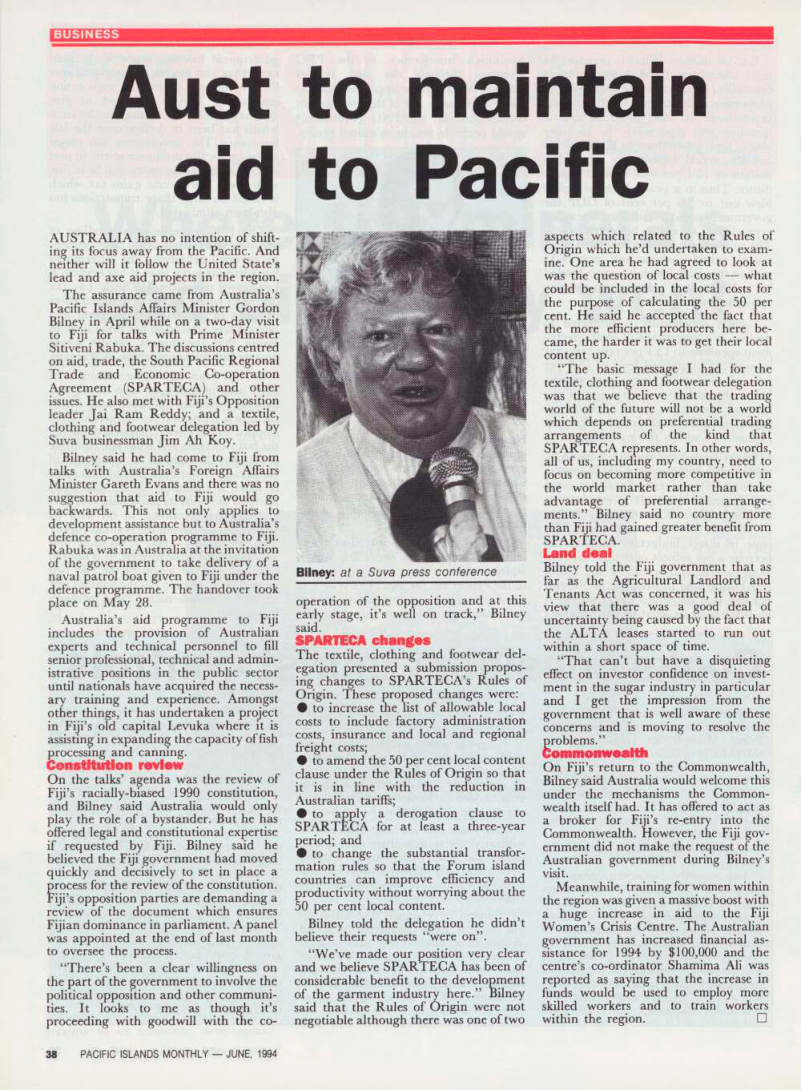
The assurance came from Australia’s Pacific Islands Affairs Minister Gordon Bilney in April while on a two-day visit to Fiji for talks with Prime Minister Sitiveni Rabuka. The discussions centred on aid, trade, the South Pacific Regional Trade and Economic Co-operation Agreement (SPARTECA) and other issues. He also met with Fiji’s Opposition leader Jai Ram Reddy; and a textile, clothing and footwear delegation led by Suva businessman Jim Ah Koy.
Bilney said he had come to Fiji from talks with Australia’s Foreign Affairs Minister Gareth Evans and there was no suggestion that aid to Fiji would go backwards. This not only applies to development assistance but to Australia’s defence co-operation programme to Fiji.
Rabuka was in Australia at the invitation of the government to take delivery of a naval patrol boat given to Fiji under the defence programme. The handover took place on May 28.
Australia’s aid programme to Fiji includes the provision of Australian experts and technical personnel to fill senior professional, technical and admin istrative positions in the public sector until nationals have acquired the necess ary training and experience. Amongst other things, it has undertaken a project in Fiji’s old capital Levuka where it is assisting in expanding the capacity of fish processing and canning.
Constitution review On the talks’ agenda was the review of Fiji’s racially-biased 1990 constitution, and Bilney said Australia would only play the role of a bystander. But he has offered legal and constitutional expertise if requested by Fiji. Bilney said he believed the Fiji government had moved quickly and decisively to set in place a process for the review of the constitution.
Fiji’s opposition parties are demanding a review of the document which ensures Fijian dominance in parliament. A panel was appointed at the end of last month to oversee the process.
“There’s been a clear willingness on the part of the government to involve the political opposition and other communi ties. It looks to me as though it’s proceeding with goodwill with the co-
operation of the opposition and at this early stage, it’s well on track,” Bilney said.
SPARTECA changes The textile, clothing and footwear del egation presented a submission propos ing changes to SPARTECA’s Rules of Origin. These proposed changes were: to increase the list of allowable local costs to include factory administration costs, insurance and local and regional freight costs; to amend the 50 per cent local content clause under the Rules of Origin so that it is in line with the reduction in Australian tariffs; to apply a derogation clause to SPARTECA for at least a three-year
period; and
to change the substantial transfor mation rules so that the Forum island countries can improve efficiency and productivity without worrying about the 50 per cent local content.
Bilney told the delegation he didn’t believe their requests “were on”.
“We’ve made our position very clear and we believe SPARTECA has been of considerable benefit to the development of the garment industry here.” Bilney said that the Rules of Origin were not negotiable although there was one of two
aspects which related to the Rules of Origin which he’d undertaken to exam ine. One area he had agreed to look at was the question of local costs what could be included in the local costs for the purpose of calculating the 50 per cent. He said he accepted the fact that the more efficient producers here be came, the harder it was to get their local content up.
“The basic message I had for the textile, clothing and footwear delegation was that we believe that the trading world of the future will not be a world which depends on preferential trading arrangements of the kind that SPARTECA represents. In other words, all of us, including my country, need to focus on becoming more competitive in the world market rather than take advantage of preferential arrange ments.” Bilney said no country more than Fiji had gained greater benefit from
Sparteca.
Land deal Bilney told the Fiji government that as far as the Agricultural Landlord and Tenants Act was concerned, it was his view that there was a good deal of uncertainty being caused by the fact that the ALTA leases started to run out within a short space of time.
“That can’t but have a disquieting effect on investor confidence on invest ment in the sugar industry in particular and I get the impression from the government that is well aware of these concerns and is moving to resolve the
problems.”
Commonwealth On Fiji’s return to the Commonwealth, Bilney said Australia would welcome this under the mechanisms the Common wealth itself had. It has offered to act as a broker for Fiji’s re-entry into the Commonwealth. However, the Fiji gov ernment did not make the request of the Australian government during Bilney’s visit.
Meanwhile, training for women within the region was given a massive boost with a huge increase in aid to the Fiji Women’s Crisis Centre. The Australian government has increased financial as sistance for 1994 by SIOO,OOO and the centre’s co-ordinator Shamima Ali was reported as saying that the increase in funds would be used to employ more skilled workers and to train workers within the region. □
Bilney: at a Suva press conference