Pacific Business
pp. 36-37 · Read in the full issue
Where the minerals and oil money went
By Roman Grynberg
ONE of the most predictable and distressing facts about the oil and mining boom in Papua New Guinea was how the revenues were spent. What the govern ment should have done with the non renewable revenues was hotly debated in PNG for years before the boom began.
While there was no agreement among
There were others such as the perceived law and order or problems with land owners which are perceived by investors to be much greater constraints to invest ment and economic development than taxation.
In the 1992 budget the government budgeted for a deficit of Kina 51 million, the actual deficit was K 233 million (5.6 per cent of Gross Domestic Product).
Last year the situation was also serious
economists on whether the money should be taken off shore or invested in the agricultural sec tor, everyone wanted to avoid what has now happened namely the oil rev enues hitting the government and ending up in a mass ive increase in gov ernment recurrent
spending.
The results of the short lived boom were depressingly predictable. Last year the Wingti-led coalition govern ment lowered the highest marginal rate or personal income
tax to 28 per cent from 45 per cent. The rate of company tax was lowered from 30 per cent to 25 per cent. The strategy was aimed primarily at making PNG a low tax area.
In fact it now has one of the lowest rates of direct tax in the Pacific region. The then Finance Minister, Sir Julius Chan, when introducing the tax reduction argued that it would stimulate invest ment and job creation. It is extremely doubtful that the level of taxes in PNG as they existed before the 1993 budget were the principle or even major con straints to its economic development.
with a budgeted deficit of K 162 million which is now estimated at K 235 million (4.7 per cent of GDP). The 1993 actual deficit is forecast to be as high as K 315 million. This year the projected blidget deficit is estimated to be K 242.8 million (4.7 per cent of GDP).
Moreover, the Minerals Resource Stabilisation Fund (MRSF), which was originally intended to buffer the econ omy and the budget from the type of revenue fluctuations that have occurred as a result of the oil and minerals boom of the past two years has effectively been
destroyed due to changes in legislation
that occurred under the previous Wingti/ Chan government in the late 1980 s. The government is now able to virtually draw down as much of the MRSF as it wants.
This year the projected injections into the MRSF will peak due to lagged payment of dividends and taxes from last year at K 318.6 million and the govern ment will draw down K 193.8 million. By the end of last year the MRSF, after two
peak years of oil and
gold production
a balance below that which existed in 1989 the last year of operation of the Bou gainville mine. It is difficult given PNG’s past history of fiscal prudence to con clude anything other than the fact that government has mis handled the revenues from the minerals boom. Given that the peak of the mineral boom has already passed and govern ment cutbacks in ex penditure are gener ally difficult there is no reason for opti mism about how the government will
handle the mineral revenues for the remainder of the decade.
Expenditure in the budget has in creased by 9.4 per cent for 1994 and is projected to be K 163 million. Expendi ture as a proportion of GDP is expected to rise from 30 per cent in 1993 to 31 per cent in 1994. Expenditure by national departments will increase from K 564 million in 1993 to K 684 million in 1994.
While increasing its own spending, the national government will at the same time drastically cut provincial govern ment spending from Kl6O million to
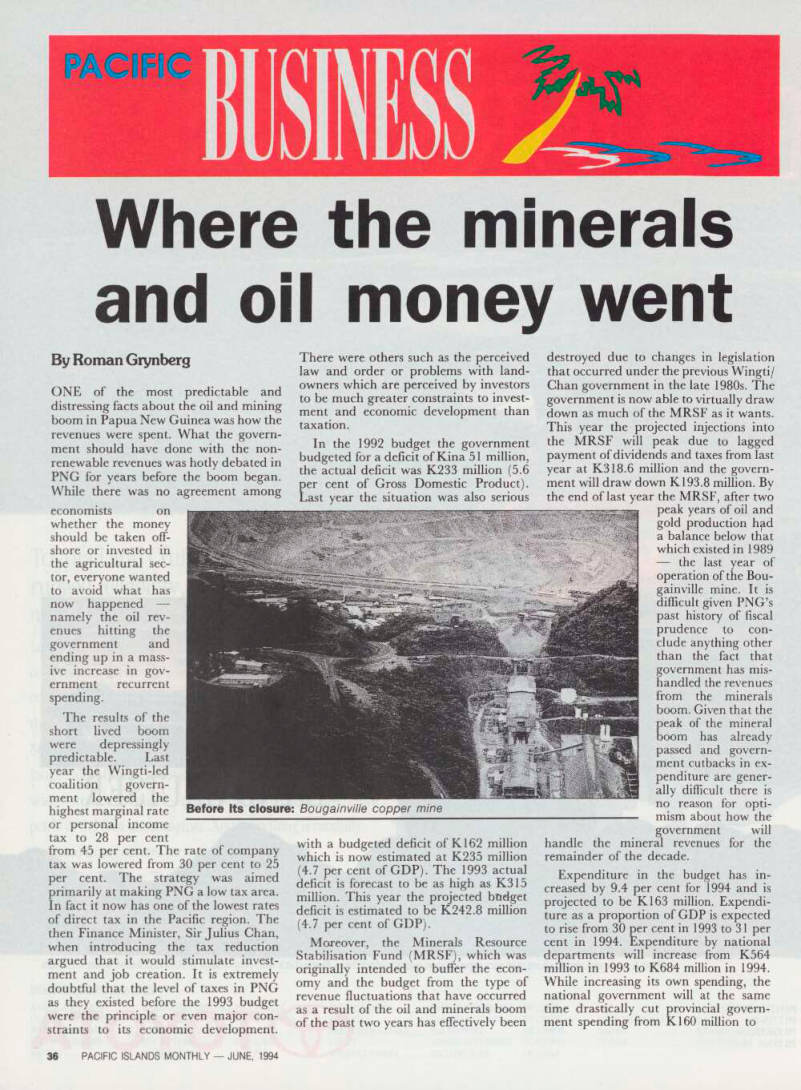
Before Its closure: Bougainville copper mine
K 125.8 million. What is perhaps the most disturbing trend in government expenditure patterns is the decline in the
proportion of capital expenditure to total
expenditure. In 1992 projected capital
spending was expected to be 16.6 per cent of total expenditure or K 196 million but the actual expenditure was K 165 million or 12.1 per cent of total expen diture. Thus in a year where the deficit blew out to 5.6 per cent of GDP the government could not institute its capital expenditure to reach budgeted levels.
The government has also instituted a free school subsidy which will cost K 33 million this year, which is in part funded by a K 9 million reduction in existing school programmes.
Capital expenditure is projected to
decline as a percentage of total govern ment spending to 13.1 per cent this year from a 1993 budgeted level of 15.3 per cent of total government expenditure.
What this indicates is that less of the mineral wealth is being devoted to capital spending and more to recurrent expenditure within the government.
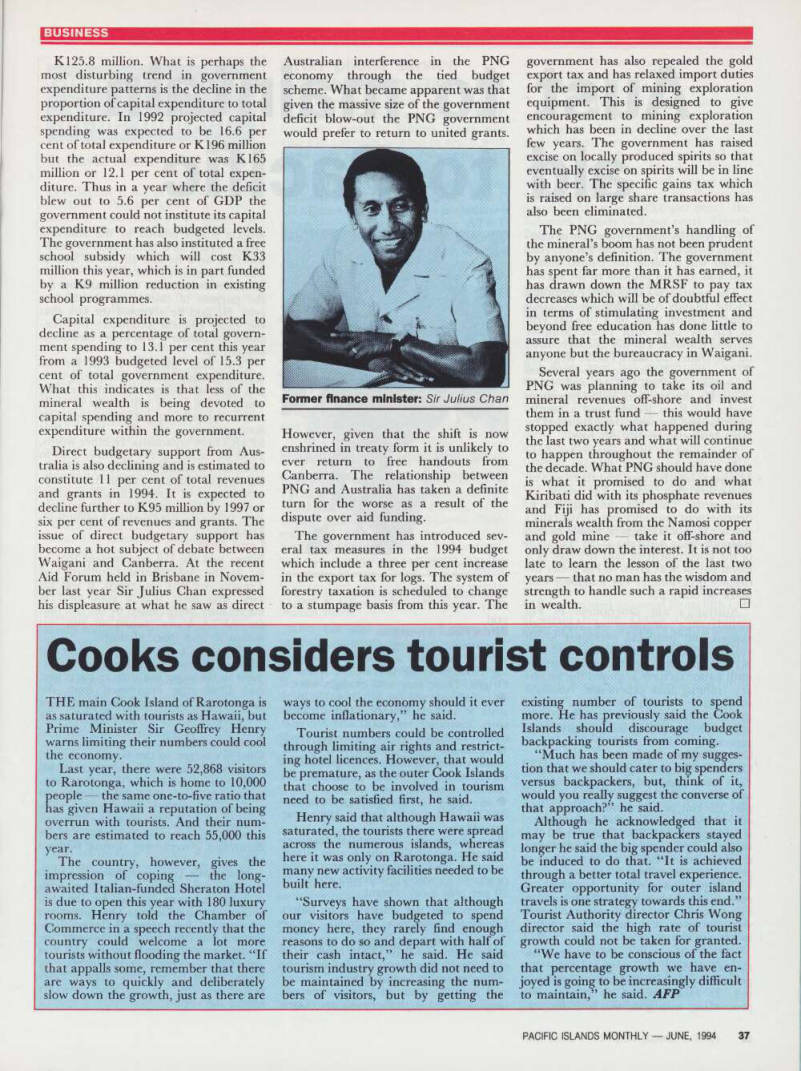
Direct budgetary support from Aus tralia is also declining and is estimated to constitute 11 per cent of total revenues and grants in 1994. It is expected to decline further to K 95 million by 1997 or six per cent of revenues and grants. The issue of direct budgetary support has become a hot subject of debate between Waigani and Canberra. At the recent Aid Forum held in Brisbane in Novem ber last year Sir Julius Chan expressed his displeasure at what he saw as direct
Australian interference in the PNG economy through the tied budget scheme. What became apparent was that given the massive size of the government deficit blow-out the PNG government would prefer to return to united grants.
However, given that the shift is now enshrined in treaty form it is unlikely to ever return to free handouts from Canberra. The relationship between PNG and Australia has taken a definite turn for the worse as a result of the dispute over aid funding.
The government has introduced sev eral tax measures in the 1994 budget which include a three per cent increase in the export tax for logs. The system of forestry taxation is scheduled to change to a stumpage basis from this year. The
government has also repealed the gold export tax and has relaxed import duties
for the import of mining exploration
equipment. This is designed to give
encouragement to mining exploration
which has been in decline over the last few years. The government has raised excise on locally produced spirits so that eventually excise on spirits will be in line with beer. The specific gains tax which is raised on large share transactions has also been eliminated.
The PNG government’s handling of the mineral’s boom has not been prudent by anyone’s definition. The government has spent far more than it has earned, it has drawn down the MRSF to pay tax decreases which will be of doubtful effect in terms of stimulating investment and beyond free education has done little to assure that the mineral wealth serves anyone but the bureaucracy in Waigani.
Several years ago the government of PNG was planning to take its oil and mineral revenues off-shore and invest them in a trust fund this would have
stopped exactly what happened during
the last two years and what will continue to happen throughout the remainder of the decade. What PNG should have done is what it promised to do and what Kiribati did with its phosphate revenues and Fiji has promised to do with its minerals wealth from the Namosi copper and gold mine take it off-shore and only draw down the interest. It is not too late to learn the lesson of the last two years that no man has the wisdom and strength to handle such a rapid increases in wealth. □
Former finance minister: Sir Julius Chan