Dalai Lama visits Hawaii
pp. 26-27 · Read in the full issue

Hawaii
By Ed Rampell
THE Dalai Lama visited Hawaii from April 14 to 18 on the first stop of a Compassion for World Peace tour, bringing Tibetans and Hawaiians together in soli darity, for a people-to-people communion supporting indigen ous self-determination.
His Holiness addressed a packed joint session of the Hawaii state legislature on April 14, stressing the Buddhist themes of non-violence and forgiveness.
Tibet’s spiritual leader said “I believe human nature is gentle ness.” Many were impressed with the Dalai Lama’s merriment, which broke with the protocol of a visit by a head of state (albeit a deposed one), as he made Hawaii’s usually somber state
capitol offices resound with laughter.
In a press conference immediately after his speech, Tenzin Gyatso spoke about similarities between the Tibetan and Hawaiian sovereignty movements, as Tibet was occupied by China in 1950 and the Dalai Lama was ousted in 1959, while America overthrew the Hawaiian monarchy in 1893 and annexed Hawaii in 1898. The 1989 Nobel Peace Prize winner said; “Nowadays, independence is fashionable ... my advice is preserve your own cultural heritage ... I have heard that in New Zealand, Australia, and mainland America people are con cerned with sovereignty. Keep your own native names.” The Dalai Lama pointed out differences between the struggles of Tibetans and indigenous peoples in the West. “Here, there’s freedoms and democracy, which is much different in our case.” Tibetan resistance is often met with brutal repression by China, which
regards the Dalai Lama as “feudalistic”.
The man followers believe is the 14th incarnation ofßuddha went on to say: “I can’t be clearcut on sovereignty. Tibet was historically a separate nation ... we’re not demanding independence (from China). My main consideration is Tibetan culture, which is more import ant than politics.”
As actions speak louder than words, the Dalai Lama went directly from the capitol in downtown Honolulu to nearby lolani Palace for a native Ho’okupu, or offering ceremony. America’s only royal palace symbolises Hawaiian resistance, as this is where US troops toppled the independent kingdom of Hawaii. Amidst much Polynesian pomp, pageantry, and protocol Tibet’s spiritual leader took part m sacred rituals. Traditional kahunas (priests practicing pre-contact religion) and na koa or warriors surrounded a controversial ahu, a rock altar with
religious significance. Chants and
conch shells rang out as tradition ally clad Hawaiians in sarongs and loin cloths formed a pro cession to welcome and give flower and leaf leis, taro plants,
poi pounders, and other gifts to
the Dalai Lama. He, in exchange, gave white prayer scarfs to the representatives of the 27 native groups the Tibetan received at a sacrosanct portion of the palace grounds, near a burial mound for high chiefs and the ahu.
This altar was built near the palace in January, 1993, as part of the commemoration of the 100th anniversary of the US backed overthrow of the Ha waiian monarchy. Since the cen tennial demonstrations the largest political protests in Ha waii’s history tne state govern
ment has demandea removal of the altar, against the will of aboriginal activists.
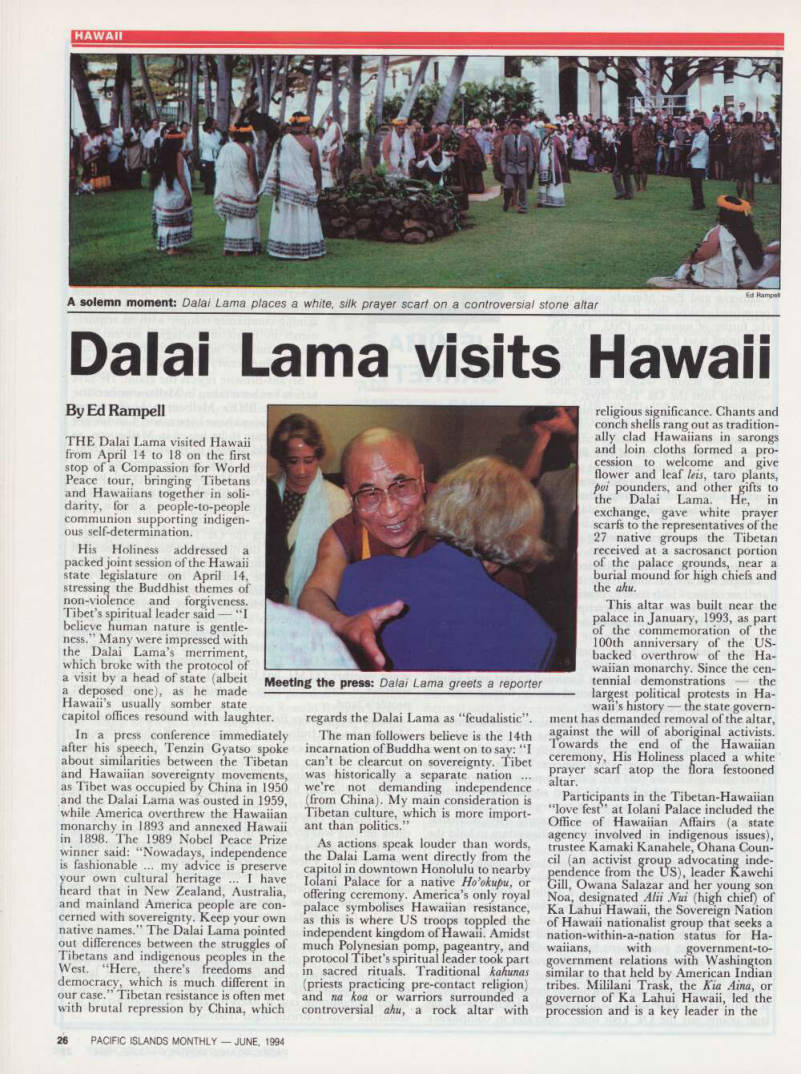
Towards the end of the Hawaiian ceremony, His Holiness placed a white prayer scarf atop the flora festooned altar.
Participants in the Tibetan-Hawaiian “love fesi at lolani Palace included the Office of Hawaiian Affairs (a state agency involved in indigenous issues), trustee Kamaki Kanahele, Ghana Coun cil (an activist group advocating inde pendence from the US), leader Kawehi Gill, Owana Salazar and her young son Noa, designated Alii JVui (high chief) of Ka Lahui Hawaii, the Sovereign Nation of Hawaii nationalist group that seeks a nation-within-a-nation status for Ha waiians, with government-to government relations with Washington similar to that held by American Indian tribes. Mililani Trask, the Kia Aina, or governor of Ka Lahui Hawaii, led the procession and is a key leader in the
Ed Rampell
A solemn moment: Dalai Lama places a white, silk prayer scarf on a controversial stone altar
Meeting the press: Dalai Lama greets a reporter
Hawaiian sovereignty movement which seeks native self government with land, cultural and religious rights. In an interview Trask said: “The Dalai Lama’s visit here, the way he has done the ceremony with us, is very positive for us.
He’s a great world leader, and when he comes here to recognise the Hawaiian people, the Hawaiian nation, he is an indigenous person and is also a refugee from his own land ... By his coming here he endorses and shows support for the
struggle of indigenous people and self
determination. That’s why all indigen ous leaders from all over the islands came to be with Dalai Lama today to honour him. Because we know that he, like us, is fighting for self determination, but fighting in a peaceful way.”
Trask, who has previously heard His Holiness speak at United Nations confer ences on native rights at Vienna, said that Ka Lahui Hawaii was co-operating with Tibetans in a UN-linked organis ation. “The Dalai Lama and his sup porters created an organisation in 1991 called Unrepresented Nations and Peoples Organisations (UNPO). Tibet and Dalai Lama were, of course, charter members, but over the years other indigenous peoples and nations that are not recognised were added to it, includ ing the Kurds ... Aboriginal organis ations from Australia, and, in 1993, Ka Lahui Hawaii became the first of the indigenous nations of the Pacific basin to be admitted. They provide facilitation in the international arena, at Geneva and elsewhere, and they provide a bridge for communications with nations that do not wish to recognise indigenous peoples.”
As for the issue of repression, Trask, an activist attorney, contends: “The op pression of our people by America is different than what the Chinese are doing to Tibet. The Chinese armed forces are visible on all the streets. Here, we have more American military in Hawaii than in any other state, but they’re not as visibly oppressive as they are in China ... Hawaiians are being arrested every day. The night before Dalai Lama came, police forces came and tore down the home of one of our sisters (Marie Beltran) living on the beach with her family. All over the islands Hawaiians are arrested and taken to jail in the same way China arrests people in Tibet and takes them to jail. So in civil disobedient practice we nave a common thread.”
After the convocation of two peoples, His Holiness spoke to large crowds at a number of Oahu and Big Island forums, on Local Identity in the Global Com munity Creating Peace in the 21st Century, Compassion for World Peace, Is a Non-Violent Society Possible?, and Compassion and Wisdom A Teaching and Ceremony for Generating the Mind of Enlightenment. On April 18 he left Hawaii for a US tour after leaving behind a strong spirit, and that white prayer scarf on the stone altar, making it harder for authorities to remove the altar. □