nuclear waste
pp. 11-13 · Read in the full issue
Cover Story
Cashing in on nuclear waste
By David North
THERE’S an old saying, “if you have a lemon, make lemonade”. In other words, make the best of a bad situation.
Some major forces in the Republic of the Marshall Islands want to do just that take one or more of the nuclear damaged islands, and rent them to the world as sites for atomic waste.
Bikini would be a logical location for such a dump, argue some Marshallese,
while others are adamantly op posed to even entertaining the notion. The amounts of money mentioned in connection with such a development are stagger ing. The New York Times sug gested US$5O million a year for 20 years, or $1 billion. RMTs ambassador to the US, Wilfred Kendall, told PIM that the annual income could be more than all of the republic’s current revenues, from all sources, now some $7O million a year. He cautioned, however, that conver sations are currently at a “very
preliminary phase”.
Floating around Washington, however, is an unsigned docu ment, dated February 1, 1994, marked “confidential” dealing with this subject. I was told on good authority that it had at least passed through the hands of the RMI embassy.
The smoothly-written, carefully-worded document seeks
funding for a feasibility study on the question of locating a nuclear storage facility on one or more uninhabited or nuclear-damaged islands in the Mar shalls. No island names are specified. The heading for the 16-page paper is “Long term Storage and Permanent Disposal of Nuclear Materials - a Proposal for a Feasibility Study in the Marshall Islands.” As one who is familiar with both island and Washington writing styles, my assumption is that it was written by mainland lawyers or consult ants. It is clearly intended to persuade a mainland source of money to put up an
unspecified, but substantial sum of money to conduct a sophisticated, three part feasibility study. Speculation is that the study alone, would cost $1 to $2 million. Ambassador Kendall, while not discussing the cost of the study, said that the potential sponsor of the study would be “in the private sector”.
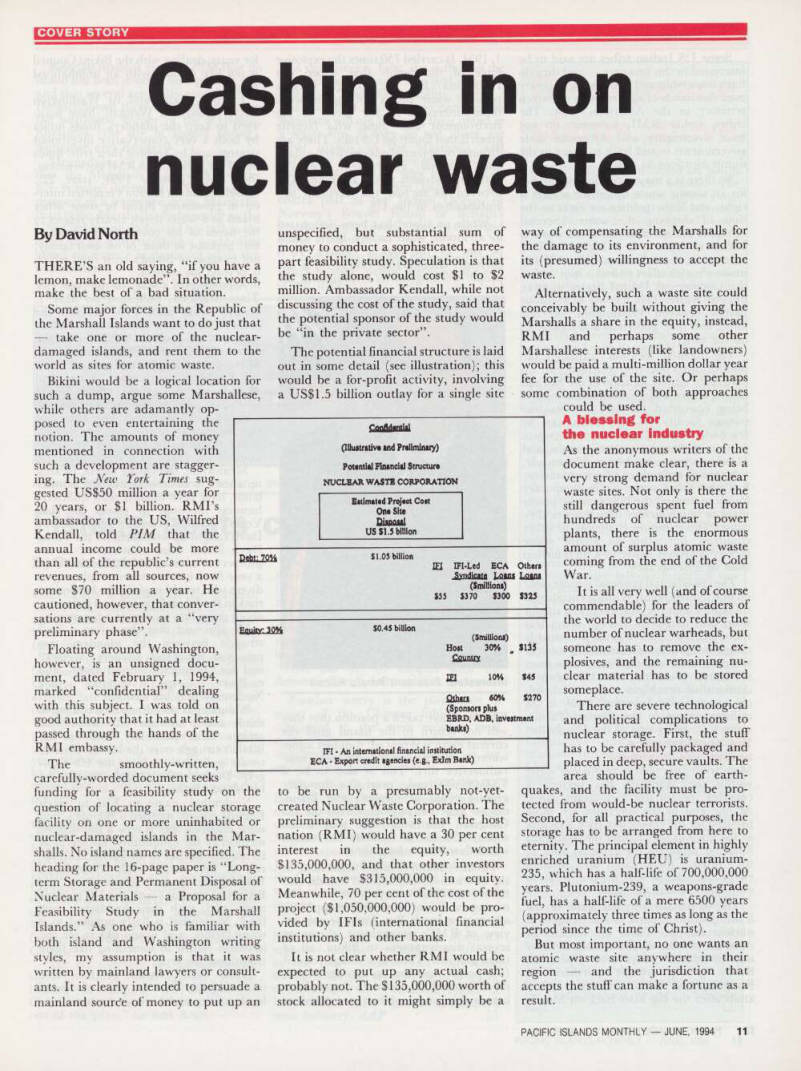
The potential financial structure is laid out in some detail (see illustration); this would be a for-profit activity, involving a US$l.5 billion outlay for a single site
to be run by a presumably not-yet created Nuclear Waste Corporation. The preliminary suggestion is that the host nation (RMI) would have a 30 per cent interest in the equity, worth $135,000,000, and that other investors would have $315,000,000 in equity.
Meanwhile, 70 per cent of the cost of the project ($1,050,000,000) would be pro vided by IFIs (international financial institutions) and other banks.
It is not clear whether RMI would be expected to put up any actual cash; probably not. The $135,000,000 worth of stock allocated to it might simply be a
way of compensating the Marshalls for the damage to its environment, and for its (presumed) willingness to accept the waste.
Alternatively, such a waste site could conceivably be built without giving the Marshalls a share in the equity, instead, RMI and perhaps some other
Marshallese interests (like landowners)
would be paid a multi-million dollar year fee for the use of the site. Or perhaps some combination of both approaches
could be used.
A blessing for the nuclear Industry As the anonymous writers of the document make clear, there is a very strong demand for nuclear waste sites. Not only is there the still dangerous spent fuel from hundreds of nuclear power plants, there is the enormous amount of surplus atomic waste coming from the end of the Cold War.
It is all very well (and of course commendable) for the leaders of the world to decide to reduce the number of nuclear warheads, but someone has to remove the ex plosives, and the remaining nu clear material has to be stored
someplace.
There are severe technological
and political complications to
nuclear storage. First, the stuff has to be carefully packaged and placed in deep, secure vaults. The area should be free of earth
quakes, and the facility must be pro tected from would-be nuclear terrorists, Second, for all practical purposes, the storage has to be arranged from here to eternity. The principal element m highly pinched uranium HEU) is uranium -235, which has a half-life of 700,000,000 years. Plutomum-239, a weapons-grade a half . life of a mere 650 0 years / approximate i y t h ree times as long as the iod since the t j me 0 f Christ), g ut most important, no one wants an atomic waste site anywhere in their region and the jurisdiction that accepts the stuff can make a fortune as a result.
Some US Indian tribes are said to be interested in this prospect and they do have ownership and some political power over thousands of square miles of barren territory in the American West. The tribes, unlike RMI, however, do not have sovereignty and American state governments would have to agree to the dump locations as well.
So there is a major, continuing market for an atomic waste site, if the setting is right, and if the politics are right at the time of shipping the waste. (Second thoughts are not a factor; if the waste is buried someplace, it is highly unlikely ever to be moved away.) The US has made a major effort to find a spot within the Continental United States to store nuclear waste. This has led to vigorous battles between Washington, on one hand, and state governors and legislators on the other.
The likeliest location, although the politics are not yet clarified, is an extremely remote location in the Nevada desert, where a large abandoned mine is being converted for use as a nuclear storage facility. If agreement can be reached, it would take care of only a portion of America’s atomic waste, and so far no storage has begun. Meanwhile, substantial collections of spent nuclear fuel and other waste sit in temporary locations around the US, near the power plant or bomb factory from whence they came. The situation is similar in other countries, but siting an atomic waste facility is always easier in a dictatorship than in a democracy.
The confidential proposal is quite clear on one related point. While it encourages thinking about the Marshalls as a site for short and long-term storage of nuclear materials, it is opposed to the presumably dangerous process of dismantling nuclear weapons in the islands. That is to be done elsewhere. (Currently the US Army is dismantling nerve gas and other chemi cal weapons on Johnston Atoll, a US military island in the Central Pacific, some 1500 miles east of the Marshalls.) The controversies among the islanders Meanwhile, the politics of nuclear waste within the Marshalls has become a complex, potentially high-stakes game.
At one end of the spectrum are those pressing for the creation of such a facility as the obvious way to end the Marshalls financial problems for decades; and, at the other, there are the staunch environmentalists who do not want to even think about the issue.
The Marshalls also has some of the leading world experts in the dangers of nuclear fall-out. These are families of those people who died of various forms of nuclear-related cancer after Operation Bravo spewed atomic particles on Rongelap and Utirik and many other atolls after the big blast back on March
1, 1954. It carried 750 times the explosive force of the bomb that wiped out Hiroshima. But the struggle over a possible waste site is not just between those interested in the green of the environment and those who favorite green is that found on US bills. There are
disputes or potential ones between village
and national government, between mainland advisers to the Bikinians, and between (we are told) the Marshalls’ two ambassadors in the US.
While no island has been designated for an atomic waste facility, Bikini would be one of the logical choices. It is currently uninhabited except for a few people working on its reclamation; the
Bikinians have taken a position that they will not return to the island until the current earth is removed, dumped some where, and replaced by nice, new, non radioactive dirt. This is said to be a $200,000,000 task (even if a dumping ground could be located) and Bikini, despite generous payments from the US Congress, has only half that much money. So Bikini is likely to remain uninhabited for a long time.
Further, Bikini is larger than some of the alternative, uninhabited islands, and there would be few surprises to waste site managers. Bikini is as well mapped as any spot on earth. But, from the point of view of RMl’s government, there are several disadvantages to Bikini, all of them political. There is a village council (the people now live on another island, the 200-acre Kili) and the villagers have been making many of their own decisions
lor years; dealing with the Bikini Council is not like dealing with an uninhabited island.
Further, Bikini and its Washington
lawyer, Jonathan Wcisgall, have man
aged to keep the islanders’ funds intact by both a very conservative investment strategy and by keeping their trust funds out of the hands of the RMI government.
(See PIM, January 1994, page 22).
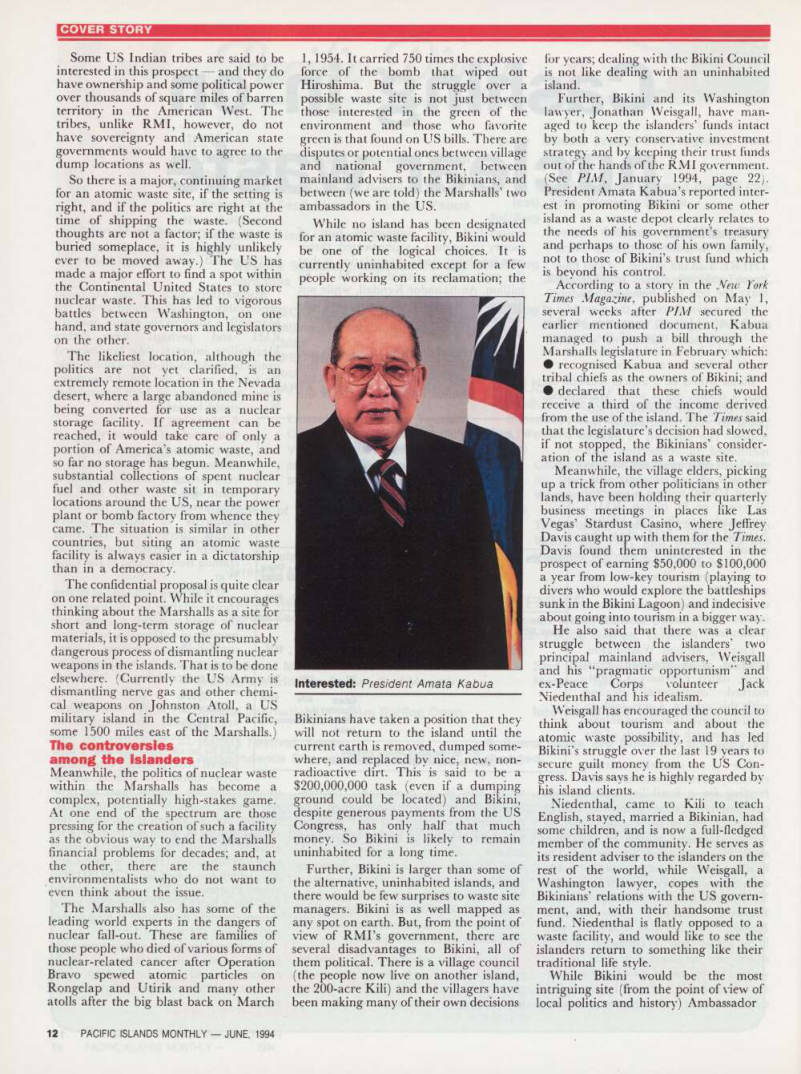
President Amata Kabua’s reported inter est in promoting Bikini or some other island as a waste depot clearly relates to the needs of his government’s treasury and perhaps to those of his own family, not to those of Bikini’s trust fund which is beyond his control.
According to a story in the New York
Times Magazine, published on May 1,
several weeks after PIM secured the earlier mentioned document, Kabua managed to push a bill through the Marshalls legislature in February which; • recognised Kabua and several other tribal chiefs as the owners of Bikini; and • declared that these chiefs would receive a third of the income derived from the use of the island. The Times said that the legislature’s decision had slowed, if not stopped, the Bikinians’ consider ation of the island as a waste site.
Meanwhile, the village elders, picking up a trick from other politicians in other lands, have been holding their quarterly business meetings in places like Las Vegas’ Stardust Casino, where Jeffrey Davis caught up with them for the Times.
Davis found them uninterested in the prospect of earning $50,000 to SIOO,OOO a year from low-key tourism (playing to divers who would explore the battleships sunk in the Bikini Lagoon) and indecisive about going into tourism in a bigger way.
He also said that there was a clear struggle between the islanders’ two
principal mainland advisers, Weisgall
and his “pragmatic opportunism" and
ex-Peace Corps volunteer Jack
Niedenthal and his idealism.
Weisgall has encouraged the council to think about tourism and about the atomic waste possibility, and has led Bikini's struggle over the last 19 years to secure guilt money from the US Con gress. Davis says he is highly regarded by his island clients.
Niedenthal, came to Kili to teach English, stayed, married a Bikinian, had some children, and is now a full-fledged member of the community. He serves as its resident adviser to the islanders on the rest of the world, while Weisgall, a Washington lawyer, copes with the Bikinians’ relations with the US govern ment, and, with their handsome trust fund. Niedenthal is flatly opposed to a waste facility, and would like to see the islanders return to something like their traditional life style.
While Bikini would be the most intriguing site (from the point of view of local politics and history) Ambassador
Interested: President Amata Kabua
Kendall made it clear to PIM that no island has been selected for a possible site, and that several are under consideration.
He mentioned three other islands, all in the northwest corner of the Republic: Enewetak (the site of atomic testing),
Alinginae and Rongerik.
Meanwhile, we gather in Washington that the Marshalls’ ambassador to the US, is more interested in exploring the prospect of a waste site in the Marshalls, than is the Marshalls’ ambassador to the UN, Carl Heine. We could not talk to the latter, as he was attending a world-wide island conference in Barbados while this was written.
What happens next? It probably will
be a slow process. First, the authors of the confidential paper need to find someone willing to fund the feasibility study and once that is under way perhaps the Bikinians will opt for using their island as a waste site. If they do not, there are other islands, in the Marshalls, and elsewhere. (If the seas are not impossible, and harbours exist, why not France’s uninhabited Kerguelen Islands in the colder part of the Indian Oceaxi, or Norway’s Bouvet Island or Britain’s South Georgia Islands, both in the frigid South Atlantic?) I suspect that we will be reading about where to store atomic waste for the rest of our lives. □
Arvind Kumar
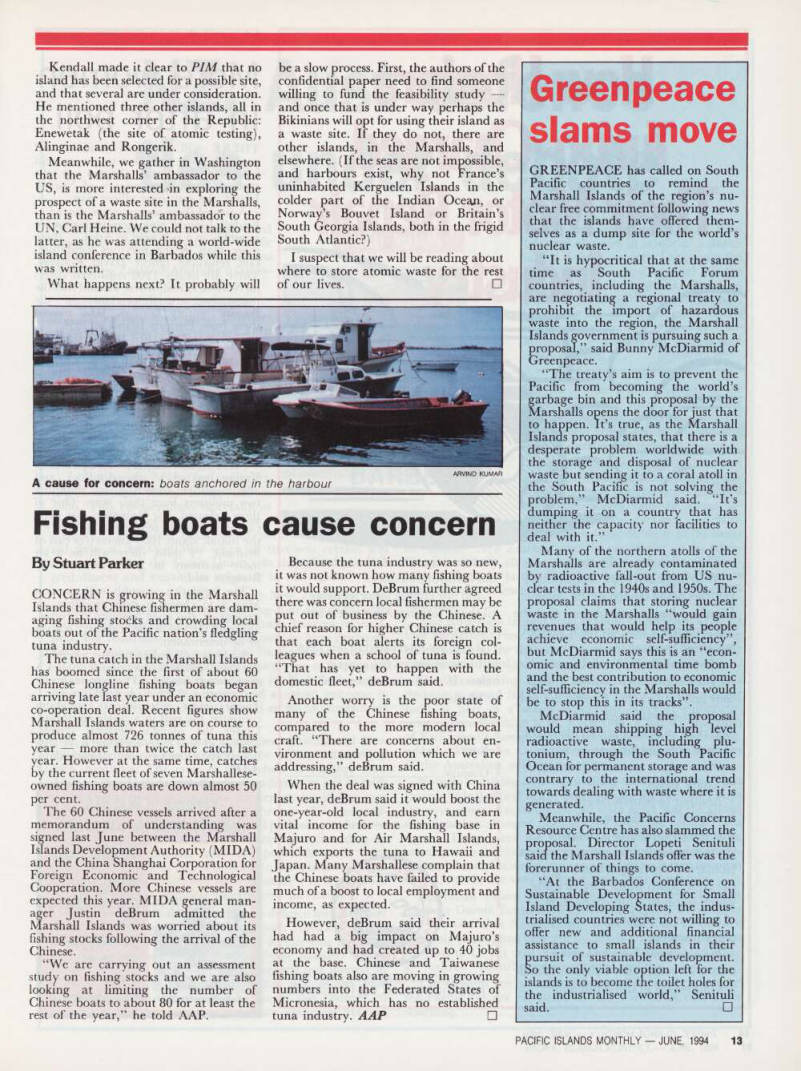
A cause for concern: boats anchored in the harbour