Medal assault
pp. 61-63 · Read in the full issue
Sports
By Shailendra Singh
V GIANT assault on athletics medals is ooming at the December Mini South ’acific Games in Vanuatu. This became vident six-and-a-half months before the ctual event during the Mobil Interna ional Athletics Meet in Suva.
Not so much bv the heat of the
ompetition TaffiJ
Vestern Samoa, Papua New Guinea, Vanuatu and the Cook Islands from June 4-26, but rather by the lack of it. None f the seven countries treated the Mobil ames as a bona fide international meet. bey used it more as build-up for Port ila and to take a peek at what the other Duntries were doing in preparation.
The games, a Fiji concept, was used to ive young athletes international ex osure and get others kick-started into aimng all with the aim of doing well i Port Vila. The absence of some leading thletes in Suva also said a lot as to how nously countnes are preparing.
Many big names in the region are ready training or competing in >U J| ltl A eS SU< ? aS n^ted States, Eng nd, Australia and even Kenya. They ill all lock horns in Port Vila from
December 10-16. This type oflong-term planning and the employment of fulltime coaches and administrators is a new trend as far as South Pacific nations are concerned.
It’s an about-turn from the previous rather carefree attitude to sports. Now the attitude is towards a stronger desire to best not only at home, but also catch up with the'rest of the world.
Despite the missing names, the Mobil meet which attracted 57 overseas participants including a team from USA was not totally devoid of action. Some new stars who should make an impact in Port Vila emerged in Suva and a few veterans of the 1991 South Pacific Games did arrive, adding spark to the event.
Said observer Mike Danila, athletics director at the Kooralbyn International School, Brisbane; “At this stage, results are good. This is a test to make it into the national team. The real job, the hard work is just about to start. To get a medal in Vanuatu will be very hard because ° ver the last four V ears . athletes has become stronger and stronger in every
even •
In Suva, Papua New Guinea’s Elizabeth Kamilus who scored four firsts in the
sprints and hurdles appears set to make a strong challenge in December. The lanky 22-year-old from Rabaun in East New Britain won the 100 m, 200 m, 400 m hurdles and 100 m hurdles, putting a smile on coach Samu Samasama s face, “ Her times ai ; e g ood considering we are really trying to peak at this stage, sa * d Samasama, a full-time officer with the PNG National Sports Institute.
Kamilus was a member of the 1991 SPG 4x400m gold medal winning team but this time she is after an individual medal. She will move lodgings with Mary Unido, 20, the only other PNG athlete who competed in Suva to the sports institute headquarters in Boroka, the Eastern Highlands for further train m^‘ “By the time the games are here, she should be fit for competition and will be running faster than now,” said Samsama.
The performance of Vanuatu’s Tawai officials that he will be a threat for F;ji Keiwan chilled the hearts of Fiji officials in Port Moresby during the 5000 m when he raced from behind to split three Fiji athletes to win the silver and deprive Fiji
Krishna Mani
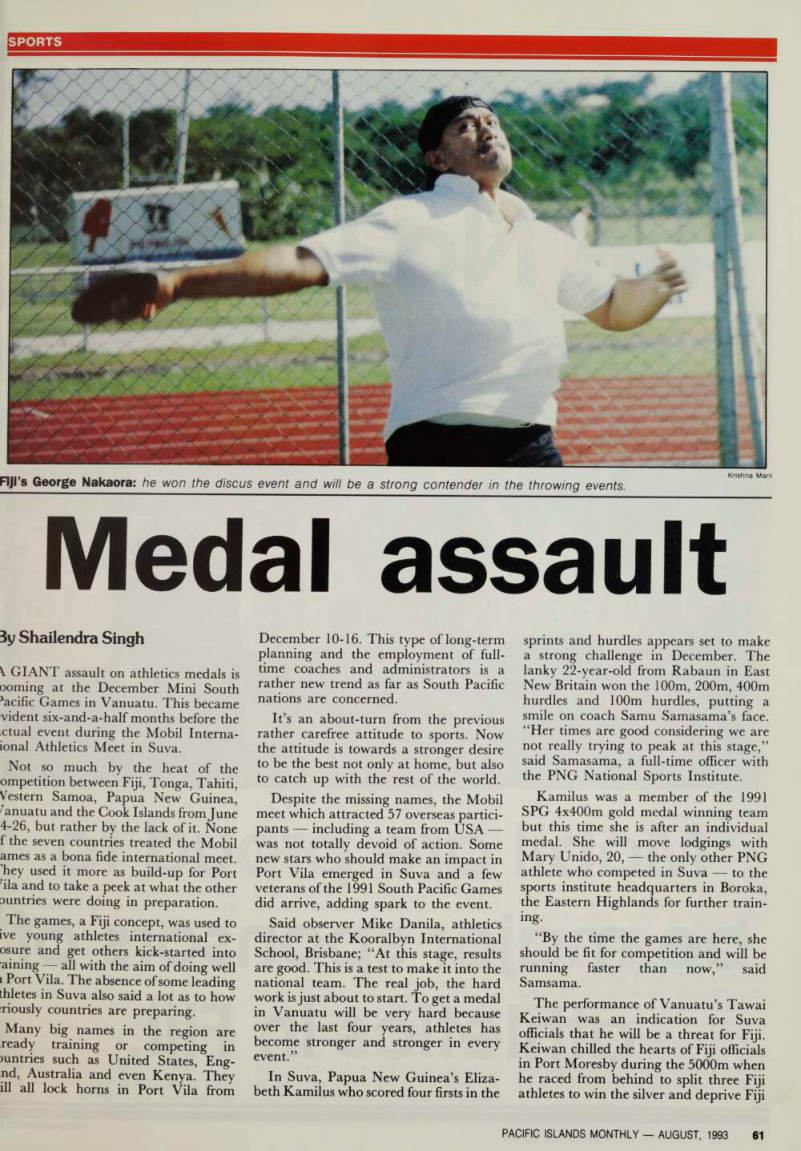
FIJI’s George Nakaora: he won the discus event and will be a strong contender in the throwing events.
of a clean sweep. The gold medal was won by Fiji’s Daven Prakash Singh who has spent the last year training and competing in Kenya and Europe.
With the home-advantage, Keiwan will test even more severly Fiji’s domi nance in the men’s distance events. He won all his three events in Suva and the gold he lost to Singh in Port Moresby may be well within reach at Port Vila.
Still on distance events, New Cale donia will unleash an athlete in the mould of the legendary Alan Lazare of the ’7o’s and ’Bo’s era although this time in the women’s events. She is Nadia Prasad, one of the few world class ithletes from the South Pacific. Nadia, vho was not in Suva came second in a 10km event at Boulder, USA in May ihead of New York marathon champion md double Commonwealth Games nedalist, Australian Lisa Oindieki. A nonth later in Utah, she clocked 15mins 2s to win a 5000 m event. Her time was 4secs short of the world record.
Prasad, who was missing from the ithletics scene from 1990 after giving >irth twice to baby girls is the wife of Fiji unner Binesh Prasad. Her husband, a >PG marathon gold medalist will be unning in Fiji colours in Port Vila. Her nly serious challenger should be Guam’s an Allred who swept up the 1500 m, 000 m, 10,000 m and marathon gold in brt Moresby.
Another class performance is expected om PNG male sprinters who were nmatched in both the individual and elay races in 1991. Danila, coach of the Lomanian junior national team before e defected to Australia in 1987 de :ribed the New Guineans’ as “world lass.” They made a clean sweep of the 00m, 200 m, 400 m 400 m hurdles,
xlOOm relay and 4x400m relay gold
ledals in Port Moresby.
Trying to break the PNG dominance ill be Tongan Tolatau Koula, the istest man in the South Pacific last year, he 20-year-old who ran 10.8 s in the 30m in Barcellona had just recovered
om a nagging hamstring injury when
e competed in Suva. “He had been insistently running 10.5 s last year,” said
bngan Sports Development officer
rian Minikim. The Aussie expatriate iid Koulau is capable of doing 10.4 s and arned that he will be out to regain his tie at Port Vila.
In the women’s sprints event, the ijians who dominated in PNG should rove as strong as ever. Schoolgirls Rosi amani, Rachael Rogers and Vaciseva avaga who won the 4xloom gold in
art Moresby and hold several Fiji
cords between them have the added Ivantage of having trained and com bed under Danila in Australia.
Another indicator of how fierce cont rition will be in Port Vila is the
distribution of athletics medals at the last SPG. Gold medal distribution was Fiji, 10; PNG, 9; New Caledonia, 9; Tahiti, 6; Guam, 4; Vanuatu, 3. It was the most even distribution in any SPG. Previously the lion’s share went to French Terri tories New Caledonia and Tahiti who enjoyed superior coaching and training facilities, had more finance and more international exposure.
But other countries are apparently catching up by strengthening infrastruc ture through improving administration, implementing development plans and vigorously seeking overseas assistance and corporate sponsorship. This is not to say the French are a spent force. Officials feel rather being put down by their waning influence, they will be all the more invigorated to reclaim their mantle.
The topic of talent and potential in the South Pacific was also discussed and the qualified coaches who were in Suva are convinced our athletes can match the best in the world. Tongan coach Minikim, who holds a honours degree in physical education from Canberra said Pacific athletes were in the same mould as black sportsmen, “There’s extraord inary potential here. Talk to any coach from Europe and you’ll hear the same thing. Pacific athletes start at a point where most European athletes would have to train for ages to get to.”
Minikim said the challenge ahead was to develop this potential to compete with the world’s best and to get overseas coaches to look at the talent here.
“Competitions like this one (Mobil International Meet), will help a great deal. You can’t expect athletes to train for something that comes around every two, four years.”
He said South Pacific athletes should not confine themselves to Australia and New Zealand but also seek out opportunities in America and Europe.
“Australia and New Zealand could help but they are interested in Olympic medals too. They are not going pour money in so we can take medals away from them. American schools and college sports structures are more sophisticated.
They have many levels of competition in each state.lt’s matter of attracting coaches from there to look at our talent.”
Danila, an athletics coach for 20 years said Pacific athletes now face a bigger challenge in catching up with the rest of the world. “Because of the money involved with the introduction of the Mobil Grand Prix, more and more people are taking up athletics as a full time occupation. Its getting very com petitive. Pacific athletes were already a step behind the rest of the world. Now other parts of the world are are going up at an even faster pace. To keep up, Pacific athletes have to train even harder
than ever.”
The Mobil Grand Prix, introduced in Europe in 1985 and later in Australia offers cash incentives to winning athletes.
It was introduced in Fiji this year, though naturally, on a very much smaller scale. It is also being run in PNG.
Danila said the stakes were increasing every year, resulting in worldwide per formance improving at a fast pace.
“Previously we had 12, 13 athletes at the top level and the rest way down but now we have 30 to 40 clustered at the top.”
Danila, who is regularly invited by countries in the region to conduct coaching clinics, has produced 12 na tional champions. His pride and joy is obviously 18-year-old Cathy Freeman, a member of the 1990 Australian Com monwealth gold medal 4x100m relay team. Freeman, the first Aborigine to win a medal in a major international meet is currently rated among the top 16 200m runners in the world.
Danila believes there are many more Cathy Freemans out in the Pacific. “The potential is here. People here have the talent. I don’t know what’s holding them back — probably lack of competition or confidence that they can’t be as good as those world champions,” said Danila.
In Port Villa, an expected 300 track and field athletes from 17 nations will vie for 42 x 3 gold, silver and bronze medals. □
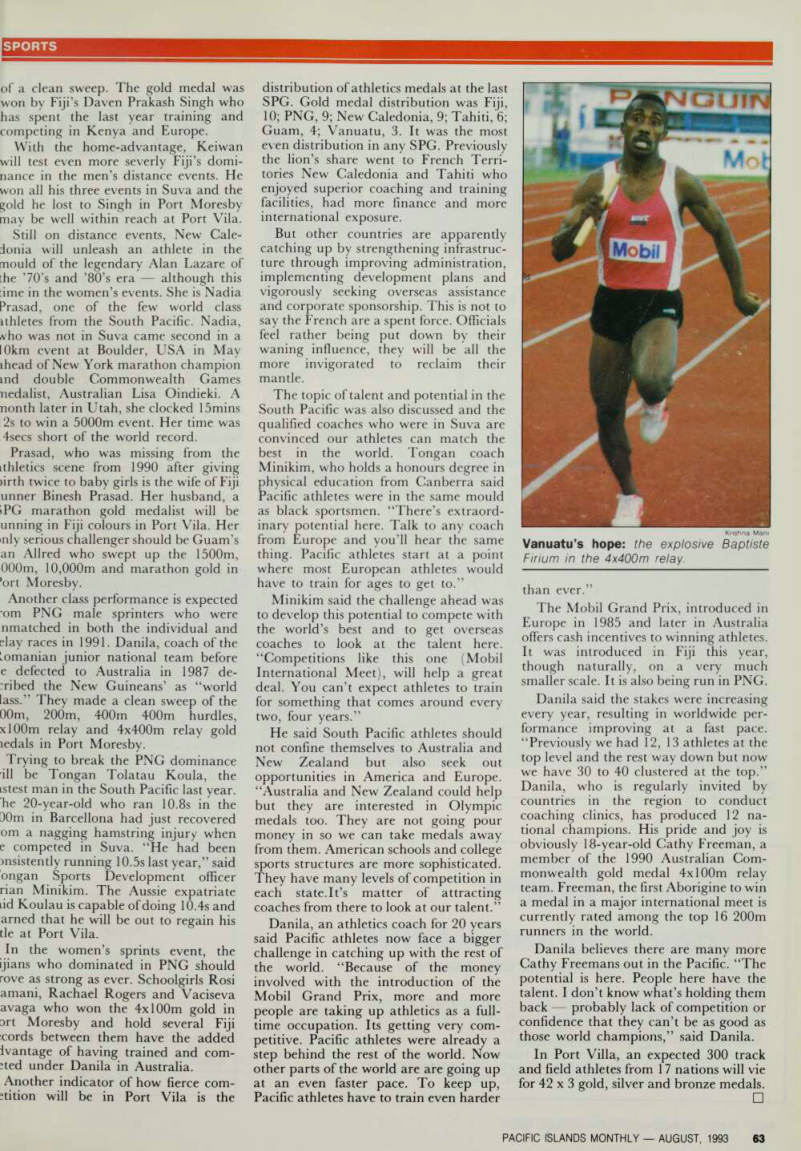
Krishna Mani Vanuatu’s hope: the explosive Baptiste Firium in the 4x400m relay.