the islands?
pp. 36-39 · Read in the full issue


The Region
What furture the islands?
As a market we are tiny, as allies irrelevant, and as a source of supply, we don’t matter one dollar beyond the PNG oil fields
By Roman Grynberg
THIS month our leaders will meet again for the annual Forum Meeting. It is fitting in a sense that the meeting should be held in Nauru an island that so vividly represents the bizarre economic and environmental relationship between the developed nations of the region and that of the aspirations of the islands. Nauru has for decades been one of the most important suppliers of phosphates for the Australian and New Zealand agricul tural sectors. It has in a sense been one
of the few islands in the region that has actually been at the heart of the wealth of Australia and New Zealand. The rest of the region has been gold mines, oil fields and tourist resorts not withstand ing, a massive financial burden for Canberra and Wellington, It was Nauru’s phosphates that permit ted both the Australians and New Zealanders to continue agricultural and soil conservation practices that they have long known to be utterly unsustainable.
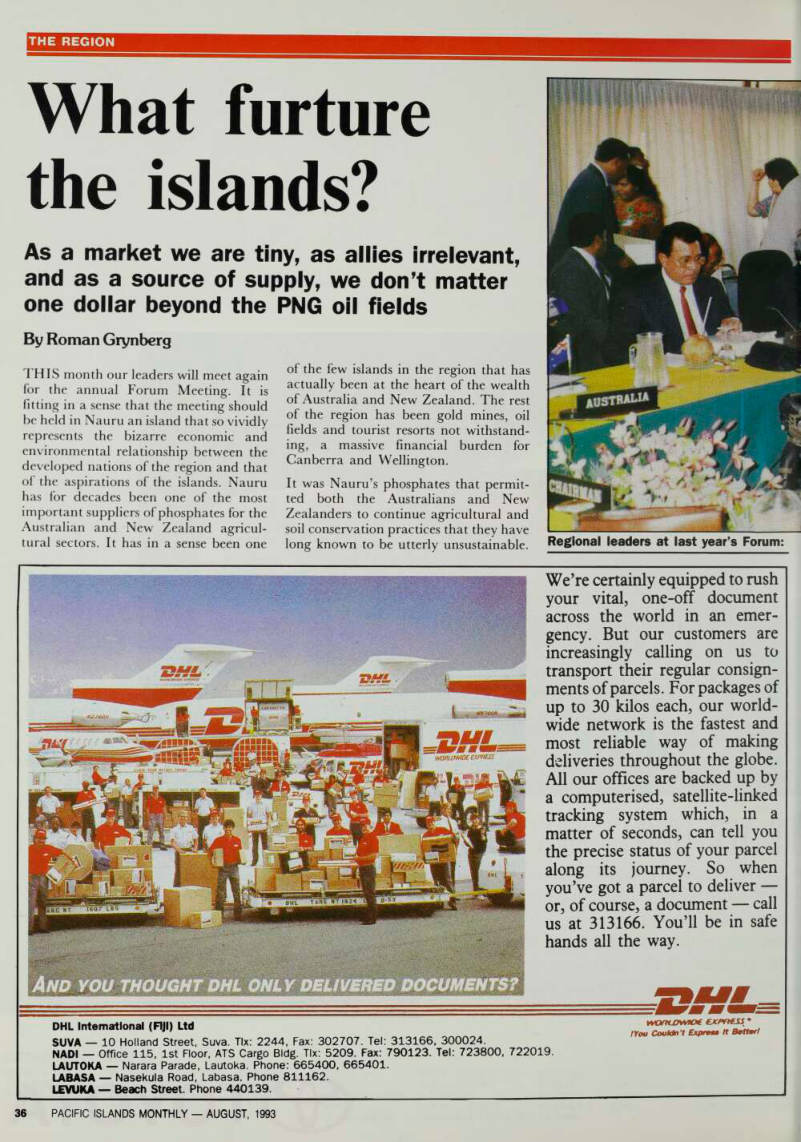
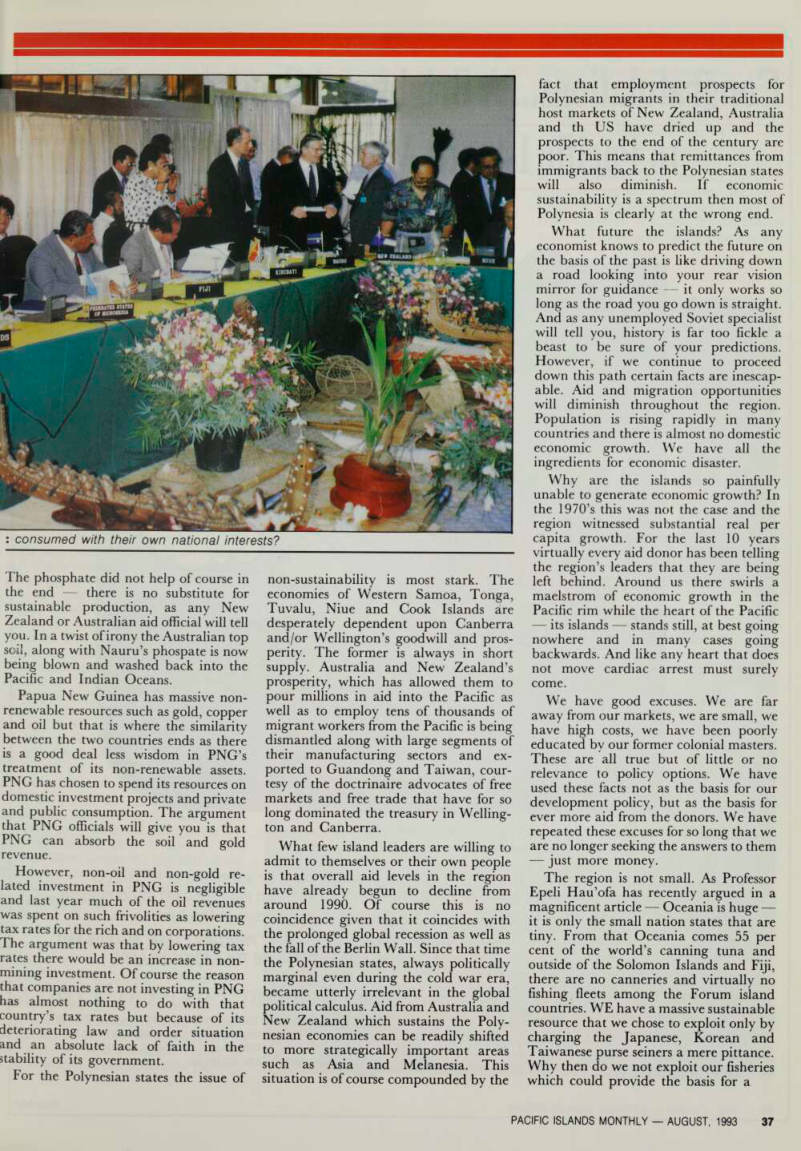
Regional leaders at last year’s Forum:
The phosphate did not help of course in the end there is no substitute for sustainable production, as any New Zealand or Australian aid official will tell you. In a twist of irony the Australian top soil, along with Nauru’s phospate is now being blown and washed back into the Pacific and Indian Oceans.
Papua New Guinea has massive nonrenewable resources such as gold, copper and oil but that is where the similarity between the two countries ends as there is a good deal less wisdom in PNG’s treatment of its non-renewable assets.
PNG has chosen to spend its resources on domestic investment projects and private and public consumption. The argument that PNG officials will give you is that PNG can absorb the soil and gold reveniip ‘ However, non-oil and non-gold related investment in PNG is negligible and last year much of the oil revenues was spent on such frivolities as lowering fcax rates for the rich and on corporations.
I he argument was that by lowering tax rates there would be an increase in nonmining investment. Of course the reason that companies are not investing in PNG has almost nothing to do with that country s tax rates but because of its detenoratmg law and order situation and u .i an a bsolute lack of faith in the stability of its government.
For the Polynesian states the issue of
non-sustainability is most stark. The economies of Western Samoa, Tonga, Tuvalu, Niue and Cook Islands are
desperately dependent upon Canberra
and/or Wellington’s goodwill and pros perity. The former is always in short supply. Australia and New Zealand’s prosperity, which has allowed them to pour millions in aid into the Pacific as well as to employ tens of thousands of migrant workers from the Pacific is being dismantled along with large segments of their manufacturing sectors and ex ported to Guandong and Taiwan, cour tesy of the doctrinaire advocates of free markets and free trade that have for so long dominated the treasury in Welling ton and Canberra. what few island i eaders are wil ii ng t 0 • o admit to themselves or their own people is that overall aid levels in the region have already begun to decline from around 1990. Of course this is no coincidence given that it coincides with the prolonged global recession as well as the fall of the Berlin Wall. Since that time the Polynesian states, always politically marginal even during the cold war era, became utterly irrelevant in the global political calculus. Aid from Australia and New Zealand which sustains the Poly nesian economies can be readily shifted to more strategically important areas such as Asia and Melanesia. This situation is of course compounded by the
fact that employment prospects for Polynesian migrants in their traditional host markets of New Zealand, Australia and th US have dried up and the prospects to the end of the century are poor. This means that remittances from immigrants back to the Polynesian states will also diminish. If economic sustainability is a spectrum then most of Polynesia is clearly at the wrong end.
What future the islands? As any economist knows to predict the future on the basis of the past is like driving down a road looking into your rear vision mirror for guidance it only works so long as the road you go down is straight.
And as any unemployed Soviet specialist will tell you, history is far too fickle a beast to be sure of your predictions.
However, if we continue to proceed down this path certain facts are inescap able. Aid and migration opportunities will diminish throughout the region.
Population is rising rapidly in many
countries and there is almost no domestic economic growth. We have all the ingredients for economic disaster.
Why are the islands so painfully unable to generate economic growth? In the 1970’s this was not the case and the region witnessed substantial real per capita growth. For the last 10 years virtually every aid donor has been telling the region’s leaders that they are being left behind. Around us there swirls a maelstrom of economic growth in the Pacific rim while the heart of the Pacific its islands stands still, at best going nowhere and in many cases going backwards. And like any heart that does not move cardiac arrest must surely come.
We have good excuses. We are far away from our markets, we are small, we have high costs, we have been poorly educated by our former colonial masters.
These are all true but of little or no relevance to policy options. We have used these facts not as the basis for our development policy, but as the basis for ever more aid from the donors. We have repeated these excuses for so long that we are no longer seeking the answers to them just more money.
The region is not small. As Professor Epeli Hau’ofa has recently argued in a magnificent article Oceania is huge it is only the small nation states that are tiny. From that Oceania comes 55 per cent of the world’s canning tuna and outside of the Solomon Islands and Fiji, there are no canneries and virtually no fishing fleets among the Forum island countries. WE have a massive sustainable resource that we chose to exploit only by charging the Japanese, Korean and Taiwanese purse seiners a mere pittance.
Why then do we not exploit our fisheries which could provide the basis for a
: consumed with their own national interests?
sustainable but an albeit modest stan dard of living for our people? The problem of the tuna fisheries in many ways typifies our problem. To compete on the world market we must set our wages at levels close to those in Philip pines and Thailand, who are our prin ciple competitors in tuna canning. We are not willing to do this because the massive amount of aid we receive makes us relatively rich and makes it unneces sary for us to have to compete. This situation is of course coming to an end and while we may not wish to have the meagre standard of living of Thai and Filipino cannery workers, we one day may have no choice.
What then of Australia and New Zealand? Let us tell the ugly truth. They really do not care whether the islands exist or not. As a market we are tiny, as allies we are irrelevant and as a source of supply, given that Nauru’s phosphate is gone, we do not matter one dollar beyond the oil fields of New Guinea.
Only Melanesia matters to Australia and that is primarily for reasons of defence. Australia’s defence strategy, despite protestations to the contrary, rests in large measure as it has since the beginning of the century on PNG as either a buffer or battleground. Australia has no interest in this region beyond PNG and possibly the Solomon Islands and this is witnessed by some of its most recent policy changes the creation of the new portfolio of minister for the Pacific islands Gordon Bilney. This is not proof, as some have argued that Australia is paying more attention to the region, but rather the opposite. It is proof of our increasing marginalisation the Australian foreign minister prefers the view from the Bangkok Hilton to that of Suva harbour and feels comfortable
enough to delegate regional responsibil
ities to a junior minister. Asia is now the centre of Australia’s attention, and well it should be as it is Australia’s most
important market.
In the Pacific the Australians offer no leadership, not because they are unwill ing to do so their leadership in the UN over Cambodia proved that but because they simply do not care about the region due to its economic insignifi cance. This would be fine if the region’s leaders were to provide serious regional initiatives. But most do not see them selves as a part of a region either they are consumed with their own national issues which are sometimes of micro scopic importance. There is no greater vision of the Pacific islands not from within and not from without.
It is a time for hard economic policy in the islands because we must adapt to :he post-cold war economic reality or link into ever more miserable poverty.
This time also calls for dreams for we may soon be able to afford little else.
Australia, and to a lesser degree New Zealand, has no place for us in their headlong race to Asia. If Australia and New Zealand join a greater trading block we shall probably be dragged along as an afterthought> but that is aII The structures that were created for us at independence - the tiny nation states —cannot generate wealth. Only poverty or emigration are our common future. It is time to change these political struc tures into something larger. We have
hope of serious development as a group of nations in federations based possibly on the Melanesian Spearhead Group example and other sub-regional group ings. Such federations may be the only real hope for the region to solve its problems of economic viability and more serious political issues such as the Bou „r D & a ! nv ! e ?° n , . 1C ' course, i e ou- amvllle the bigger issues are not on the forum agenda. It is time lor the rorum t( ?. lts root:s again and go back to the vlslon oi its creators, □