Where
pp. 25-30 · Read in the full issue
Cover Stories
Has The
Money Gone?
By David North
NAURU authorities in London have apparently been conned out of as much as AS2I million in a “prime bank notes” scam.
The island appears to be losing close to A 54.500 million on the struggling West End musical Leonardo (see story on page 50).
And the most imposing of the island’s investments, Nauru House in downtown Melbourne, is said to be suffering from “concrete cancer.”
Some observers see these quite separ ate events as omens of serious trouble in the investments of the phosphate-rich nation. Other grime indicators include : • the angry resignation of a top Australian money manager from his two month-old post with the Nauru Phos phate Royalties Trust, saying that the Trust was in “dire financial straits;” • the sale of Nauru’s interest in the
money-losing phosphate treatment plant
in India; • public complaints by Nauru that Japanese brokers treated the nation unfairly in deals there, which apparently involved large losses; and • two highly unprecedented demon strations on the tarmac of Nauru’s airport, as crowds (mostly women) sought to stop the departures of Air Nauru planes on investment-related junkets.
The last-mentioned events, apparently not reported until now, indicate that at least some rank-and-file Nauruans are furious with the way their government is investing their money.
Nauru is like a family on an isolated farm whose grandfather discovered gold under the back pasture; the gold is almost gone, but the gold led to a number of investments. The members of the family (there are only about 4000 Nauruans in the world) now have to manage the money and have established various vehicles to do so. Some of the vehicles work better than others, and there are the inevitable family feuds.
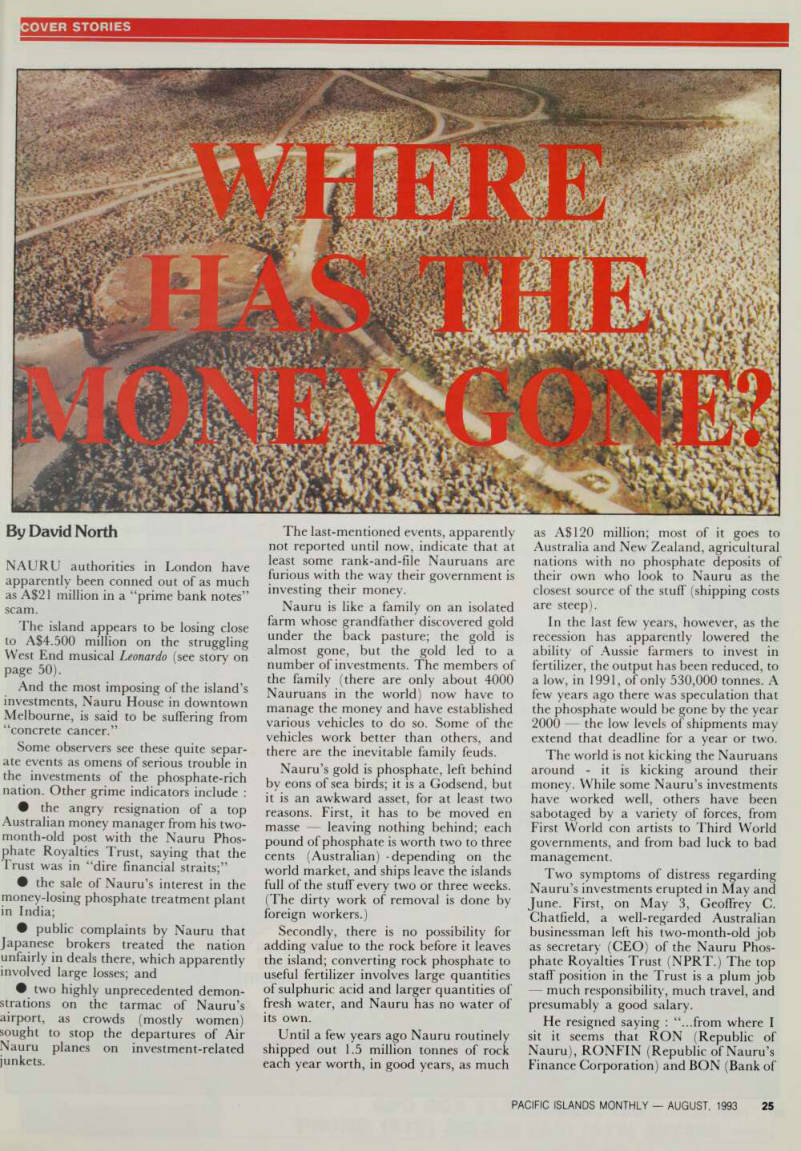
Nauru’s gold is phosphate, left behind by eons of sea birds; it is a Godsend, but it is an awkward asset, for at least two reasons. First, it has to be moved en masse leaving nothing behind; each pound of phosphate is worth two to three cents (Australian) -depending on the world market, and ships leave the islands full of the stuff every two or three weeks. (The dirty work of removal is done by
foreign workers.)
Secondly, there is no possibility for adding value to the rock before it leaves the island; converting rock phosphate to useful fertilizer involves large quantities of sulphuric acid and larger quantities of fresh water, and Nauru has no water of its own.
Until a few years ago Nauru routinely shipped out 1.5 million tonnes of rock each year worth, in good years, as much
as AS 120 million; most of it goes to Australia and New Zealand, agricultural nations with no phosphate deposits of their own who look to Nauru as the closest source of the stuff (shipping costs
are steep).
In the last few years, however, as the recession has apparently lowered the ability of Aussie farmers to invest in fertilizer, the output has been reduced, to a low, in 1991, of only 530,000 tonnes. A few years ago there was speculation that the phosphate would be gone by the year 2000 the low levels of shipments may extend that deadline for a year or two.
The world is not kicking the Nauruans around - it is kicking around their money. While some Nauru’s investments have worked well, others have been sabotaged by a variety of forces, from First World con artists to Third World governments, and from bad luck to bad management.
Two symptoms of distress regarding Nauru’s investments erupted in May and June. First, on May 3, Geoffrey C.
Chatfield, a well-regarded Australian businessman left his two-month-old job as secretary (CEO) of the Nauru Phos phate Royalties Trust (NPRT.) The top staff position in the Trust is a plum job much responsibility, much travel, and presumably a good salary.
He resigned saying : “...from where I sit it seems that RON (Republic of Nauru), RONFIN (Republic of Nauru’s Finance Corporation) and BON (Bank of
Nauru) are in such dire straits financially that they will continue to seek funding from NPRT.
“Of course our own position is now so distressed that we will not be able to accommodate them. Loans provided directly to both RON and RONFIN, as well as the collateral support we have had to provide for their outside borrow ings, have decimated both the overall value of NPRT and its cash reserves, in addition because our equities and bonds have been liquidated to meet the de mands of RON and RONFIN we are now inappropriately overweight in high risk property investments.
“The trust is desperately illiquid,” he wrote to his Nauruan boss, R.Kun, chairman of NPRT, “and we will have...difficulty avoiding a default on any of its own commitments... In my view a default by one or other Nauru entity is a matter of weeks away...”
This from the top money manager of a fund which Nauru officials have estimated as being worth Asl.2 billion.
His letter of resignation continued :
“..relationships are becoming acri
monious as our finances deteriorate...! believe that there is very real danger of my being made the scapegoat. I am worried about my physical safety, par
ticularly on the island.”
Chatfield, when reached at his home in the Melbourne suburbs said he did not want to talk about his resignation or Nauru’s finances : “I do not want to make matters worse.”
Shortly after Chatfield’s resignation a group of Nauruans on the island ex pressed their displeasure with the govern ment’s investments policies in a quite different way. On May 27 several of the island’s leaders were preparing to take off for London to join Nauru President Bernard Dowiyogo (who was already there) for the opening of the RONFlN financed Leonardo. Among those planning to board the Air Nauru flight was Paul Jeremiah, the Speaker of the 18-member Nauru Parliament, and the Ministers of Justice and Health. Also in the theatre party was the wife of one of the political leaders of Kiribati, who was planning to go as Nauru’s guest.
The crowd sat down on the tarmac in front of the plane, and refused to let the plane leave until it was clear all those heading for Leonardo’s opening were not on board. At first it was a standoff; the pilot would not drive the plane over the crowd; the crowd would not leave, and the theatre-goers insisted on making the trip. Eventually the group headed for
London gave up the struggle; the crowd checked the tickets of those boarding to make sure the official party was not getting on the plane, allowing the rest of the passengers to take the flight to Nadi.
A few weeks later another angry crowd tried to prevent President Dowiyogo from leaving the airport on the first step of a triumphal journey. He was planning a Nauru-Nadi-Honolulu-Seattle outing so that he could fly back in Air Nauru’s brand new Boeing 737-400. This time the police intervened, and former Nauru Finance Minister (and current MP) K.R.Adeang said, “there was some violence; the women were roughed up.”
The President made his trip.
While the loss on Leonardo will prob ably be one of Nauru’s smaller invest ment losses, and while the President’s desire to take delivery of the new plane may be somewhere between ostentatious and harmless, the tarmac demonstrations pinpointed these events because they are tangible symbols of an otherwise highly secret process.
In sharp contrast to stockholder owned corporations and government agencies in much of the rest of the world, none of Nauru’s financial institutions publish annual reports. Further, neither the Nauru Phosphate Royalties Trust, the Nauru Phosphate Corporation, nor
the Director of the Republic of Nauru’s Finance Corporation (RONFIN) would discuss the island’s investments with PIM. In the case of Kelly Emiu, who doubles as RONFIN executive director and secretary of Nauru’s Cabinet, he told me he did not conduct interviews over the telephone but suggested he would respond to a fax. We sent him one, but have had no reply at this writing.
It isn’t that the NRPT, for example, does not have an annual financial report; there is such a document. But a very
limited number of copies are printed in Australia each year (one source said 25 copies, another 150).
With the exception of some file copies in Melbourne, the bal ance is shipped to Nauru for the edifi cation of members of the Parliament and a few top officials. A landowner wanting to know what is hap pening to the invest ments does not get a copy in the mail; if he is curious, he goes to a member of the Cabinet and asks to
read the report, at the minister’s home or office. PIM was not able to get its hands on a copy.
We did acquire one key piece of financial information, however, which more or less has to be public. This is the annual flow of interest payments to the island’s landowners whose land has been shiped off to Australia, have fallen in
recent years, according to Adeang
from AS23 million in the financial year ending June 30, 1990, to AS2I million in the year ending June, 1991, and to AS 19
million in the year ending June, 1992.
The most recent financial year ended this June 30 and worried landowners will not learn until October if they face yet another fall in interest payments. (These interest payments, at the rate of about Assooo for every Nauruan, constitute a large percentage of most Nauruans’ incomes. The other half of Nauru’s population consists of foreign workers who do not share in these payments.) Adeang recognises that some part of the decline in interest payments relates to
a world-wide decline in interest rates but he senses there is a loss of capital as well.
These interest payment go into RONWAN, one of four trust funds administered by NPRT.
Bilateral Investments Adeang is critical of Nauru’s invest ment policy. “We need a new govern ment, one that is less extravagant in its investments, and in its governmental expenditures,” he told PIM.
He said the government, in addition to
being improvident in its internal spend ing patterns, had made many poor investments, and listed these three as
examples :
. . * The joint investment with Indian interests in Paradeep Phosphate, Ltd. in Orissa, India. This phosphate processing pl an t has been running at a loss for years, anc * Nauru’s 49 per cent interest was recently sold for US$64 million to an Indian firm. While there once had been high hopes for continuing profits it appears Nauru, after many years, has
just broken even on the deal. • A similar joint venture in the Philippines, which is still in place. • A frustrat ing effort to work out invest ments of various kinds in Western Samoa; al though Apia is hungry for external invest ments, the deal
fell through
after much spin ning of wheels.
Real Estate
while it u impossible to tell what is carried in Nauru’s books, the view from outside is mixed. For instance, there is Nauru House the island’s hncre invest iMauru Mouse, me island s huge invest ™ent ,n downtown Melbourne. (The Nauru Phosphate Royalties Trust occupies the 50th floor, so it is a flagship investment.) g P It is plagued by something called “spalling” which results from a sloppy construction technique in which the poured cement slabs on the outside of the building have their iron-rod reinforce
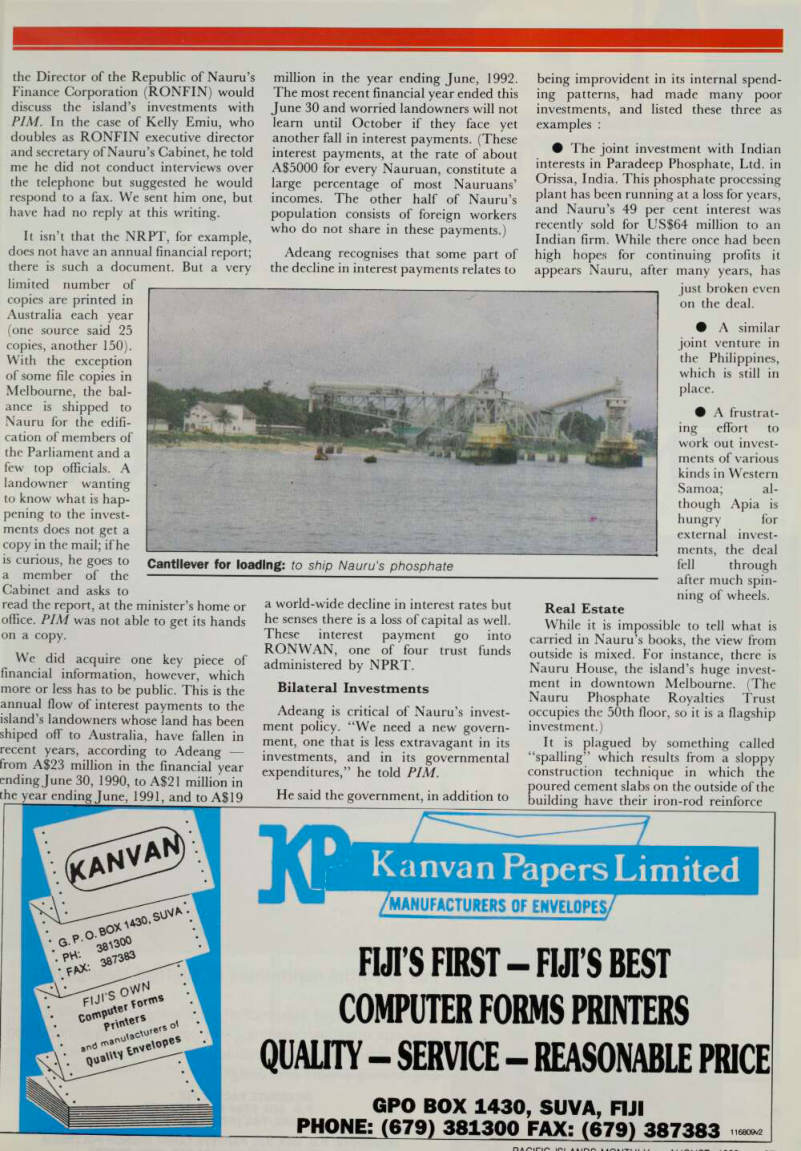
Cantilever for loading: to ship Nauru’s phosphate
ments too close to the outer surface. The nearness of the iron to the exterior allows the rods to rust, which leads to chipping of the cement, and the dropping of small segments of cement no bigger than pebbles, we were told on those below.
To prevent this Nauru has, at some considerable cost, decided to cover the cement surface with aluminium.
So Nauru House is not falling down, but the not-fully rented building has scaffolds all around it as an expensive new face is applied. Co-incidentally, this is exactly what is happening to the otherwise attractive building owned by Nauru in Houston; the six-storey struc ture, occupied by CAE-Link, manufac turer of pilot training devices, suffers from expensive complexion problems.
The facial board that had covered its exterior, since it was erected about a dozen years ago, has developed leaks and other failings and is now being replaced with black glass.
Continuing in this mixed vein, there are, for example, two of Nauru’s invest ments within 150 miles of each other the Pacific Star Hotel in Guam and the Nauru office building in Saipan. The Pacific Star, one of the largest and most successful hotels in Guam, is apparently prosperous, and is usually full of Japan ese tourists.
The Saipan building had a promising
start. It was a spanking new, highly attractive office building; on the roof was the first revolving restaurant on the island, the initially successful Taipei Cafe. But after a while the mechanism to make the restaurant revolve stopped working, and a little later the restaurant went out of business. Now the place, we are told, has only a few tenants and appears unkempt. Apparently the man agers set the rental rates too high when it opened, and never adjusted to the market realities.
One can draw a similar comparison between Nauru’s successful venture into Washington D.C.’s real estate market, and its disastrous hotel in Majuro. Now fully rented, Washington’s Pacific House contains the offices of Fred Radewagen, the publisher of Washington Pacific Report who handled the development of the building, and several other Pacific related interests, such as the Embassy of Papua New Guinea.
Then, in contrast, there is the never quite-finished, 15-year-old Nauru hotel in Majuro. When, and if, completed it will double the number of hotel rooms in the principal city of the Marshalls. It stood so long half-completed that it became an eyesore, and the President of RMI, Amata Kabua, had to intervene with the President of Nauru to get construction going again.
On the other hand, the Nauru invest
ment in real estate near Honolulu’s Waikiki appears to be going well the whole picture is indeed a mixed bag.
Duke Minks Two of Nauru’s other real-estate ventures in Australia are associated with Duke Minks, who, it turns out, is much more to Nauru than just the producer of Leonardo. Minks, through his Australian corporation, Austfin Pty. Ltd., manages the Randwick Shopping Mall in the Sydney suburbs for Nauru, and is working on a project with the island to build the Railway Square Hotel near the Sydney railroad station.
Former Finance Minister Adeang thinks Duke Minks plays too important a role in Nauru’s finances. The island and the 47-year-old native of Liverpool have had several adventures together.
Minks, a one-time manager for a rock group, is not only interested in theatre, he loves airlines. At one point Nauru lent substantial funds to the low-fare, East- West Airlines of which Minks was the president. This was an Australian ven ture which apparently did Nauru little or no harm. More recently Minks con vinced Nauru, which already has one money-losing airline (Air Nauru), to join him in a bidding war to acquire another failed carrier, Compass Airlines. But the Australian government opted for a bid from Southern Cross Airlines. It was just as well that Nauru lost that one Southern Cross tried to run the line for six months, and then it collapsed again.
Air Nauru The airline is simultaneously a contri bution to the small island states of the Central Pacific and consistent money
loser.
For example, it recently worked out an arrangement with Kiribati’s airline, Air Tungaru, to operate a Tarawa/Christ mas Island/Honolulu service. But no matter how good the sport fishing is off Christmas Island, flying long distances between small population centers is a guaranteed way to lose money in the airlines business. And Air Nauru, in the island’s tradition, does not issue financial reports.
Oldtimers in the Pacific love to swap Air Nauru stores. In the early days the then president of the country, Hammer Deßoburt, would charge off in the plane without thought of its schedule. On one occasion the plane was scheduled to go to Guam, but Deßoburt wanted to go to Manila; so the plane, the president and the passengers all went to Manila.
Air Nauru put the passengers up in a hotel for a day or two, and eventually they all reached Guam but at considerable expense to the airline, and thus to the people of Nauru.
Then there was a period, a few years ago, when the pilots, worried about their safety and that of their passengers, refused to fly until better arrangements were made for aircraft maintenance.
This has been done, but not before the carrier was de-certified by international authorities for a while.
On the other hand, since Air Nauru uses its home airport as its hub, many travellers who would not otherwise visit Nauru find themselves there, often over night, between legs of a single journey. In addition to the Christmas Island run for Air Tungaru, Air Nauru serves Manila; Guam; Chuuk, Pohnpei and Kosrae in
FSM; Tarawa; Nadi and Suva; Honiara; Noumea; Auckland; and Sydney and Melbourne.
Air Nauru, in 1991 had ordered two Boeing 737-400 s, one of which was delivered in June (following the tarmac demonstration) and the other is sched uled to arrive in October. It is not clear whether the two would expand the fleet or replace two older 737-200 s.
The purchase was totally leveraged with borrowed money. According to the loan officer in charge at the US Export- Import Bank, Air Nauru did not make even a symbolic down payment.
The two planes cost U 5579.5 million; the Export-Import Bank guaranteed US$69 million of that, and Citibank N.A., Hong Kong put up the rest. There are to be 48 quarterly installments beginning no later than February 20, 1994.
The Ex-Im Bank’s press release ofjune 28, 1993 reads as follows on the owner ship of the planes : “Victoria Aircraft
Leasing Coorporation, Georgetown,
Grand Cayman Islands (a semi autonomous British territory in the Caribbean) will purchase the aircraft for lease to the Republic of Nauru Finance
Corporation (RONFIN).”
This sounds as if Victoria Aircraft was
to be the owner of the plane, and I asked about it. The loan officer brushed aside this concept saying, “Oh, no, Nauru will own the plane when it pays off the loans; Victoria is just a dummy corporation used for tax purposes; its stock is owned by Nauru and is pledged against the loan.”
The Ex-Im press release also said, “The Bank’s current exposure in Nauru is 54.4 million.” This turns out to be another Nauru borrowing, this time for a telecommunications system based in the island’s hotel; we could get no further description of what the $4.4 million purchased.
The World Court Suit In addition to its troubled investments Nauru has two remaining major assets the last of the phosphate on the island and a suit against Australia for As 72 million. Nauru’s claim in the World Court is that it had been woefully underpaid by Australia, New Zealand and the United Kingdom for the phos phate removed prior to 1968; the Austra lians reply that a deal is a deal, and it is too late for Nauru to re-open an agreement concluded almost 25 years ago.
The UK and New Zealand apparently have taken moves with the World Court
that prevent them from being sued, as Australia is. The World Court’s decisions are significant (particularly vis-a-vis a
democracy like Australia) but they are
not binding.
Nauru has invested an unknown but presumably large amount of money hiring lawyers to mount the court case, and employing researchers to provide the documentation. (The exhibits are said to run to ten volumes).
If Nauru wins, or gains a substantial out-of-court settlement, it will prove to be a wise investment; if not, not. If it loses it will be another long-shot, like Leonardo ; if it wins, there will be new money to invest, and it will be interesting to see what happens to it.
At press time the Australian govern ment indicated it might prefer to settle the case out of court for something like Asso million with the notion these negotiations might be concluded by the upcoming Forum meeting in Nauru.
It was not clear how the Nauru government felt about the offer, but Adeang told PIM he and his supporters would fight it if it meant another large hunk of cash for the current administra tion. Adeang preferred the settlement take the form of, say, Asso million worth of physical restoration of the island. □