We’ve come a long way
From The Editor’S Desk
YES, it’s our birthday this month, and we are 63 this year no mean achievement for a publication that covers an area extending over a third of the planet’s surface and spanning a region with diverse cultures, histories and ways of life. But survive we have, and this anniversary is perhaps an opportune time for us to pause in our tracks and reflect on a bit of our history and our future role in the Pacific.
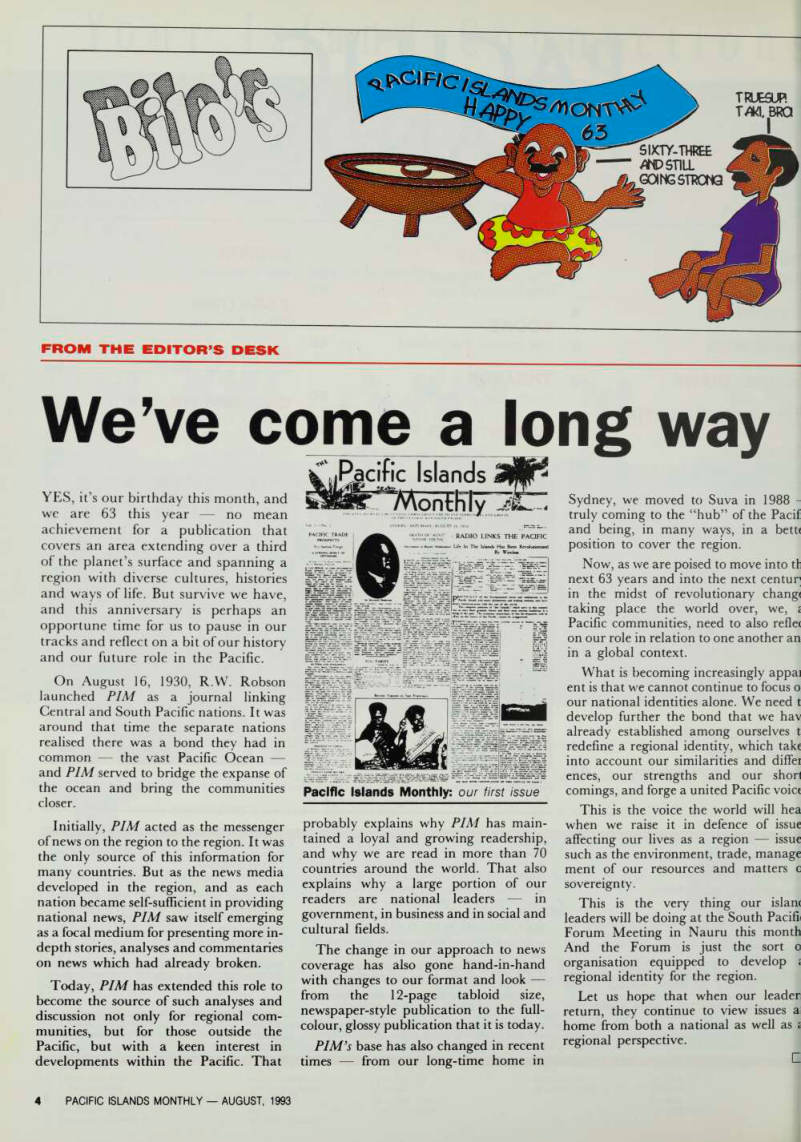
On August 16, 1930, R.W. Robson launched PIM as a journal linking Central and South Pacific nations. It was around that time the separate nations realised there was a bond they had in common the vast Pacific Ocean and PIM served to bridge the expanse of the ocean and bring the communities closer.
Initially, PIM acted as the messenger of news on the region to the region. It was the only source of this information for many countries. But as the news media developed in the region, and as each nation became self-sufficient in providing national news, PIM saw itself emerging as a focal medium for presenting more in depth stories, analyses and commentaries on news which had already broken.
Today, PIM has extended this role to become the source of such analyses and discussion not only for regional com munities, but for those outside the Pacific, but with a keen interest in developments within the Pacific. That
probably explains why PIM has main
tained a loyal and growing readership,
and why we are read in more than 70 countries around the world. That also explains why a large portion of our readers are national leaders in government, in business and in social and cultural fields.
The change in our approach to news coverage has also gone hand-in-hand with changes to our format and look from the 12-page tabloid size, newspaper-style publication to the full colour, glossy publication that it is today.
PlM’s base has also changed in recent times from our long-time home in
Sydney, we moved to Suva in 1988 truly coming to the “hub” of the Pacif and being, in many ways, in a bett( position to cover the region.
Now, as we are poised to move into th next 63 years and into the next centur in the midst of revolutionary chang< taking place the world over, we, < Pacific communities, need to also reflet on our role in relation to one another an in a global context.
What is becoming increasingly appai ent is that we cannot continue to focus o our national identities alone. We need t develop further the bond that we hav already established among ourselves t redefine a regional identity, which take into account our similarities and differ ences, our strengths and our shorl comings, and forge a united Pacific voice This is the voice the world will hea when we raise it in defence of issue affecting our lives as a region issue such as the environment, trade, manage ment of our resources and matters c sovereignty.
This is the very thing our islam leaders will be doing at the South Pacifit Forum Meeting in Nauru this month And the Forum is just the sort o
organisation equipped to develop *
regional identity for the region.
Let us hope that when our leader return, they continue to view issues a home from both a national as well as £ regional perspective.
Pacific Islands Monthly: our first issue