More than 'sports tourists'
pp. 50-51 · Read in the full issue
By Brian Wightman
NOW THAT the Olympic Games are over it is time to evaluate performances of Pacific islanders in Barcelona. Bearing in mind the article in PIM in July, 1992 it should be possible to determine answers to questions aired in that article.
It was at least the second Olympic Games for all participating Pacific countries and the figures indicate the regional countries have taken steps to ensure they are not qualified to be described as “sports tourists”.
This is definitely an improvement on Seoul where most countries sent the six athletes whose expenses were paid by the International Olympic Committee < IOC). We can remember some of those athletes being conspicuous for being lapped in athletics competition and others who were not even allowed to compete because of administrative hic cups.
A total of 80 competitors from the nine Pacific countries American Samoa, Cook Islands, Fiji, Guam, Papua New
Guinea, Solomon Islands, Tonga, Vanu atu, and Western Samoa competed in nine sports.
Pacific competitors were in the top 10 in three sports, were in the top 25 in a couple of athletic events and left behind a person ranked 19th in the world in
another discipline.
A closer look reveals only Fiji, Guam and Papua New Guinea exceeded their quota of six “free” or “paid for”
competitors.
Guam had the largest Pacific team with 22 competitors in eight disciplines which is indicative they have been selective taking only their best per formers in those sports and seeking experience and exposure.
Fiji had only one less competitor overall but only entered four sports. PNG took 16 competitors in five sports enter ing yachting for the first time.
All other countries entered five com petitors or less in one or two sports. It is interesting to note all Pacific countries with the exception of Fiji and Guam entered weight-lifting. These indications that it is the the most popular sport are quite different from the previous olym
pics where athletics and boxing were the] dominant sports.
On this occasion four countries were not represented in athletics and only three entered boxing (although one! withdrew at the last minute). Athletics] was still the sport with the highest] number of participants from the Pacific!
This is probably a result of boxers having to qualify at the Oceania Boxing Tournament held in Apia early this year.
A similar situation in weight-lifting: prevails although countries were able to enter one person who was not qualified which would account for the spread of weight-lifters.
What is of great significance is the administrative aspects of Pacific island attendance.
Every country had its National Olym pic Committee (NOC) president or secretary present in Barcelona in some capacity. Only two presidents and three secretaries did not attend.
This should augur well for the admin-; istrative future of the NOCs in the! region. However, it is perhaps even more surprising to look at the administrative people looking after the teams in the
Olympic Village.
All team managers are members of their country’s NOC executive. They include one president, one past president, one senior vice-president, one assistant secretary and two treasurers.
Included are Senator Mike Reily from Guam and Tevita Tupou, Tongan Minister for Justice. Viliame Saulekaleka Minister of State in Fiji was also part of the Fiji team.
This is all hopefully an indication of the enthusiasm of the leaders of sport in the Pacific and their desire to learn. The experience will certainly be of assistance.
While a couple of countries took media people of their own, it was a luxury most countries could not afford.
Remembering that radio is the fastest media in the Pacific, moves were begun at the Oceania National Olympic Com mittee’s annual meeting in the Cook Islands in May this year to ensure suitable coverage.
Fortunately the Australian Olympic Committee agreed to help the Pacific islands sports administrators and it transpired thanks to the efforts of the islands sports administrators that Brendan Telfer was filing daily reports back to the entire Pacific through Radio Australia.
This is one aspect of aid which is often underestimated or overlooked.
This is perhaps a measure of the administrative competence and aware
ness in the region which is undoubtedly growing.
The top three performers are undoubt edly — Fas Maselino of American Samoa who reached the boxing quarter finals in the 71kg category; Fiji’s Tony Philp who finished 10th in board sailing (Lechner A-390); and Marcus Stephen of Nauru who was competing for Western Samoa and gained ninth place in the 60kg class of weight-lifting.
Maselino reached a similar position in the Seoul Olympics. It was hoped that following his experience on an lOC scholarship in the USA he might im prove his ranking in Barcelona.
Unfortunately he lost a rather doubt ful decision to Mizsei of Hungary in the
quarter final.
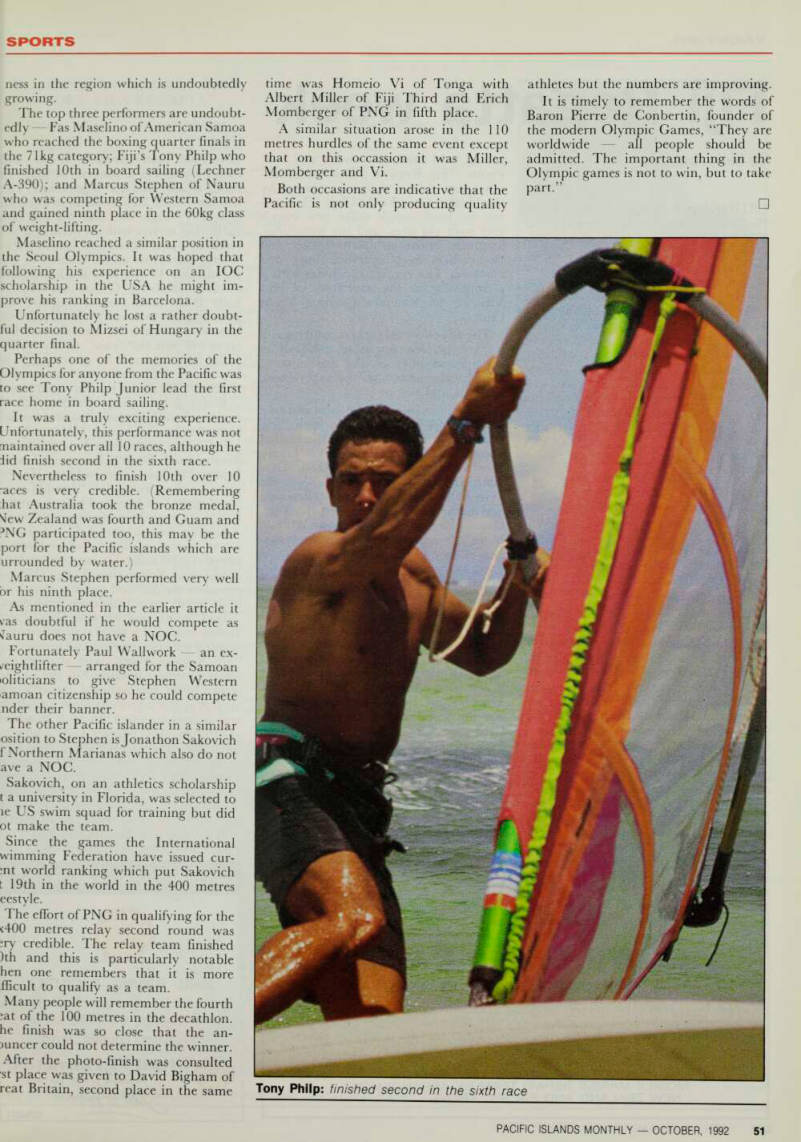
Perhaps one of the memories of the Olympics for anyone from the Pacific was to see Tony Philp Junior lead the first race home in board sailing.
It was a truly exciting experience.
Unfortunately, this performance was not maintained over all 10 races, although he did finish second in the sixth race.
Nevertheless to finish 10th over 10 •aces is very credible. (Remembering hat Australia took the bronze medal, 'lew Zealand was fourth and Guam and -*NG participated too, this may be the port for the Pacific islands which are urrounded by water.) Marcus Stephen performed very well or his ninth place.
As mentioned in the earlier article it vas doubtful if he would compete as tfauru does not have a NOC.
Fortunately Paul Wallwork an ex /eightlifter arranged for the Samoan •oliticians to give Stephen Western amoan citizenship so he could compete nder their banner.
The other Pacific islander in a similar osition to Stephen is Jonathon Sakovich f Northern Marianas which also do not ave a NOC.
Sakovich, on an athletics scholarship t a university in Florida, was selected to ic US swim squad for training but did ot make the team.
Since the games the International wimming Federation have issued cur *nt world ranking which put Sakovich t 19th in the world in the 400 metres eestyle.
The effort of PNG in qualifying for the <4OO metres relay second round was "ry credible. The relay team finished )th and this is particularly notable hen one remembers that it is more fficult to qualify as a team.
Many people will remember the fourth *at of the 100 metres in the decathlon, he finish was so close that the an juncer could not determine the winner.
After the photo-finish was consulted st place was given to David Bigham of reat Britain, second place in the same
time was Homeio Vi of Tonga with Albert Miller of Fiji Third and Erich Momberger of PNG in fifth place.
A similar situation arose in the 110 metres hurdles of the same event except that on this occassion it was Miller, Momberger and Vi.
Both occasions are indicative that the
Pacific is not only producing quality
athletes but the numbers are improving, It is timely to remember the words of Baron Pierre de Conbertin, founder of the modern Olympic Games, “They are worldwide all people should be admitted. The important thing in the Olympic games is not to win, but to take part.” □
Tony Phllp: finished second in the sixth race