Setting an example
p. 36 · Read in the full issue
By George Matai
IT IS FOUR in the morning.
Apia Park is still very dark.
A white four-wheel drive with the World Health Organisation emblem pulls into the parking lot.
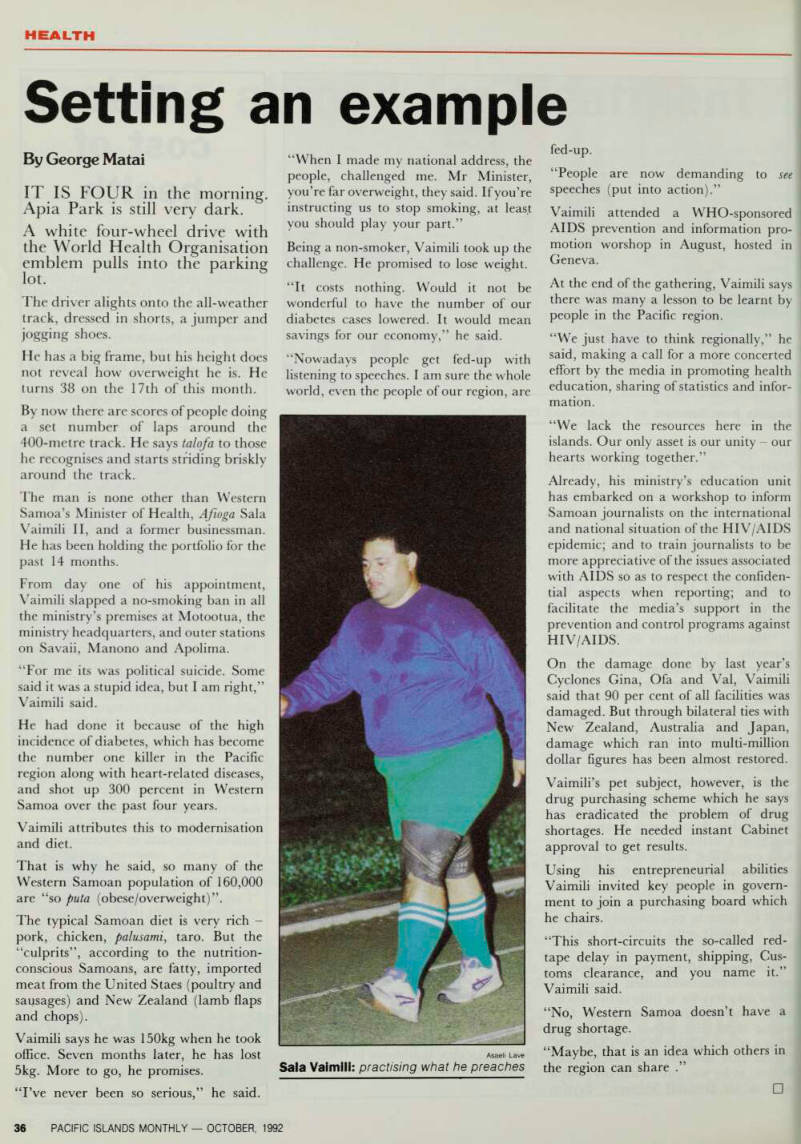
The driver alights onto the all-weather track, dressed in shorts, a jumper and
jogging shoes.
He has a big frame, but his height does not reveal how overweight he is. He turns 38 on the 17th of this month.
By now there are scores of people doing a set number of laps around the 400-metre track. He says talofa to those
he recognises and starts striding briskly
around the track.
The man is none other than Western Samoa’s Minister of Health, Afioga Sala Vaimili 11, and a former businessman.
He has been holding the portfolio for the past 14 months.
From day one of his appointment, Vaimili slapped a no-smoking ban in all the ministry’s premises at Motootua, the ministry headquarters, and outer stations on Savaii, Manono and Apolima.
“For me its was political suicide. Some said it was a stupid idea, but I am right,”
Vaimili said.
He had done it because of the high incidence of diabetes, which has become the number one killer in the Pacific region along with heart-related diseases, and shot up 300 percent in Western Samoa over the past four years.
Vaimili attributes this to modernisation and diet.
That is why he said, so many of the Western Samoan population of 160,000 are “so puta (obese/overweight)”.
The typical Samoan diet is very rich pork, chicken, palusami , taro. But the “culprits”, according to the nutrition conscious Samoans, are fatty, imported meat from the United Staes (poultry and sausages) and New Zealand (lamb flaps
and chops).
Vaimili says he was 150 kg when he took office. Seven months later, he has lost skg. More to go, he promises.
“I’ve never been so serious,” he said.
“When I made my national address, the people, challenged me. Mr Minister, you’re far overweight, they said. If you’re instructing us to stop smoking, at least you should play your part.”
Being a non-smoker, Vaimili took up the challenge. He promised to lose weight.
“It costs nothing. Would it not be wonderful to have the number of our diabetes cases lowered. It would mean savings for our economy,” he said.
“Nowadays people get fed-up with listening to speeches. I am sure the whole world, even the people of our region, are
fed-up.
“People are now demanding to see speeches (put into action).”
Vaimili attended a WHO-sponsored AIDS prevention and information pro motion worshop in August, hosted in Geneva.
At the end of the gathering, Vaimili says there was many a lesson to be learnt by people in the Pacific region.
“We just have to think regionally,” he said, making a call for a more concerted effort by the media in promoting health education, sharing of statistics and infor mation.
“We lack the resources here in the islands. Our only asset is our unity - our hearts working together.”
Already, his ministry’s education unit has embarked on a workshop to inform Samoan journalists on the international and national situation of the HIV/AIDS epidemic; and to train journalists to be more appreciative of the issues associated with AIDS so as to respect the confiden tial aspects when reporting; and to facilitate the media’s support in the prevention and control programs against
Hiv/Aids.
On the damage done by last year’s Cyclones Gina, Ofa and Val, Vaimili said that 90 per cent of all facilities was damaged. But through bilateral ties with New Zealand, Australia and Japan, damage which ran into multi-million dollar figures has been almost restored.
Vaimili’s pet subject, however, is the drug purchasing scheme which he says has eradicated the problem of drug shortages. He needed instant Cabinet approval to get results.
Using his entrepreneurial abilities Vaimili invited key people in govern ment to join a purchasing board which he chairs.
“This short-circuits the so-called red tape delay in payment, shipping, Cus toms clearance, and you name it.”
Vaimili said.
“No, Western Samoa doesn’t have a
drug shortage.
“Maybe, that is an idea which others in the region can share .”
Asaell Lave Sala Vaimili: practising what he preaches