Bougainville on the agenda
p. 15 · Read in the full issue
By lan Williams
OUTSIDE the Pacific, few people have heard of Bougain ville, Papua New Guinea’s troubled province. Many more will now, since the issue was successfully put onto the agenda of the United Nations Human Rights Commission in Geneva this August. The Sub- Commission on the Prevention of Discrimination and Protection of Minorities for the first time adopted a resolution which called on PNG to restore freedom of movement to the inhabitants of Bougainville in the interests of protecting and promoting hu man rights and fundamental freedoms. It also asked the Spe cial Rapporteur on the study of treaties between states and indi genous people to include in his report the case of the agreements between PNG and the indigenous
people of Bougainville.
The sub-commission allows petitioners from human rights arganizations, and in this case
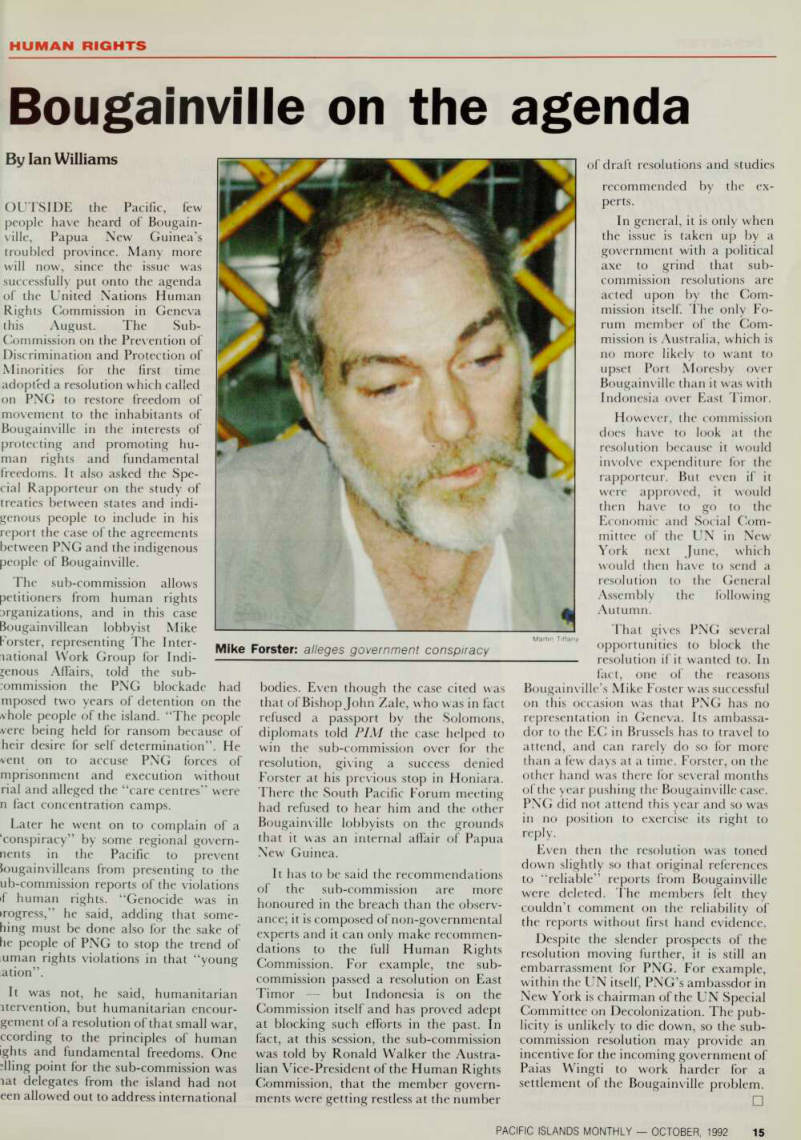
Bougainvillean lobbyist Mike
Forster, representing The Inter lational Work Group for Indi genous Affairs, told the sub
:ommission the PNG blockade had mposed two years of detention on the vhole people of the island. “The people vere being held for ransom because of heir desire for self determination”. He vent on to accuse PNG forces of mprisonment and execution without rial and alleged the “care centres” were n fact concentration camps.
Later he went on to complain of a ‘conspiracy” by some regional govern nents in the Pacific to prevent lougainvilleans from presenting to the ub-commission reports of the violations if human rights. “Genocide was in trogress,” he said, adding that some hing must be done also for the sake of he people of PNG to stop the trend of uman rights violations in that “young ation”.
It was not, he said, humanitarian itervention, but humanitarian encour gement of a resolution of that small war, ccording to the principles of human ights and fundamental freedoms. One dling point for the sub-commission was lat delegates from the island had not een allowed out to address international
bodies. Even though the case cited was that of Bishop John Zale, who w as in fact refused a passport by the Solomons, diplomats told PIM the case helped to win the sub-commission over for the resolution, giving a success denied Forster at his previous stop in Honiara.
There the South Pacific Forum meeting had refused to hear him and the other Bougainville lobbyists on the grounds that it was an internal affair of Papua New Guinea.
It has to be said the recommendations of the sub-commission are more honoured in the breach than the observ ance; it is composed of non-governmental experts and it can only make recommen dations to the full Human Rights Commission. For example, tne sub commission passed a resolution on East Timor but Indonesia is on the Commission itself and has proved adept at blocking such efforts in the past. In fact, at this session, the sub-commission was told by Ronald Walker the Austra lian Vice-President of the Human Rights Commission, that the member govern ments were getting restless at the number
of draft resolutions and studies recommended by the ex perts.
In general, it is only when the issue is taken up by a government with a political axe to grind that sub commission resolutions are acted upon by the Com mission itself. The only Fo rum member of the Com mission is Australia, which is no more likely to want to upset Port Moresby over Bougainville than it was with Indonesia over East Timor.
However, the commission does have to look at the resolution because it would involve expenditure for the rapporteur. But even if it were approved, it would then have to go to the Economic and Social Com mittee of the UN in New York next June, which would then have to send a resolution to the General Assembly the following Autumn.
That gives PNG several opportunities to block the resolution if it wanted to. In fact, one of the reasons
Bougainville’s Mike Foster was successful on this occasion was that PNG has no representation in Geneva. Its ambassa dor to the EC in Brussels has to travel to attend, and can rarely do so for more than a few days at a time. Forster, on the other hand was there for several months °f the Y ear pushing the Bougainville case, PNG did not attend this year and so was in no position to exercise its right to re P T Even then the resolution was toned
m “rehable” reVom hTlucamv^
wer/ltL/X^bers^lh'They 6
couldn’t comment on the reliability of the reports without first hand evidence, Des^ite the slender DrosDerts of thp resolution moving further it is still an res ° lutlon moving further, it. is still an embarrassment for PNG. For example, within the UN itself, PNG’s ambassdor in New York is chairman of the UN Special Committee on Decolonization. The pub licity is unlikely to die down, so the sub commission resolution may provide an incentive for the incoming government of Paias Wingti to work harder for a settlement of the Bougainville problem, □
Mike Forster: alleges government conspiracy