Is health beyond our reach?
From The Editor’S Desk
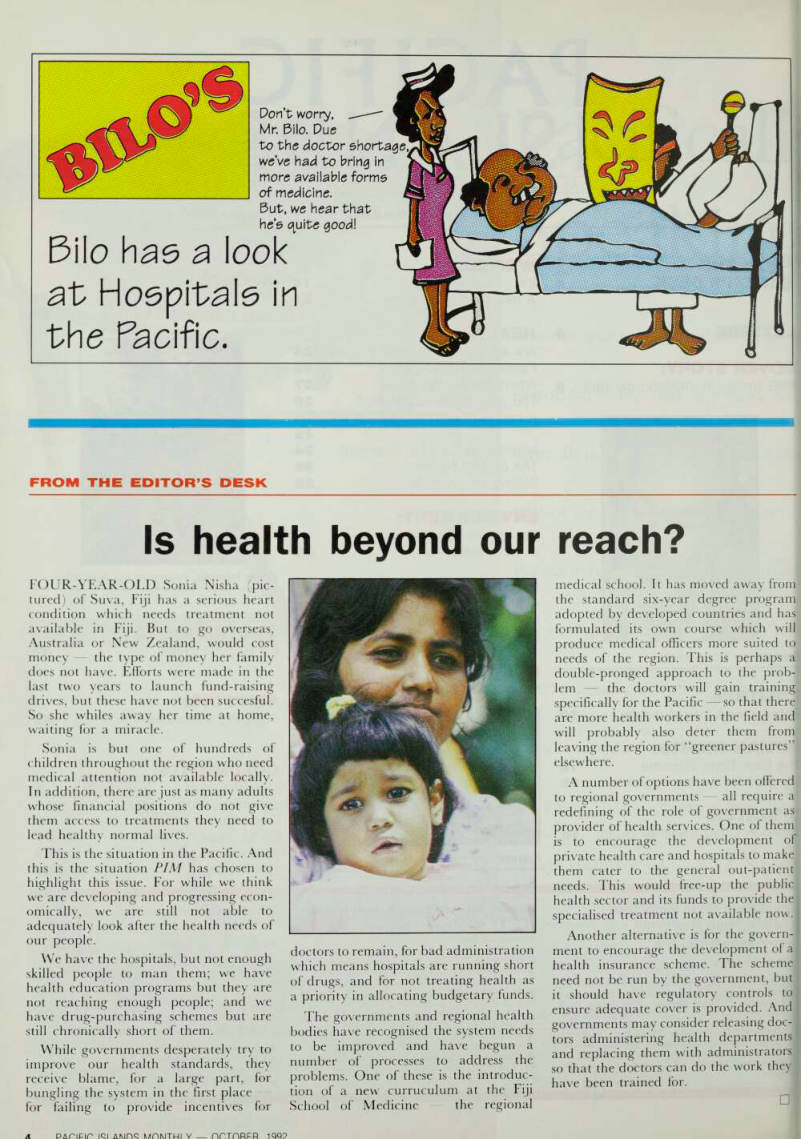
POUR-YEAR-OLD Sonia Nisha (pic tured) of Suva, Fiji has a serious heart condition which needs treatment not available in Fiji. But to go overseas, Australia or New Zealand, would cost money the type of money her family does not have. Efforts were made in the last two years to launch fund-raising drives, but these have not been succesful.
So she whiles away her time at home, waiting for a miracle.
Sonia is but one of hundreds of children throughout the region who need medical attention not available locally.
In addition, there are just as many adults whose financial positions do not give them access to treatments they need to lead healthy normal lives.
This is the situation in the Pacific. And this is the situation PIM has chosen to highlight this issue. For while we think we are developing and progressing econ omically, we are still not able to adequately look after the health needs of
our people.
We have the hospitals, but not enough skilled people to man them; we have health education programs but they are
not reaching enough people; and we
have drug-purchasing schemes but are still chronically short of them.
While governments desperately try to improve our health standards, they receive blame, for a large part, for bungling the system in the first place for failing to provide incentives for
doctors to remain, for bad administration which means hospitals are running short of drugs, and for not treating health as
a priority in allocating budgetary funds.
The governments and regional health bodies have recognised the system needs to be improved and have begun a number of processes to address the problems. One of these is the introduc tion of a new curruculum at the Fiji School of Medicine the regional
medical school. It has moved away from I the standard six-year degree program adopted by developed countries and has! formulated its own course which will produce medical officers more suited to needs of the region. This is perhaps a double-pronged approach to the prob-” lem the doctors will gain training specifically for the Pacific so that there are more health workers in the field and will probably also deter them from leaving the region for “greener pastures”! elsewhere.
A number of options have been offered to regional governments all require a redefining of the role of government asr provider of health services. One of them is to encourage the development of private health care and hospitals to makejj them cater to the general out-patient ; needs. This would free-up the public i health sector and its funds to provide the specialised treatment not available now. 1 Another alternative is for the govern-1 ment to encourage the development of a! health insurance scheme. The scheme] need not be run by the government, but < it should have regulatory controls to ensure adequate cover is provided. And! governments may consider releasing doc-1 tors administering health departments I and replacing them with administrators I so that the doctors can do the work they have been trained for.