of solving the
p. 53 · Read in the full issue
The Region
On the verge of solving the Earhart mystery
By David North
rHEY went to Nikumaroro last year hoping to find the wreck of Amelia Earhart’s plane. They thought it would be in the waters r the Kiribati islands.
They came back with 10 pounds or so ‘aluminium aircraft debris, which they e now “90 per cent” sure came from *r ill-fated trip around the world in 137.
Earhart, the first woman to fly across e Atlantic Ocean and the first female make the crossing alone, disappeared the Pacific in 1937 with co-pilot ederick Noonan.
The International Group for Historic rcraft Recovery (TIGHAR) said the ?ces of wreckage had several features lich indicated it could have come from rhart’s Lockheed Electra 10.
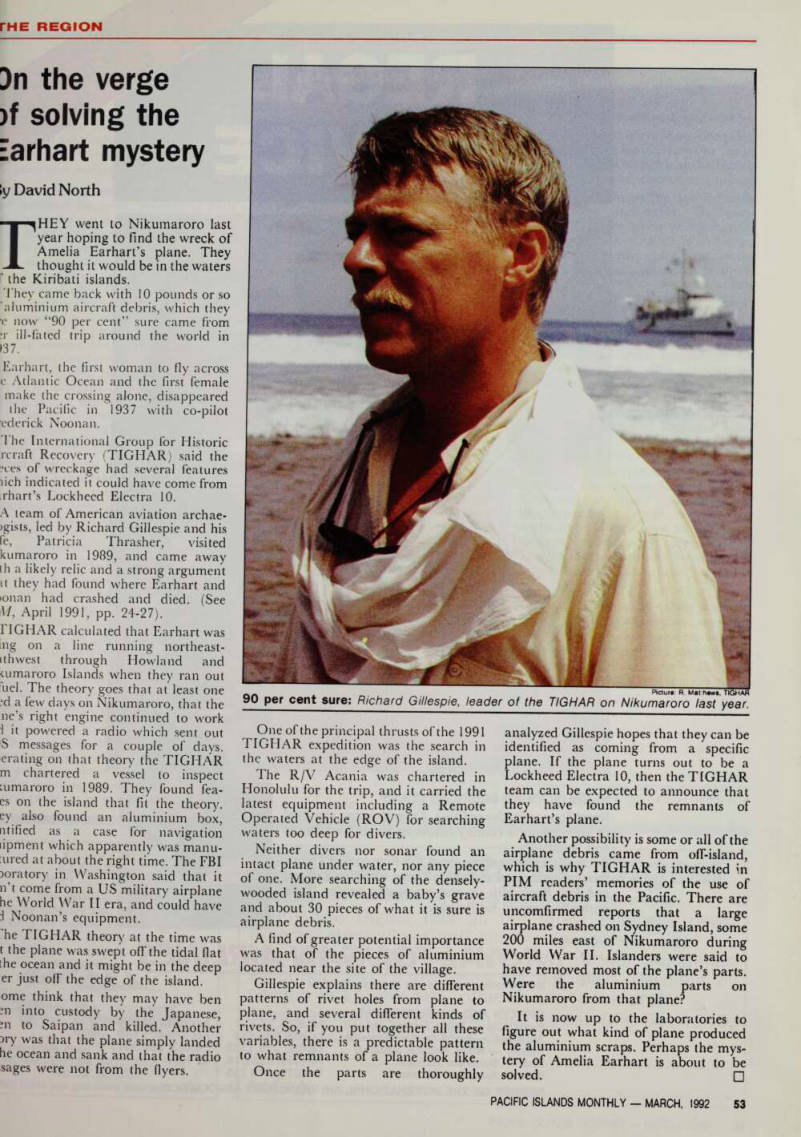
A team of American aviation archae )gists, led by Richard Gillespie and his fe, Patricia Thrasher, visited kumaroro in 1989, and came away th a likely relic and a strong argument it they had found where Earhart and •onan had crashed and died. (See M, April 1991, pp. 24-27).
LIGHAR calculated that Earhart was ing on a line running northeast ithwest through Howland and aimaroro Islands when they ran out ucl. The theory goes that at least one *1 a few days on Nikumaroro, that the ne’s right engine continued to work f it powered a radio which sent out S messages for a couple of days, crating on that theory the TIGHAR m chartered a vessel to inspect mmaroro in 1989. They found fea es on the island that fit the theory, cy also found an aluminium box, ii tilled as a case for navigation lipment which apparently was manu ured at about the right time. The FBI moratory in Washington said that it n t come from a US military airplane he World War II era, and could have I Noonan’s equipment.
'he TIGHAR theory at the time was t the plane was swept off the tidal flat the ocean and it might be in the deep er just off the edge of the island, ome think that they may have ben - n into custody by the Japanese, -n to Saipan and' killed. Another }ry was that the plane simply landed he ocean and sank and that the radio sages were not from the flyers.
One of the principal thrusts of the 1991 TIGHAR expedition was the search in the waters at the edge of the island.
The R/V Acania was chartered in Honolulu for the trip, and it carried the latest equipment including a Remote Operated Vehicle (ROV) for searching waters too deep for divers.
Neither divers nor sonar found an intact plane under water, nor any piece of one. More searching of the densely wooded island revealed a baby’s grave and about 30 pieces of what it is sure is airplane debris.
A find of greater potential importance was that of the pieces of aluminium located near the site of the village.
Gillespie explains there are different patterns of rivet holes from plane to plane, and several different kinds of rivets. So, if you put together all these variables, there is a predictable pattern to what remnants of a plane look like.
Once the parts are thoroughly
analyzed Gillespie hopes that they can be identified as coming from a specific plane. If the plane turns out to be a Lockheed Electra 10, then theTIGHAR team can be expected to announce that they have found the remnants of Earhart’s plane.
Another possibility is some or all of the airplane debris came from off-island, which is why TIGHAR is interested in PIM readers’ memories of the use of aircraft debris in the Pacific. There are uncomfirmed reports that a large airplane crashed on Sydney Island, some 200 miles east of Nikumaroro during World War 11. Islanders were said to have removed most of the plane’s parts.
Were the aluminium parts on Nikumaroro from that plane?
It is now up to the laboratories to figure out what kind of plane produced the aluminium scraps. Perhaps the mys tery of Amelia Earhart is about to be solved. □
Picture R. Mat[?]hews. TIGHAR 90 per cent sure: Richard Gillespie, leader of the TIGHAR on Nikumaroro last year.