Days of handouts are numbered
p. 49 · Read in the full issue
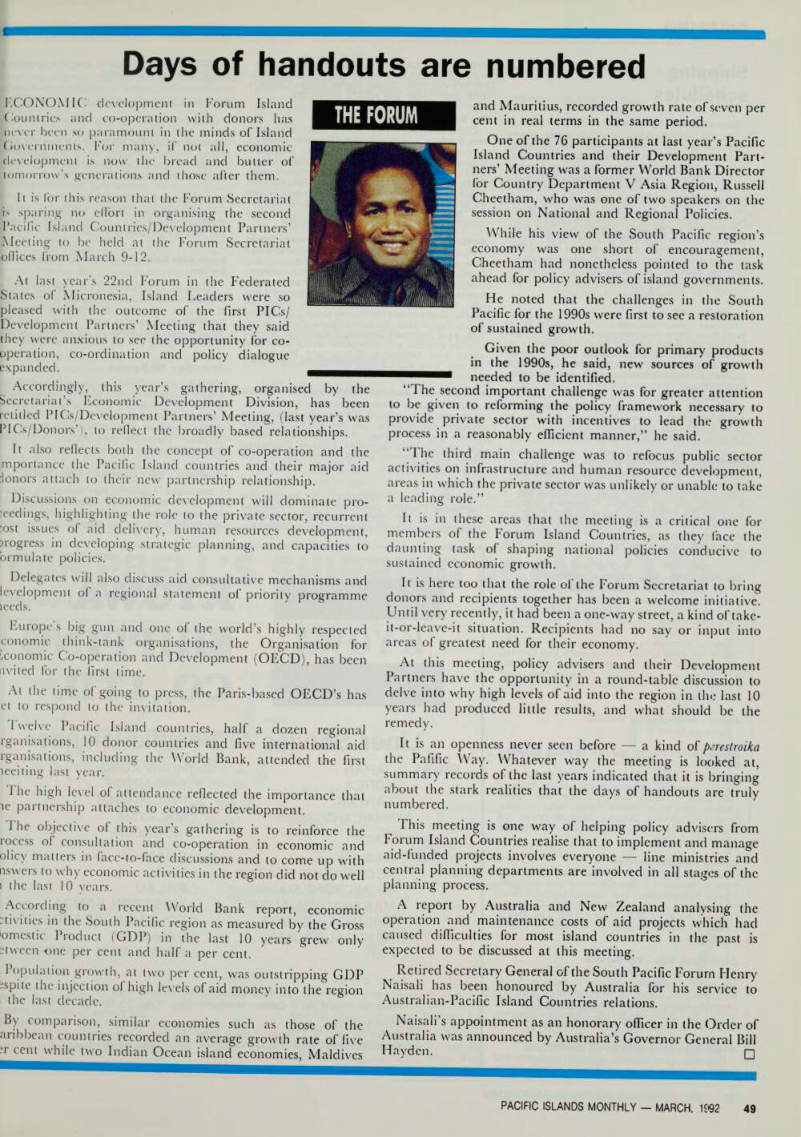
ECONOMIC development in Forum Island Countries and co-operation with donors has never been so paramount in the minds of Island Governments. For many, if not all, economic development is now the bread and butter of tomorrow’s generations and those after them.
It is lor this reason that the Forum Secretariat is sparing no effort in organising the second Pacific Island Countrics/Development Partners’
Meeting to be held at (he Forum Secretariat offices from March 9-12.
At last year’s 22nd Forum in the Federated States of Micronesia, Island Leaders were so pleased with the outcome of the first PICs/ Development Partners’ Meeting that they said they were anxious to see the opportunity for co operation, co-ordination and policy dialogue expanded.
Accordingly, this year’s gathering, organised by the Secretariat’s Economic Development Division, has been re titled PICs/Development Partners’ Meeting, (last year’s was PICs/Donors’), to reflect the broadly based relationships.
It also reflects both the concept of co-operation and the mportance the Pacific Island countries and their major aid lonors attach to their new partnership relationship.
Discussions on economic development will dominate pro reedings, highlighting the role to the private sector, recurrent :ost issues of aid delivery, human resources development, progress in developing strategic planning, and capacities to
brmulatc policies.
Delegates will also discuss aid consultative mechanisms and levelopment of a regional statement of priority programme Leeds.
Europe s big gun and one of the world’s highly respected conomic think-tank organisations, the Organisation for economic Co-operation and Development (OECD), has been nvited for the first time.
At the time of going to press, the Paris-based OECD’s has et to respond to the invitation. iwelve Pacific Island countries, half a dozen regional rganisations, 10 donor countries and five international aid rganisations, including the World Bank, attended the first leeiting last year.
The high level of attendance reflected the importance that
le partnership attaches to economic development.
The objective of this year’s gathering is to reinforce the rocess of consultation and co-operation in economic and olicy matters in face-to-face discussions and to come up with nswers to why economic activities in the region did not do well i the last 10 years.
According to a recent World Bank report, economic rtivi ties in the South Pacific region as measured by the Gross omcstic Product (GDP) in the last 10 years grew only e tween one per cent and half a per cent. 1 opulalion growth, at two per cent, was outstripping GDP _spi te the injection of high levels of aid money into the region the last decade.
By comparison, similar economies such as those of the an bbean countries recorded an average growth rate of five -i cent while two Indian Ocean island economies, Maldives
The Forum
and Mauritius, recorded growth rate of seven per cent in real terms in the same period.
One of the 76 participants at last year’s Pacific Island Countries and their Development Part ners’ Meeting was a former World Bank Director for Country Department V Asia Region, Russell Cheetham, who was one of two speakers on the session on National and Regional Policies.
While his view of the South Pacific region’s economy was one short of encouragement, Cheetham had nonetheless pointed to the task ahead for policy advisers of island governments.
He noted that the challenges in the South Pacific for the 1990 s were first to see a restoration of sustained growth.
Given the poor outlook for primary products in the 19905, he said, new sources of growth needed to be identified.
“The second important challenge was for greater attention to be given to reforming the policy framework necessary to provide private sector with incentives to lead the growth process in a reasonably efficient manner,” he said.
“The third main challenge was to refocus public sector activities on infrastructure and human resource development, areas in which the private sector was unlikely or unable to take a leading role.”
It is in these areas that the meeting is a critical one for members of the Forum Island Countries, as they face the daunting task of shaping national policies conducive to sustained economic growth.
It is here too that the role of the Forum Secretariat to bring donors and recipients together has been a welcome initiative.
Until very recently, it had been a one-way street, a kind of take it-or-leave-it situation. Recipients had no say or input into areas of greatest need for their economy.
At this meeting, policy advisers and their Development Partners have the opportunity in a round-table discussion to delve into why high levels of aid into the region in the last 10 years had produced little results, and what should be the remedy.
It is an openness never seen before a kind o tperestroika the Pafific Way. Whatever way the meeting is looked at, summary records of the last years indicated that it is bringing about the stark realities that the days of handouts are truly numbered.
This meeting is one way of helping policy advisers from Forum Island Countries realise that to implement and manage aid-funded projects involves everyone line ministries and central planning departments are involved in all stages of the planning process.
A report by Australia and New Zealand analysing the operation and maintenance costs of aid projects which had caused difficulties for most island countries in the past is expected to be discussed at this meeting.
Retired Secretary General of the South Pacific Forurn Henry Naisali has been honoured by Australia for his service to Australian-Pacific Island Countries relations.
Naisali s appointment as an honorary officer in the Order of Australia was announced by Australia’s Governor General Bill Hayden. n