for Fijian
pp. 42-43 · Read in the full issue
Big slice for Fijian Holdings
By Martin Tiffany
TWO things that will stick in your mind after visiting Sitiveni Weleilakeba in his office are the view and cake.
The view is magnificent and is the first thing to catch your eye, as you step into his eighth floor office in Suva’s Ratu Sukuna House and look 180 degrees over the city and out to sea. The cake, or at least the image of one, is used as he describes a variety of things.
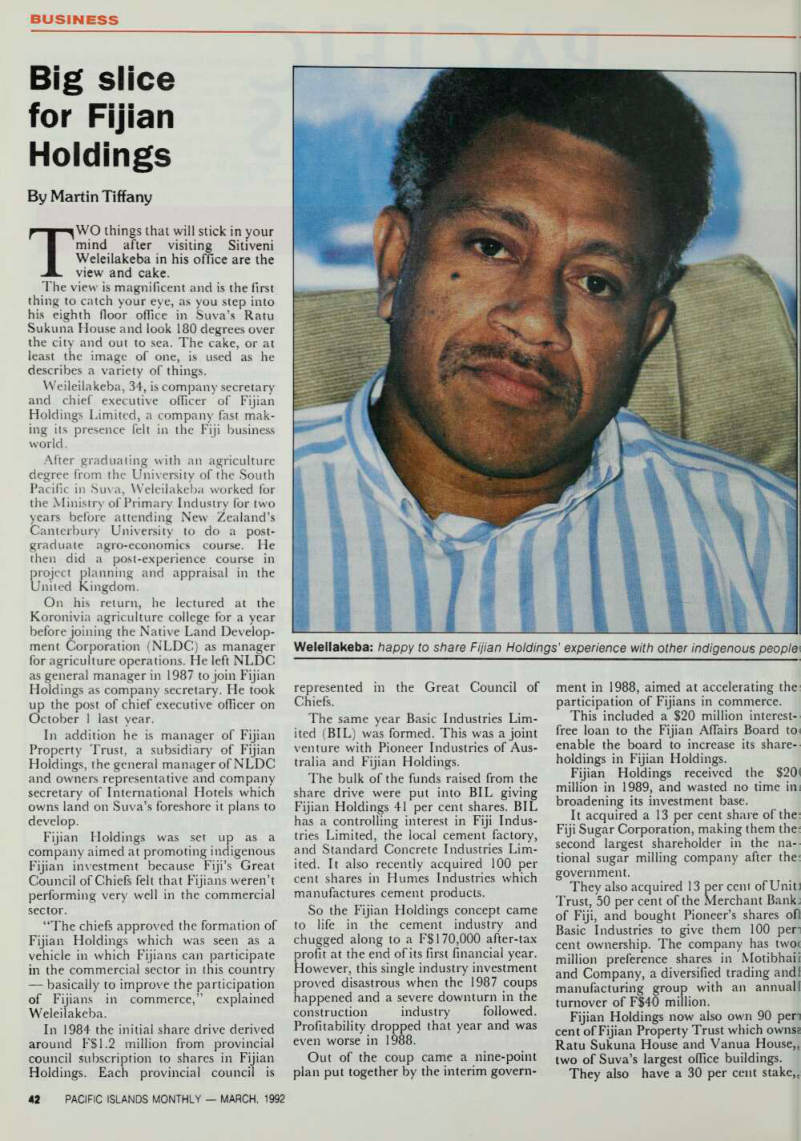
Weileilakeba, 34, is company secretary and chief executive officer of Fijian Holdings Limited, a company fast mak ing its presence felt in the Fiji business world.
After graduating with an agriculture degree from the University of the South Pacific in Suva, Weleilakeba worked for the Ministry of Primary Industry for two years before attending New Zealand’s Canterbury University to do a post graduate agro-economics course. He then did a post-experience course in project planning and appraisal in the United Kingdom.
On his return, he lectured at the Koronivia agriculture college for a year before joining the Native Land Develop ment Corporation (NLDC) as manager for agriculture operations. He left NLDC as general manager in 1987 to join Fijian Holdings as company secretary. He took up the post of chief executive officer on October 1 last year.
In addition he is manager of Fijian Property Trust, a subsidiary of Fijian Holdings, the general manager of NLDC and owners representative and company secretary of International Hotels which owns land on Suva’s foreshore it plans to
develop.
Fijian Holdings was set up as a company aimed at promoting indigenous Fijian investment because Fiji’s Great Council of Chiefs felt that Fijians weren’t performing very well in the commercial sector.
“The chiefs approved the formation of Fijian Holdings which was seen as a vehicle in which Fijians can participate in the commercial sector in this country basically to improve the participation of Fijians in commerce,” explained Weleilakeba.
In 1984 the initial share drive derived around FSI.2 million from provincial council subscription to shares in Fijian Holdings. Each provincial council is
represented in the Great Council of Chiefs.
The same year Basic Industries Lim ited (BIL) was formed. This was a joint venture with Pioneer Industries of Aus
tralia and Fijian Holdings.
The bulk of the funds raised from the share drive were put into BIL giving Fijian Holdings 41 per cent shares. BIL has a controlling interest in Fiji Indus tries Limited, the local cement factory, and Standard Concrete Industries Lim ited. It also recently acquired 100 per cent shares in Humes Industries which manufactures cement products.
So the Fijian Holdings concept came to life in the cement industry and chugged along to a F$ 170,000 after-tax profit at the end of its first financial year.
However, this single industry investment proved disastrous when the 1987 coups happened and a severe downturn in the construction industry followed.
Profitability dropped that year and was even worse in 1988.
Out of the coup came a nine-point plan put together by the interim govern
ment in 1988, aimed at accelerating the; participation of Fijians in commerce.
This included a $2O million interest free loan to the Fijian Affairs Board to< enable the board to increase its share holdings in Fijian Holdings.
Fijian Holdings received the $2O( million in 1989, and wasted no time ini broadening its investment base.
It acquired a 13 per cent share of the;
Fiji Sugar Corporation, making them the;
second largest shareholder in the na tional sugar milling company after the; government.
They also acquired 13 per cent of Unit j Trust, 50 per cent of the Merchant Bank, of Fiji, and bought Pioneer’s shares ofl Basic Industries to give them 100 pen cent ownership. The company has twoc million preference shares in Motibhaii and Company, a diversified trading and! manufacturing group with an annual I turnover of Fs4o million.
Fijian Holdings now also own 90 pen cent of Fijian Property Trust which ownsz Ratu Sukuna House and Vanua House,* two of Suva’s largest office buildings.
They also have a3O per cent stake,*
Welellakeba: happy to share Fijian Holdings' experience with other indigenous peoples
worth F 53.6 million, in Fiji’s only brewery Carlton Brewery (Fiji) Lim ited; and F 53,000,001 (30.1 percent) of Carpenters Properties Limited (they intend to acquire another 20 per cent this
pear).
“A $2O million deal (with the
Carpenter Group of Companies and the
Fiji Development Bank (FBD)) enabled us to get 30 per cent of the cake,” explained Weleilakeba.
Fijian Holdings intend to acquire FDB
ihares of Carpenters Properties by June,
living them 50.1 per cent shares and naking it their subsidiary. The FDB mys the shares and holds them in trust or Fijian Holdings until they have the linds to acquire them.
The $2O million injection in 1989 has nit Fijian Holdings on firmer footing, vith a broader and diversified base. As iVelcilakeba says: “In investment you lave to spread your cake a bit.”
This spread slowly began paying off vith a F 5900,000 after-tax profit in 1989 vhich jumped to an after-tax profit of r 52.6 million at the end of the last inancial year on June 30, 1991.
Veleilakeba says that this year they iroject an after-tax profit of $2.8 to $3 nillion.
“Our return on our investment is bout 11 to 12 per cent, so we are not loing too badly. We have very good eturns, basically all the companies we iivest in are blue chip very strong and hey offer very good potential for growth ii terms of profitability this is always ur criteria.”
Recently, however, Weleilakeba said hey saw that the “fruits of the cake were ot being shared by the wide cross ection of the Fijian community”.
So last year, through the sanction of he Great Council of Chiefs, the Fijian loldings board of directors approved hares to be opened up to Fijian idividuals, tikina (district) councils and
wholly-owned Fijian companies.
Weleilakeba said they wanted to filter he success right down to the Fijian on he street.
Now Weleilakeba says it will be hard i level criticism at the company, because
a lot of individuals are coming to buy shares and “to enjoy the fruit you have to be part of the company”.
The concept behind Fijian Holdings is unique among indigenous Pacific Island ers, and Weleilakeba says he is willing to advise and share his experience with any Pacific country interested in setting up something similar. He has already met with Kanak leaders who expressed inter est in the company.
The basic idea, said Weleilakeba, is for the people to collectively pool their resources, because on their own they will find it difficult to break into business.
According to Weleilakeba, the con tinued success of the company depends on the type of assistance government provides and the ability of Fijian Hold ings to identify potentially profitable
investment proposals, particularly
businesses.
However, he said that in future they may have difficulty investing their money because of their very strict investment criteria.
“For this year I have a substantial investment program, but the year after next we may be struggling to find good investment.”
Weleilakeba said this may force them to change their policy, which could see the company participating in new proj ects and looking at areas that are considered risky. But he said that their solid base should allow them to play with more risky ventures.
Asked what Fijian Holdings was worth, Weleilakeba said his portfolio was about Fs24 million but the value of the company on net asset per share is “far greater”.
He said although they sold shares for SI to motivate Fijians to participate in the company, the value of each share was almost double that. For every dollar invested you also got a dividend of 20 cents. He encouraged all Fijians who “have some cash hidden away to partici pate as there is a lot of money to be
made”. Fijian Holdings is proving that
you can have your cake and eat it or, as Weleilakeba says: “we have the cake, all we have to do now is put the cream on it”. □