Mix and match to build a bridge
pp. 39-40 · Read in the full issue

By Liz Thompson
Australian Department for the Arts and the University of Adelaide. In 1975 it was integrated into the faculty of music at the university of Adelaide.
CASM is part of a growing face of
Aboriginal musical organisation.
AbMucic in Perth is a well established school, Broome Musicians is well known, and numerous bands have emerged from the Northern Territory.
A new music has developed within the urban Aboriginal community. It’s often difficult to transcribe traditional sounds to modern instruments, and much of the music related to Dreamtime and special events not to be recorded.
Whilst maintaining a link with tra ditional sound, many of the musicians producing comtemporary music are describing contemporary situations.
Their environment and lifestyles have changed. Whilst elements of traditional rhythm may be utilised in a modern context, many of the lyrics are highly politicised and often deal with land rights and social issues affecting the community today.
Yothu Vindi, currently one of the
highest profile Aboriginal bands in
Australia, has done exactly this. Recently returned from touring New Zealand and the United States, their performances include traditional songs and dances
Billy Mungie, a senior lecturer at the college, has a dark and deeply lined face, full of character. He, along with a handful of others, has been instrumental in establishing the teaching methods to which CASM adheres. Its principles are based on relieving students of the inaccessibility of alien western teaching curriculums which stress theory and the reading of music, and use traditional methods of teaching in conjunction with these.
Teaching at CASM takes account of the oral and aesthetic tradition of Aboriginal culture and their importance within education. By using instruction which encourages careful listening and the imitation of sound with minimal use of written instruction, they try to emulate traditional methods. It’s a revolutionary and extremely innovative institution, and has been the starting point for many of the country’s leading Aboriginal bands.
Initially a research unit set up in 1969 as a result of research by ethnomusicologist Cath Ellis, CASM was officially formed in 1972. It was funded by the Aboriginal Arts Board, the South
BILLY Mungie, a tribal elder from Pitjantjatjara, is singing into the microphone, eyes closed and hands clapping. The rep etition of words and unchanging beat lave a hypnotic effect.
Others join, clapping and chanting, hose stumbling with the words carried )y the strength of others’ voices. There s a euphoria produced through the )bvious enjoyment of the musicians hemselves.
Whilst predominantly Aboriginal here are a few white tutors at the Centre or Aboriginal Studies in Music (CASM) n North Adelaide. The creativity which akes place between them and the tudents hints at the great potential nusic has in functioning as a bridge in cross-cultural communication.
Whilst using contemporary instru ments and influences the students also lave continual exposure to tribal hythms and vocal sounds through the caching of the tribal elders specially mployed within CASM.
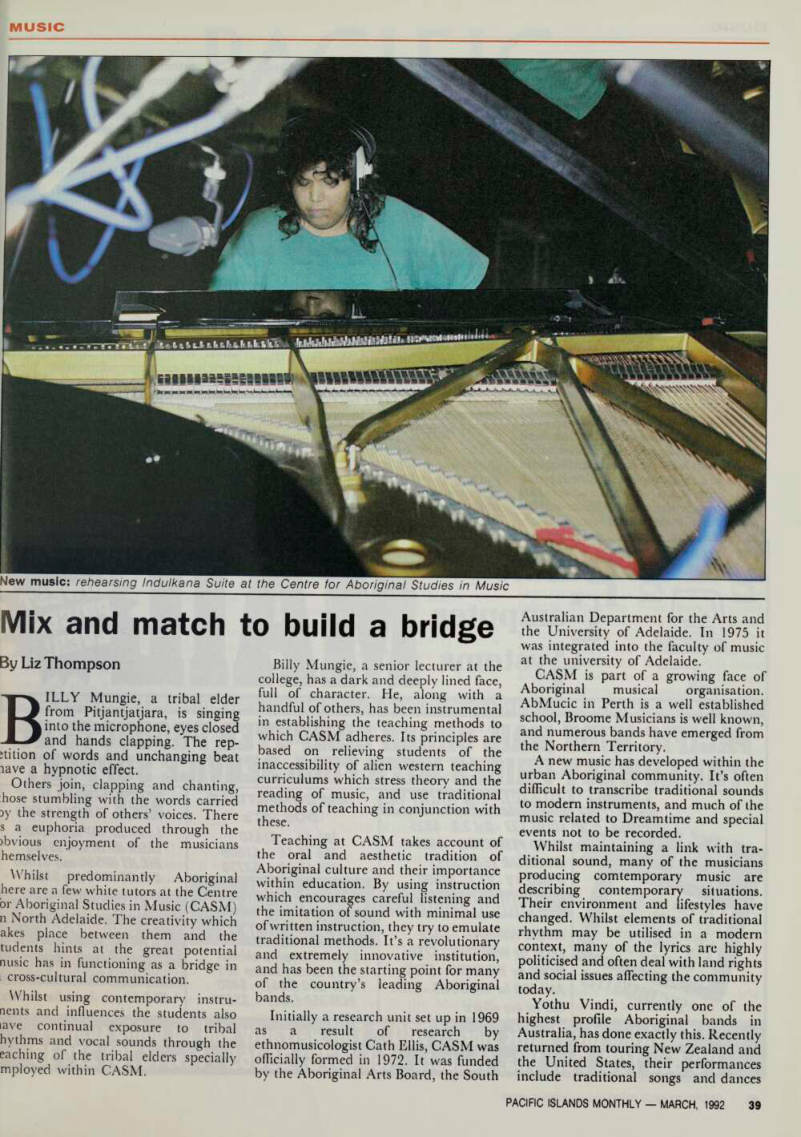
New music: rehearsing Indulkana Suite at the Centre for Aboriginal Studies in Music
accompanied by an electrical rock sound, mixing drums and guitars with the Yidaki (didgeridoo). The name of the band, formed in 1986, means “Mother and Child” or “Children of the Earth”.
Since then they’ve been acclaimed at the 1988 South Pacific Arts Festival, and at Darwin’s inaugural Festival of Aborig inal Rock Music. They’ve toured in North America and represented Austra lia at the Cultural Olympics in South Korea in 1988.
Mundawuy Yunupingue, the band’s
lead singer, says all his music is derived from a traditional understanding. “I want my music to give others an understanding of Aboriginal life. In setting up this band my objective has been to try to combine together the music of the past with the music of the future. Everything is centred on tra ditional music, the rhythm and the beat.
We’re trying to bring about an indigen ous rhythm,” he says.
This is an interesting concept a unique, Australian sound drawing from the sound of indigenous music and bands like Yothu Yindi are experimenting with it. There’s an extraordinary incongruity when Yunupingue in jeans and a t-shirt plays bass, the drums beat in the background and two dancers in body
paint thrust spears, play clapsticks and
didgeridoo. Incongruous but fascinating.
Lima Nyi: Nyi , produced by CASM and performed at the Adelaide Univer sity in the 19705, was a superb example of this juxtaposition and exemplary of CASM’s aims. One of a traditional Dreaming series, it was adapted to celebrate the tribal elders having taken on the responsibility of teaching music to non-Aboriginal students as well as the traditional teaching of their own chil dren.
Lima, using traditional and contem porary instruments as well as voices, is a song which describes events in the travels of a large group of birds at the beginning of birds. These Nyi:Nyi:, having inter changeable human and bird character istics, set out from a place called Kuituwa in the corner of South Australia. The Lima Nyi.'Nyi is a song generally taught to children and the purpose, according to the elders, was so that we may learn to listen more carefully to the important aspects of their culture.
They believed that the teaching of children’s songs was most suitable to Europeans who had a very limited knowledge of their music. Incorporating traditional and contemporary sound, the Indulkana suite as it became known, was
an educational tool as well as an extremely innovative piece of music, forging old and new.
Whether it be in pieces of this nature, designed by the traditional elders within an urban music college, or contemporary bands such as Kuckles, Warupi Band, No Fixed Address and Yothu Yindi, who have all gained wide popularity, there is
an increasing and exciting amalga
mation of old and new sounds, using traditional and contemporary instru ments.
Institutions like CASM, which have been the starting point for many of the major Aboriginal bands, are committed to designing a new kind of music. Their teaching methods are about forging a link between the past and the future in
which Aboriginal and non-Aboriginal
musicians exchange information. Whilst learning from one another, Australia is coming up with its first uniquely Austra lian sound.
The incorporation of indigenous sound is a far cry from appropriated European sound, and it’s refreshing to find that Australia is establishing the beginnings of a musical identity of its own and that a lot of it is coming from an ancient tradition. □