Where the money goes
pp. 13-14 · Read in the full issue
By Davendra Sharma
HOW are wealth from CRA’s mines distributed? Bougainville yields a good illustration.
CRA reckons PNG received a fair return for the sale of important natural resources, through which mining has been a major engine driving the export-driven economy. Some landowner groups question how the PNG government’s share of the income was divided between those immediately affected by the operation and the rest.
Mining analysts in Australia say it wasn’t so much the hatred against CRA, but largely government’s unwillingness to adequately redistribute earnings from the mine to Bougainvilleans that lengthened the crisis" into a secession movement. u i .• . a Dow much did CRA give for two decades of copper and gold mining on
Bougainville?
, n ... CRA s Bougainville accounts offer one theory; landowners got a meagre 1.4 per cent or k 24,2 million of the cash generated from Panguna operations between 1972-89. The national government took 61.5 per cent (k 1078.4 million), North Solomons provincial goveminent 4.3 per cent (k 75.2 million), CRA 22 per cent (k 387 million) and
other public shareholders 10.8 per cent (k 190 million).
CRA owns 53.6 per cent of Bougain ville Copper Ltd, while government has 19.1 per cent. Until its cessation of operations, the mine produced 3.1 mil lion tonnes of copper, 306 tonnes of gold, and 783 tonnes of silver. The production had a value of k 5.1 billion, representing 44 per cent of PNG’s exports over that period. During this time contributions to the government in the form of dividends, taxes and royalties amounted to k 1078 million, which represented 17 per cent of locally-generated revenue for the govern ment. Since the crisis on Bougainville grew in late 1988 with attacks by militants on BCL’s property, much has been raised about the company’s hand ling of sensif've issues like environment and demands of klO billion compen sation from landowners.
CRA argues its case differently. As a pioneer Australian mining company to enter PNG before Independence, it set new standards of conduct for mining in
an underdeveloped country issuing
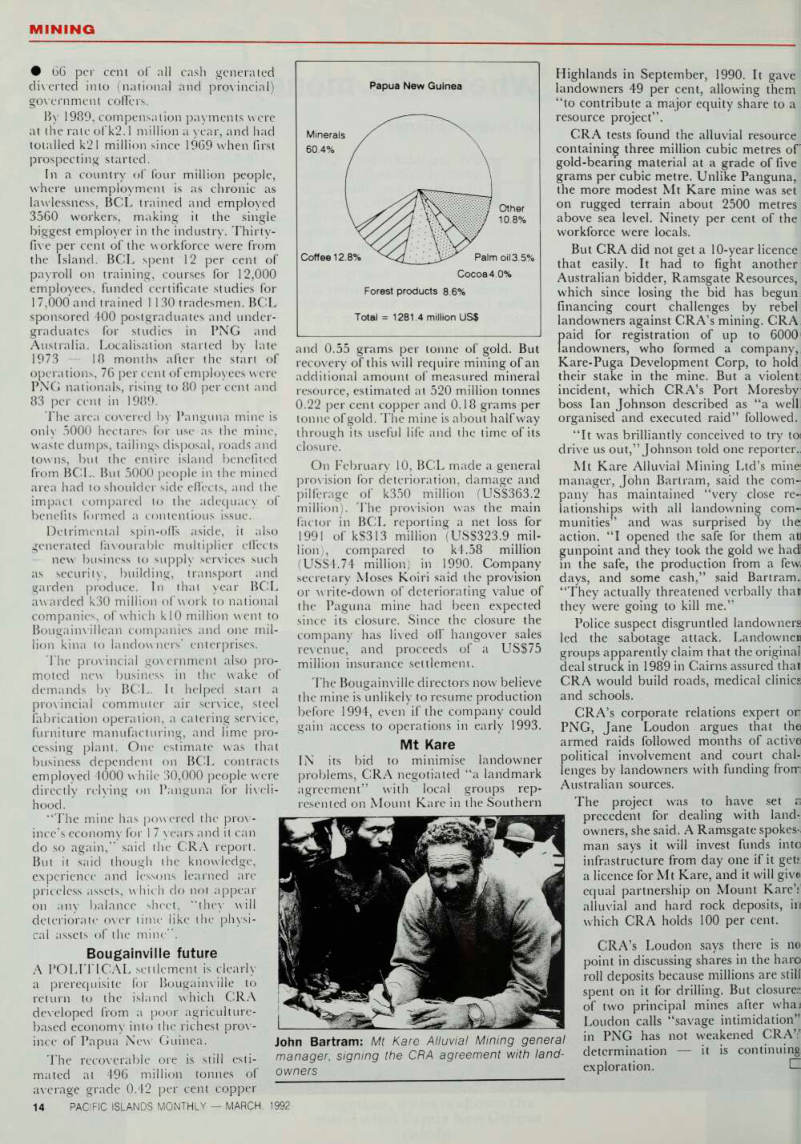
large amounts of shares to the govern ment. BCL was a model and yielded: • 1 7 per cent of PNG’s locally generated revenue, • 45 per cent of export earnings; 12 per cent of gross domestic product with
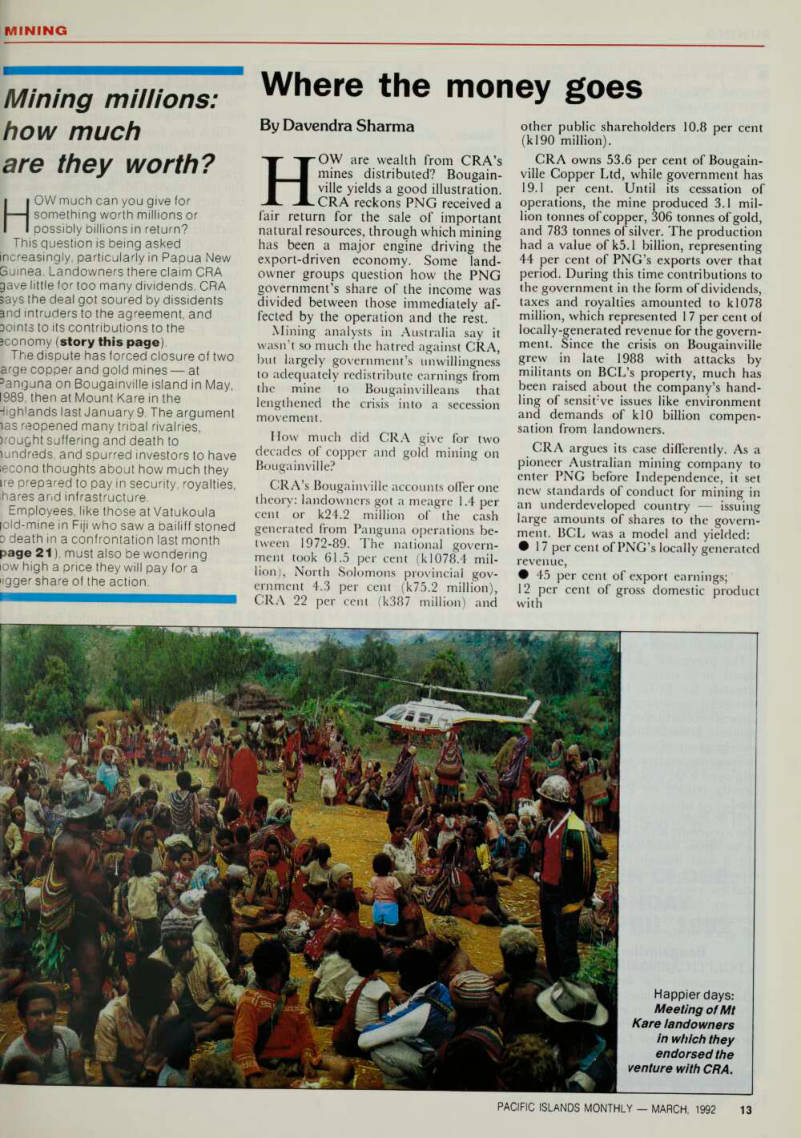
Happier days: Meeting of Mt Kare landowners in which they endorsed the venture with CRA.
• 66 per cent of all cash generated diverted into (national and provincial) government coffers.
By 1989, compensation payments w ere at the rale of k 2.1 million a year, and had totalled k2l million since 1969 when first prospecting started.
In a country of four million people, where unemployment is as chronic as lawlessness, BCL trained and employed 3560 workers, making it the single biggest employer in the industry. Thirty five per cent of the w orkforce were from the Island. BCL spent 12 per cent of payroll on training, courses for 12,000 employees, funded certificate studies for 17,000 and trained 1130 tradesmen. BCL sponsored 400 postgraduates and under graduates for studies in PNG and Australia. Localisation started by late 1973 18 months after the start of operations, 76 per cent of employees were PNG nationals, rising to 80 per cent and 83 per cent in 1989.
The area covered by Panguna mine is only 5000 hectares for use as the mine, waste dumps, tailings disposal, roads and towns, but the entire island benefited from BCL. But 5000 people in the mined area had to shoulder side effects, and the
impact compared to the adequacy of
benefits formed a contentious issue.
Detrimental spin-offs aside, it also generated favourable multiplier effects new business to supply services such as security, building, transport and garden produce. In that year BCL aw arded k3O million of w ork to national companies, of wdiich klO million went to Bougainvillean companies and one mil lion kina to landowners’ enterprises.
The provincial government also pro moted new business in the wake of demands by BCL. It helped start a provincial commuter air service, steel fabrication operation, a catering service, furniture manufacturing, and lime pro cessing plant. One estimate was that business dependent on BCL contracts employed 4000 while 30,000 people were directly relying on Panguna for liveli hood.
“The mine has pow ered the prov ince’s economy for 1 7 years and it can do so again,” said the CRA report.
But it said though the knowledge, experience and lessons learned arc priceless assets, which do not appear on any balance sheet, “they will deteriorate over lime like the physi cal assets of the mine”.
Bougainville future A POLITICAL settlement is clearly a prerequisite for Bougainville to return to the island which CRA developed from a poor agriculture based economy into the richest prov ince of Papua New Guinea.
The recoverable ore is still esti mated at 496 million tonnes of average grade 0.42 per cent copper
and 0.55 grams per tonne of gold. But recovery of this will require mining of an additional amount of measured mineral resource, estimated at 520 million tonnes 0.22 per cent copper and 0.18 grams per tonne of gold. The mine is about halfway through its useful life and the time of its closure.
On February 10, BCL made a general provision for deterioration, damage and pilferage of k 350 million (U 55363.2 million). The provision was the main factor in BCL reporting a net loss for 1991 of kS3I3 million (U 55323.9 mil lion), compared to k 1.58 million (U 554.74 million) in 1990. Company secretary Moses Roiri said the provision or write-down of deteriorating value of the Paguna mine had been expected since its closure. Since the closure the company has lived off hangover sales revenue, and proceeds of a US$75 million insurance settlement.
The Bougainville directors now believe the mine is unlikely to resume production before 1994, even if the company could gain access to operations in early 1993.
Mt Kare IN its bid to minimise landowner problems, CRA negotiated “a landmark agreement” with local groups rep resented on Mount Kare in the Southern
Highlands in September, 1990. It gave landowners 49 per cent, allowing them “to contribute a major equity share to a resource project”.
CRA tests found the alluvial resource containing three million cubic metres oT gold-bearing material at a grade of five grams per cubic metre. Unlike Panguna, the more modest Mt Rare mine was set on rugged terrain about 2500 metres above sea level. Ninety per cent of the workforce were locals.
But CRA did not get a 10-year licence that easily. It had to fight another Australian bidder, Ramsgate Resources, which since losing the bid has begun financing court challenges by rebel landowners against CRA’s mining. CRA. paid for registration of up to 6000' landowners, who formed a company,, Rare-Puga Development Corp, to hold, their stake in the mine. But a violent; incident, which CRA’s Port Moresby 1 boss lan Johnson described as “a well! organised and executed raid” followed.
“It was brilliantly conceived to try toi drive us out,” Johnson told one reporter., Mt Rare Alluvial Mining Ltd’s mine; manager, John Bartram, said the com pany has maintained “very close re lationships with all landowning com munities” and was surprised by the action. “I opened the safe for them at) gunpoint and they took the gold we hadf in the safe, the production from a few. days, and some cash,” said Bartram.
“They actually threatened verbally that they were going to kill me.”
Police suspect disgruntled landowners led the sabotage attack. Landownen groups apparently claim that the original deal struck in 1989 in Cairns assured that CRA would build roads, medical clinics and schools.
CRA’s corporate relations expert on PNG, Jane Loudon argues that the armed raids followed months of active political involvement and court chal lenges by landowners with funding from Australian sources.
The project was to have set a precedent for dealing with land owners, she said. A Ramsgate spokes-; man says it will invest funds into infrastructure from day one if it get?: a licence for Mt Rare, and it will givo equal partnership on Mount KareV alluvial and hard rock deposits, in which CRA holds 100 per cent.
CRA’s Loudon says there is no point in discussing shares in the haro roll deposits because millions are still spent on it for drilling. But closures of two principal mines after what Loudon calls “savage intimidation 5 ' in PNG has not weakened CRA’:' determination it is continuing;
exploration.
John Bartram: Mt Kare Alluvial Mining general manager, signing the CRA agreement with land owners