PNG emphasis on internal security
pp. 8-9 · Read in the full issue
By Wally Hlambohn and Beryl Cook
A RECENT comprehensive re view of Papua New Guinea’s security needs found its biggest threat to be coming from law lessness within, and uprising such as that on Bougainville.
It was then decided that the country’s law enforcement agencies and the PNG Defence Force should be revamped and improved to give greater emphasis on internal security.
The findings, along with a detailed set of funding proposals, were presented to the Australian delegation to the annual joint ministerial forum in Madang last month to discuss Aid, Investment Law and Order, Security, and Bougainville.
The delegation included Australia’s De fence Minister Senator Robert Ray and Australia’s Foreign Affairs Minister Senator Gareth Evans.
The Australians were briefed on major resource developments in the country — a major share of it by Australians — and reassured Australian investments were sound, and future prospects were bright.
But while commending these companies’ contribution to PNG’s development, Namaliu urged them to diversify from mining into agriculture, and manufac turing and import replacement sectors.
In a veiled warning, he said, Asian investors were waiting in the wings to come into these areas.
“I hope that, in the immediate future, the remarkable and welcome level of Australian investment in mining and energy resource development in PNG will be followed by agricultural diversi fication, and import replacement,” he said.
The emphasis of key considerations in findings presented to the Australians were, in Namaliu’s own words, “to cut crime, and provide a more peaceful and secure environment for our people, our guests and investors”.
Evans was quite frank about his concern for Australian investors’ security when he said the “recent, well-organised attack on Mount Rare mine gives added
urgency to the need for the PNG government to act on law and order”.
Regarding Australia’s role and re sponse, he said during a press conference in Fiji on February 4 that Australia’s policy was one of ‘‘constructive commit ment” to the region as a whole, ap proaching it as an equal partner rather than as a dominant influence.
Evans and Bruce Grant in Australia’s Foreign Relations: in the World of the 1990 s
(Melbourne University Press, 1991)
point to the importance of both regional stability, and the security which hinges on economic and social development.
Asked at the press conference whether the two notions together suggested a case for more direct intervention by bigger countries like Australia in crises like Bougainville, Evans told PIM there could be a case for more concern with development co-operation programems and other forms of assistance that would “minimise the economic and social discontent of particular minority groups or regions within countries”. But he ruled out the possibility of more direct inter vention in the form of political or military response in Bougainville.
Queried on the use of Australian helicopters by the PNG Army he said this had been to assist with transport, move ment of troops and supplies in “a very complex logistical operation for the PNG Army in dealing with the situation they were confronted (with) in Bougainville”.
They also had been given, not just for Bougainville but for the general use of the PNG Army responding to disasters or other situations that might arise pro vided they were not used as gunships
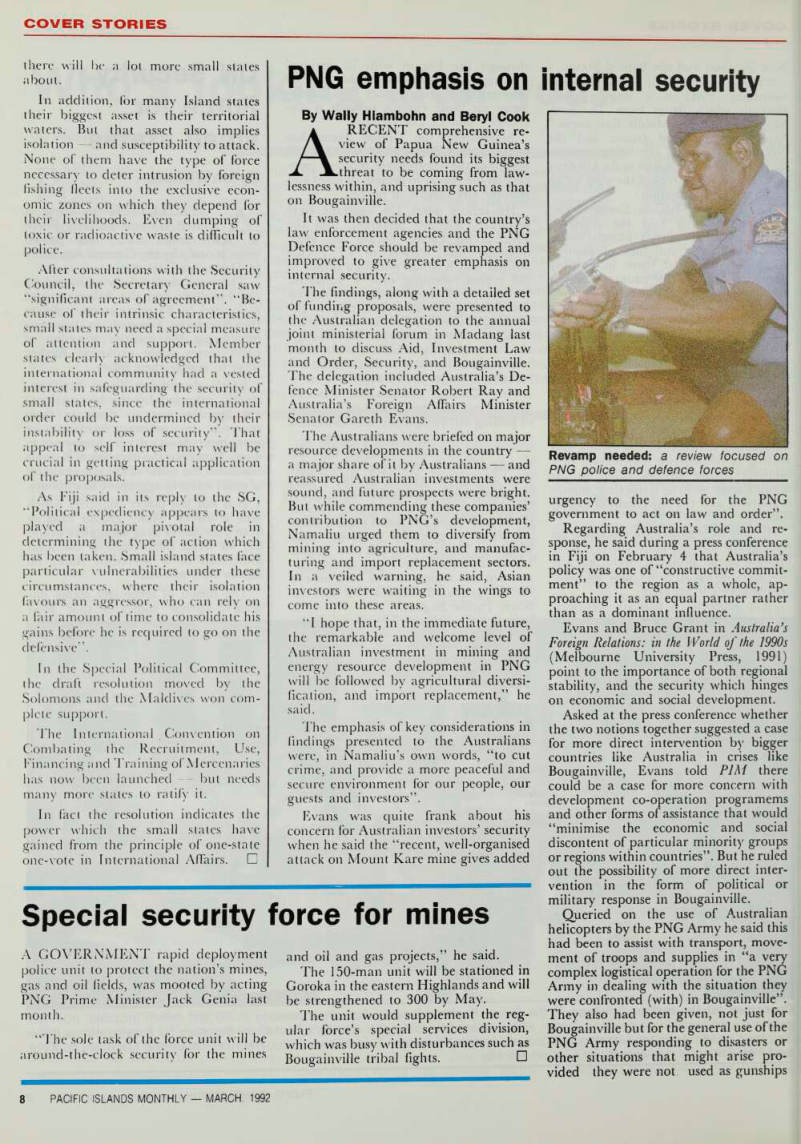
Revamp needed: a review focused on PNG police and defence forces
with mounted weaponry for assault or at lack, he said.
During his Madang v isit, Evans was briefed on developments on the island, and the involvement of international non-governmental organisations in die supply of relief and medial aid. While he respected Bougainville was an internal PNG problem, and reaffirmed Australia’s position for it to remain a part of PNG, Evans said the crisis also had a humanitarian aspect which should not be neglected.
He said Australia was ready to help with reconstruction once a political settlement had been reached.
PNG expressed concern over the involvement of certain Australians in promoting pro-secessionist propa ganda. The setting up of an illegal radio station w ith the help of an Australian, and the respected illegal entry into Bougainville by Australian journalists were examples of incidences which breated concern. It also emerged from the Ibrum that the two countries may toon enter into a new trade agreement.
A detailed review was made of the existing PNG-Auslralia Commercial ind Trade Relations Agreement PACTRA). While PACTRA had en titled favourable access of PNG exports nlo Australia, the latter believes this hould become reciprocal.
Evans said this change should be nadc to reflect the “maturing” nature >f the two countries’ relationship. He aid this would ensure Australian nanufaclurers had ready access to
) NG’s fast-growing market.
He said Australia was considering an igrecmcnl with PNG similar to the ■loser Economic Relations (CER) greement with New Zealand, which •pened up free trade between the two lations.
PNG continues to peg back the trade nbalance between the two countries, uc mainly to its rich gold and mineral xports. Three years ago, the trade alance between PNG and Australia iv cured Australia by a ratio of seven ) one, but the ratio was close to even 13 to one in Australia’s favour in le current year.
In the past year, PNG exports to Australia grew by 150 per cent to k 414 ii 11 ion while Australian exports to NO fell marginally to k 542 million. 4 otal Australian investment in PNG as estimated at kl.l billion, but the gure was set to climb to more than 2.8 billion in the next five years as tajor resource projects were com leled.
Evans called on PNG to maintain ee and open markets. □