The battle for Enenkio
pp. 19-21 · Read in the full issue
An innocent proposition sparks a territorial row.
By David North
THE last time there was battle over Wake Island, the weapons were deadly, and after a few weeks the Japanese defeated the United States Marines. This time the weapons are words, the outcome is uncertain, and the antagonists are Amata Kabua, President of the Republic of the Marshall Islands, and Ben Blaz, the Republican Congress man from Guam.
It all started innocently enough when a Hawaii Congresswoman of Japanese descent, Pat Saiki (Republican), intro duced a bill which would expand bound
aries of her state to below the Equator, taking in six outlying island possessions of the United States.
Another provi
sion in the legisla tion (which was
co-sponsored by
Blaz) would add
Wake, locally
known as Enenkio Atoll, a US Air Force base, to the
territory of
Guam.
The six new is lands for Hawaii would be Midway,
now occupied by the US Navy, three wild-life refugees (Howland, Baker and Jarvis), Kingman Reef, and Palmyra, which is privately owned and may also be a bone of contention. None of these six, except Midway, are routinely inha bited although one of the owners of Pal myra, Ainsley Fullard-Leo, coincidental ly, was visiting that island group on the day that Saiki’s proposal was announced.
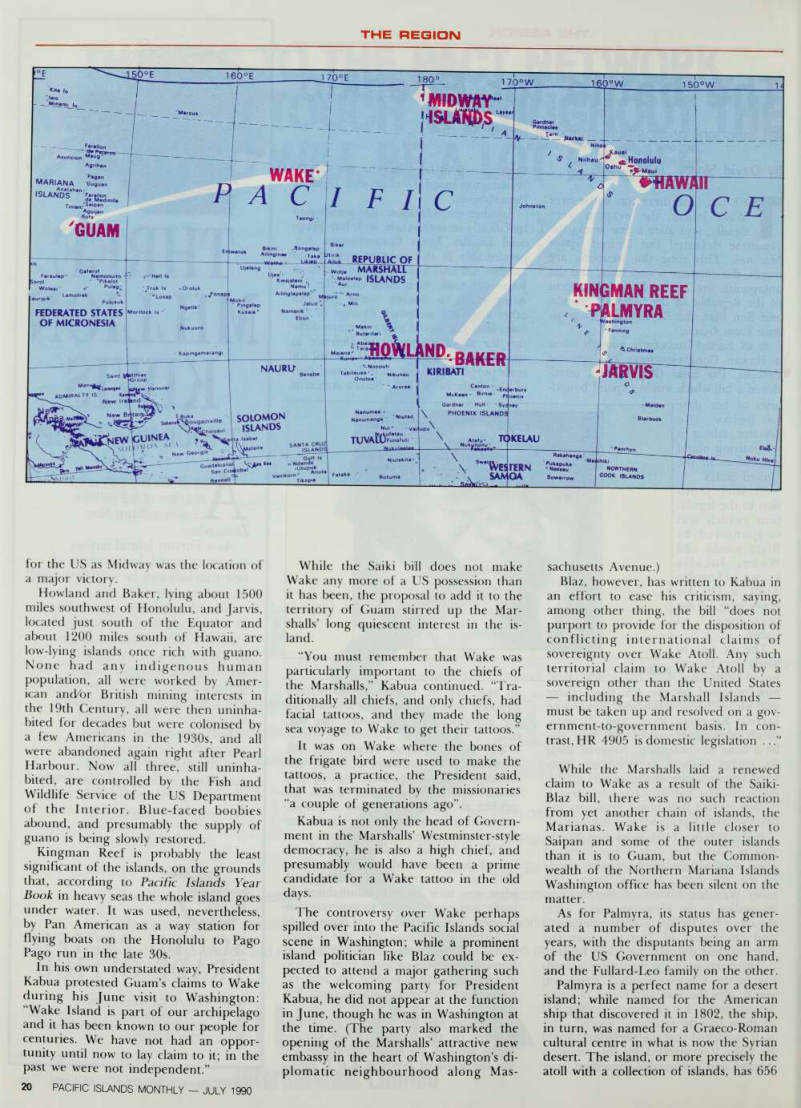
Wake is some 1400 miles East-North- East of Guam but only a few hundred miles north of the northernmost islands of the Marshalls; Midway, some 1500 miles West-North-West of Honolulu, is an outlier in the Hawaiian chain; while the other five lie 900 to 1600 miles south and southwest of Hawaii, near the Equator, and near the waters of Kiribati.
The purpose of the legislation, accord ing to the Congresswoman’s statement, was to give the State of Hawaii “a stron ger argument for environmental control of these islands’ territorial waters”. Her staff suggested that the six islands would be safer if controlled by the relatively nearby, and presumably concerned, state
Government rather than by the distant Washington-based Interior and Defence Departments.
Another consideration, not mentioned specifically in connection with her prop osed Insular Areas Consolidation Act, presumably is the current activity on another US island in the general area Johnston Atoll. It is here that the US Army plans to destroy nerve gas and other chemical weapons. Passage of the Saiki-Blaz bill would make it more diffi cult for the Department of Defence to use islands not now under its control for such purposes were they to become part of the State of Hawaii. Saiki’s concerns
on the use of Johnston to destroy weapons were reflected in a separate bill she introduced on the subject (see box, p2l).
Still another factor behind the bill, particularly the inclusion of Wake into Guam, relates to possible fishing and underwater mineral rights. Guam has neither at the moment, but might ac quire them from the US during the on
going Commonwealth negotiations.
The proposed re-alignment of the boundaries, discussed by Saiki in terms of future concerns, and dealing with what are now largely uninhabited is lands, was not expected to generate con troversy, but it certainly has done so. In addition to setting off the Guam- Marshalls controversy, the bill has re minded observers of some grim historic al events, and has rubbed salt into the wounds of the family which owns Pal myra.
Howland was the objective of Amelia Erhardt on the last leg of her ill-fated flight around the world. Wake Island was the scene of a World War II defeat
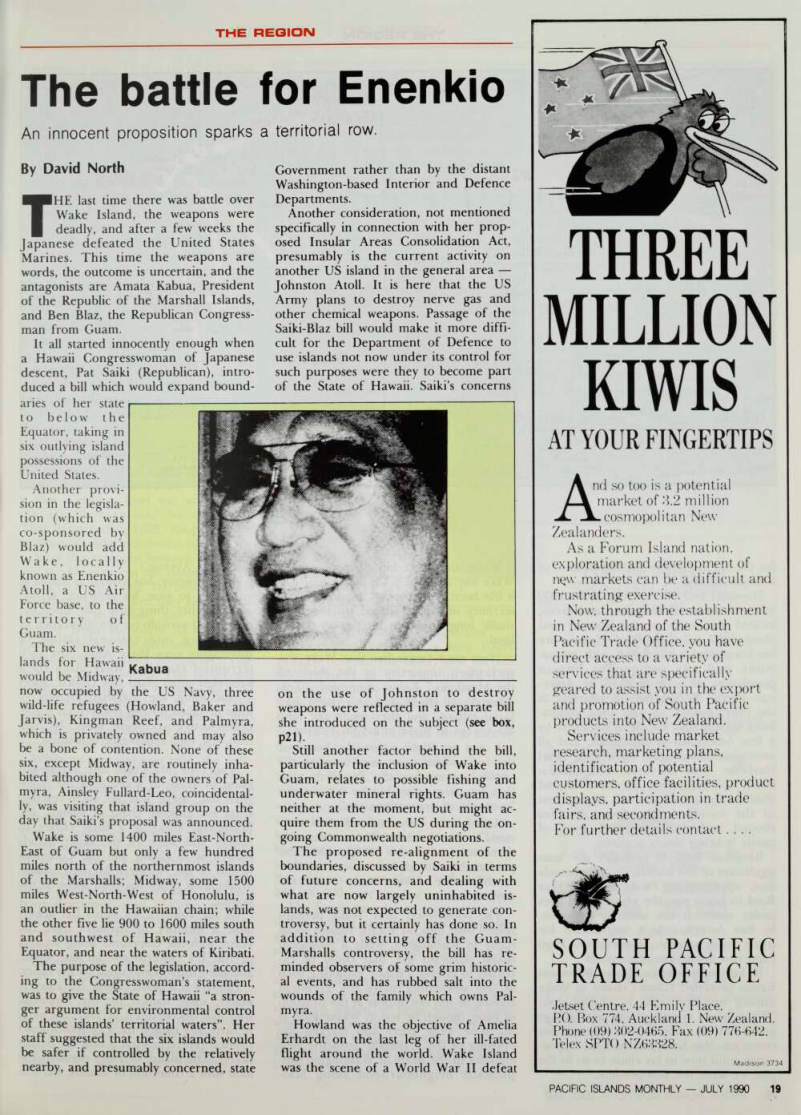
Kabua
for the US as Midway was the location of
a major victory.
Howland and Baker, lying about 1500 miles southwest of Honolulu, and Jarvis, located just south of the Equator and about 1200 miles south of Hawaii, are low-lying islands once rich with guano.
None had any indigenous human population, all were worked by Amer- ? n in D u r British mining interests m the 19th Century all were then unmhabited tor decades but were colonised by a few Americans m the 19305, and all were abandoned again right after Pearl Harbour. Now all three, still unmha-
WndlWe 3 "^^^ 6^ 15 “"I
Wildlife Service of the US Department of the Interior. Blue-faced boobies abound, and presumably the supply of guano is being slowly restored.
Kingman Reef is probably the least significant of the islands, on the grounds that, according to Pacific Islands Year Book in heavy seas the whole island goes under water. It was used, nevertheless, by Pan American as a way station for flying boats on the Honolulu to Pago Pago run in the late 30s.
In his own understated way, President Kabua protested Guam’s claims to Wake during his June visit to Washington: Wake Island is part of our archipelago and it has been known to our people for centuries. We have not had an opportunity until now to lay claim to it; in the past we were not independent.”
While the Saiki bill does not make Wake any more of a US possession than it has been, the proposal to add it to the territory of Guam stirred up the Marshalls’ long quiescent interest in the island.
“ Yo u must remember that Wake was particularly important to the chiefs of the Marshalls,” Kabua continued. “Traditionally all chiefs, and only chiefs, had f ac i a l tattoos> an d t h ey made the long sea voyage to Wake to get their tattoos.” r w . . . . f T f WaS °" ,^ ake where ‘he bones of that was terminated by the missionaries .. . f t - 1. » . 8 8 * Kabua is not only the head of Government m the Marshalls Westmmster-style democracy, he is also a high chief, and presumably would have been a prime candidate for a Wake tattoo m the old days.
The controversy over Wake perhaps spilled over into the Pacific Islands social scene in Washington; while a prominent island politician like Blaz could be expected to attend a major gathering such as the welcoming party for President Kabua, he did not appear at the function in June, though he was in Washington at the time. (The party also marked the opening of the Marshalls’ attractive new embassy in the heart of Washington’s diplomatic neighbourhood along Mas-
sachusetts Avenue.) Blaz, however, has written to Kabua in an effort to ease his criticism, saying, among other thing, the bill “does not purport to provide for the disposition of conflicting international claims of sovereignty over Wake Atoll. Any such territorial claim to Wake Atoll by a sovereign other than the United States including the Marshall Islands must be taken up and resolved on a gov ernment-to-government basis. In con trast, HR 4905 is domestic legislation ...”
While the Marshalls laid a renewed claim to Wake as a result of the Saiki- Blaz bill, there was no such reaction from yet another chain of islands, the Marianas. Wake is a little closer to Saipan and some of the outer islands than it is to Guam, but the Common wealth of the Northern Mariana Islands Washington office has been silent on the matter.
As for Palmyra, its status has gener ated a number of disputes over the years, with the disputants being an arm of the US Government on one hand, and the Fullard-Leo family on the other.
Palmyra is a perfect name for a desert island; while named for the American ship that discovered it in 1802, the ship, in turn, was named for a Graeco-Roman cultural centre in what is now the Syrian desert. The island, or more precisely the atoll with a collection of islands, has 656
hectares or over 1400 acres of dry land.
The total area of land and sheltered wa ter is about 40,000 acres according to its owners. It is probably the largest private
ly-owned grouping of tropical islands
under the US flag.
The US however, has not always had it. The Kingdom of Hawaii first laid claim to Palmyra in 1868. Britain did the same in 1889, and the Americans in cluded it in Hawaii’s boundaries when it took over the islands in 1898. A few years later a Judge Cooper, of Honolulu, acquired the title to the island group and used it to grow coconuts. Subsequently, the Judge, who died in 1929, sold vir tually all of his holdings there to the late Leslie and Ellen Fullard-Leo, of Hawaii, keeping two islets, about one acre, for his heirs, who own that smidgin of land to this day.
The first really significant contact be tween the Fullard-Leos and the Govern ment was a happy one according to Les lie Fullard-Leo, one of the three sons of the original owners.
“My mother was the only woman in the history of the United States to cause the annexation of an island to the US,”
Leslie Fullard-Leo told PIM. “She saw to it that Kingman Reef was acquired by the US Government,” he explained.
That happened in 1922. Kingman Reef is about 50 miles north-west of Palmyra.
After that relations between the family and the Government ran downhill. After the attack on Pearl Harbour the US armed services decided they needed Pal myra as a re-fuelling site for planes headed from Honolulu to the South Pacific. (Some of the alternative stopping points, such as Tarawa, having been cap tured by the Japanese). The family was willing, according to Fullard-Leo, and signed a lease prepared by the Navy, giving them full use of the Palmyra dur ing the war. But although the Navy had prepared the lease, it did not sign it.
While no rent was ever paid, the milit ary took over Palmyra in a big way.
There had been three lagoons and 52 islands. The seabees merged two of the
lagoons to create a protected landing
area for seaplanes; similarly, the military
strung together a number of the islands (there are now 39 of them) to build an
1800-metre-long landing strip for land
based planes. Roads were built, the har bour deepened, and a radio sending facility was constructed. At one point there were thousands of troops on Pal myra.
Although the US Air Force continued to use the landing strip as late as 1961, it is now unserviceable. “Too much vegeta tion, and too many birds’ nests to use,” according to a member of the family.
After the war the family sought com pensation for the war-time use of the island. “All we got was $lOO,OOO for
damages,” according to Fullard-Leo.
Meanwhile, there was a long court struggle between the family and the US Government as to who owned the islands; eventually it went to the US Sup reme Court, and eventually the family won. “And while this was going on the State of Hawaii, which had issued us our deed, never lifted a finger to help us.
We do not have much aloha for the State of Hawaii,” Fullard-Leo told PIM.
Saiki’s bill could not have come at a worse moment for the owners, the three sons of the late Leslie and Ellen Fullard-
Leo, Leslie, Dudley and Ainsley. They
have been seeking to sell the islands for some time; the asking price, we gather, has risen from $1 1,000,000 to $36,000,000 over the last several years.
The family now has a prospective cus
tomer, willing to sign a lease-purchase
arrangement. Leslie Fullard-Leo would not divulge the terms, the purchaser, or the prospective use of the islands but did allow that the pending bill might compli cate matters. Meanwhile, the deal had not been signed at press time because when the document was ready brother
Ainsley was visiting Palmyra maybe
for the last time as co-owner of the is lands. c