Caught in a crossfire
pp. 53-55 · Read in the full issue
Pacific People
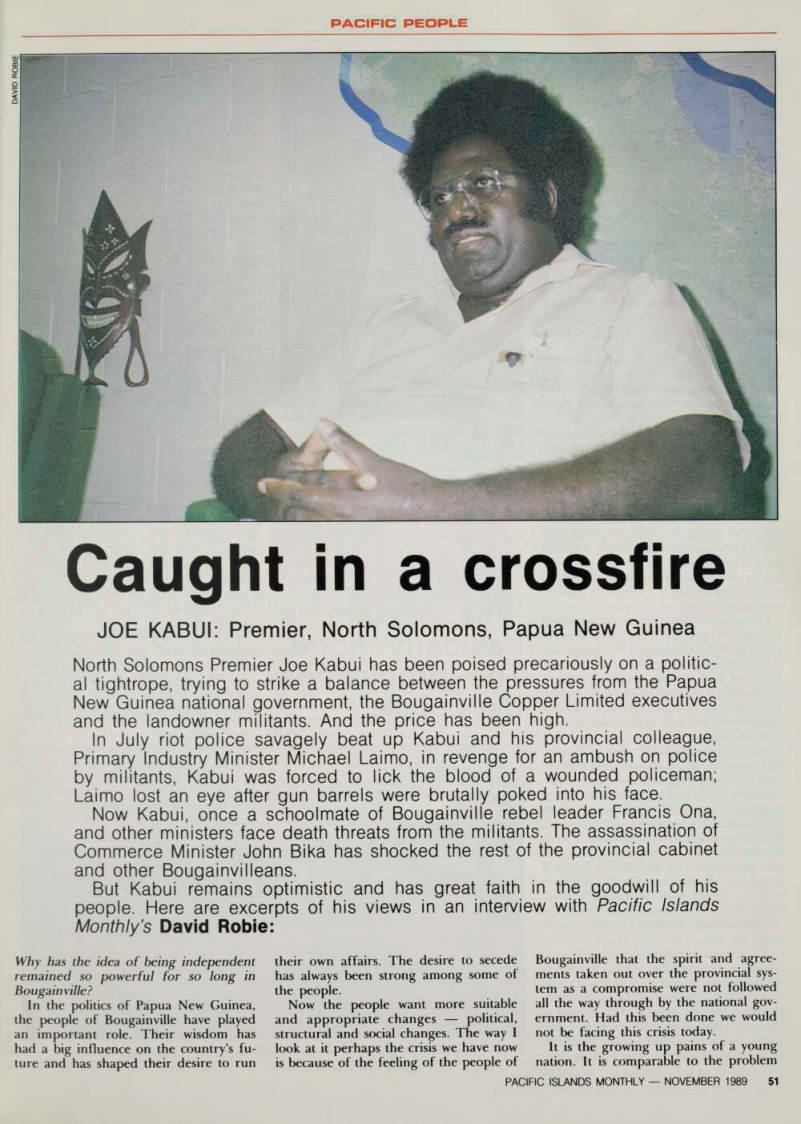
JOE KABUI: Premier, North Solomons, Papua New Guinea North Solomons Premier Joe Kabui has been poised precariously on a politic al tightrope, trying to strike a balance between the pressures from the Papua New Guinea national government, the Bougainville Copper Limited executives and the landowner militants. And the price has been high.
In July riot police savagely beat up Kabui and his provincial colleague, Primary Industry Minister Michael Laimo, in revenge for an ambush on police by militants, Kabui was forced to lick the blood of a wounded policeman; Laimo lost an eye after gun barrels were brutally poked into his face.
Now Kabui, once a schoolmate of Bougainville rebel leader Francis Ona, and other ministers face death threats from the militants. The assassination of Commerce Minister John Bika has shocked the rest of the provincial cabinet and other Bougainvilleans.
But Kabui remains optimistic and has great faith in the goodwill of his people. Here are excerpts of his views in an interview with Pacific Islands Monthly’s David Robie:
Why has the idea of being independent remained so powerful for so long in
Bougainville?
In the politics of Papua New Guinea,
the people of Bougainville have played
an important role. Their wisdom has had a big influence on the country’s future and has shaped their desire to run
their own affairs. The desire to secede has always been strong among some of
the people.
Now the people want more suitable
and appropriate changes political,
structural and social changes. The way I look at it perhaps the crisis we have now is because of the feeling of the people of
Bougainville that the spirit and agree ments taken out over the provincial sys tern as a compromise were not followed all the way through by the national gov ernment. Had this been done we would not be facing this crisis today, It is the growing up pains of a young nation. It is comparable to the problem
of teenagers. The teens are the most un predictable age when growing up, as a boy moves into manhood and a girl en ters womanhood. It can be a really ex
plosive time.
It isn’t too different for a government.
Papua New Guinea has just had its 14th birthday as a nation. And we are now in our teens.
How can the impasse be resolved?
It is going to take a lot of time and a lot of patience among political leaders among everybody to grasp and understand the problems as we move further into our second decade of inde pendence. Compromises will have to be made.
We have the structure, we have the means to strengthen provincial govern ment. In an attempt to find a long lasting solution, we have to look at de centralisation more local power. It cannot be applied across the board.
More autonomy and financial independ ence depends on the management capa bilities of the provinces.
I don’t want to see a Middle East here or a Latin America, an Afghanistan.
The world is full of political turbulence.
I don’t want to see this happen. We need a long-lasting solution.
The national government is committed to devolution of power. This is the only workable and realistic solution. Unfortu nately, a minister (Commerce Minister John Bika) has had to pay the price for his report a well-documented and very comprehensive report. It recom mends statehood for the province.
Frustrations have built up so much among our people. They have seen so many government and leaders come and go. So many promises have been made.
But they have become empty promises.
What chance is there of the Bika Report being adopted? Can it actually be im plemented, or will it become another broken promise?
Yes, our people have a lot of sceptic ism towards the national government.
And what will happen if the government changes? If the government does change, I can only hope the Namaliu
administration’s strategies and approach
favouring negotiation continue. It is in the best interests of the nation. To main tain the stability of the country it would be unwise to adopt a different approach such as abolition of provincial govern ments on the basis that they are “cumbersome, inefficient and expen sive”.
A more centralised government will not solve the problem. Other provinces would revolt against such a system and that could be the final straw in the disin tegration of the nation. The system is basically good. The problem is the peo ple. It is like driving a vehicle. The vehi cle is good, but if you have a lousy driv-
er at the wheel then the car drives badly.
The Bika Report advocates the streng thening of the provincial system and making it much better, and to give peo ple the sense that they are running their affairs.
Is there a risk of a military takeover if
‘The system is basically good.
The problem is the people’
the crisis remains unresolved?
The danger of the military cannot be ruled out altogether especially the way national politics has been played up till now. We need a lot more mature and responsible leaders. Many have the atti tude of what can they get out of it.
One of the reasons why seem to be efficiently run is because we have leaders who know why they are here. We have had our share of problems. But our efforts are for government of the peo ple, by the people and for the people.
How would it be possible to negotiate again with Francis Ona?
Many attempts are made to contact Francis Ona. At first it was okay to con tact him. But as the events have got worse, it has made it a lot more difficult.
I have got to the stage where I’m nearly 100 per cent sure that Francis is deter mined not to come out for a round-table discussion with government. It makes me very sad to see that stubbornness of his over secession. We have been doing ev erything possible to get him to talk but we have been running into a brick wall.
His determination not to talk to author ities was expressed in a powerful way by the assassination of Mr Bika. Many of us are a target, too.
I have appealed to the leaders and their militants to put their trust in me.
As a leader from here, I know the fears, the pains and the sacrifices they have made. And we are honouring our trust.
Even the late minister knew his life was at risk. Many times we have been caught in the crossfire because we have been misunderstood.
Personally, I’m very satisfied about the negotiations (with the national govern ment) up till now. We are trying to answer the demands and are addressing them with long-term and short-term answers. In the short-term, it is a matter
David Robie
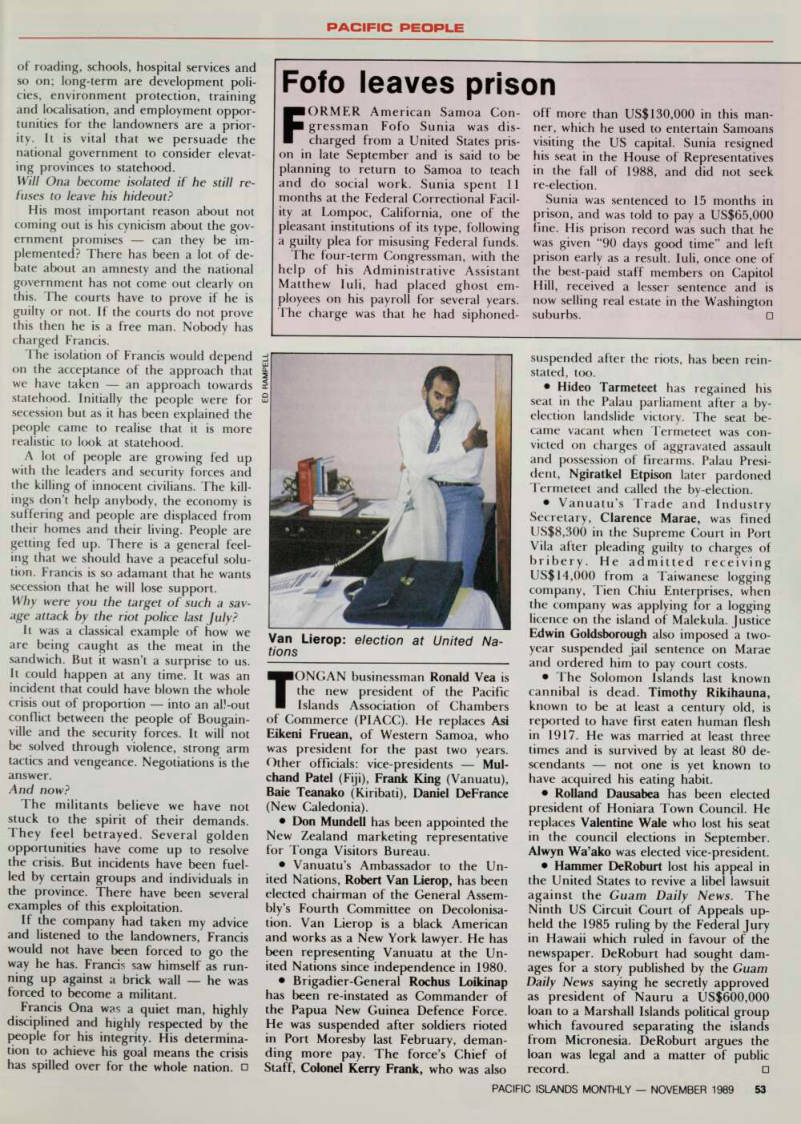
Plastic village: new camp for Bougainvilleans resettled by the army
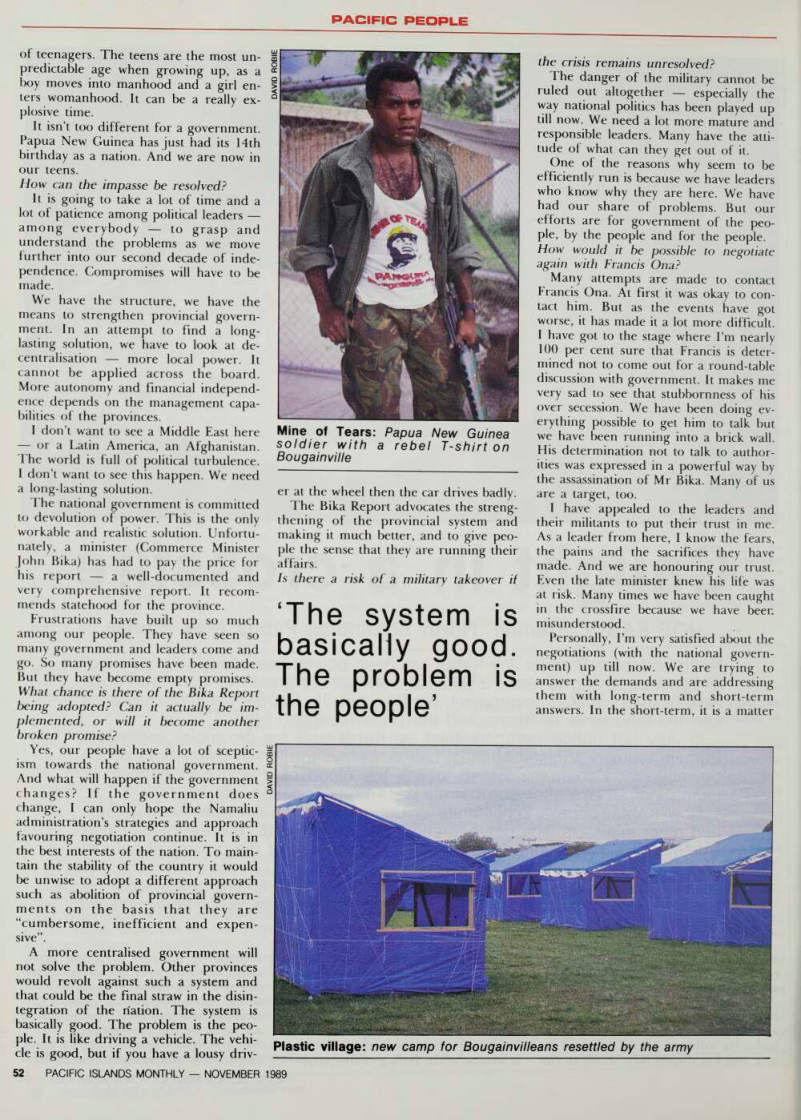
Mine of Tears: Papua New Guinea soldier with a rebel T-shirt on Bougainville
of reading, schools, hospital services and so on; long-term are development poli cies, environment protection, training and localisation, and employment oppor tunities for the landowners are a prior ity. It is vital that we persuade the national government to consider elevat ing provinces to statehood.
Will Ona become isolated if he still re fuses to leave his hideout?
His most important reason about not coming out is his cynicism about the gov ernment promises can they be im plemented? There has been a lot of de bate about an amnesty and the national government has not come out clearly on this. The courts have to prove if he is guilty or not. If the courts do not prove this then he is a free man. Nobody has
charged Francis.
The isolation of Francis would depend on the acceptance of the approach that we have taken an approach towards statehood. Initially the people were for secession but as it has been explained the people came to realise that it is more realistic to look at statehood.
A lot of people are growing fed up with the leaders and security forces and the killing of innocent civilians. The kill ings don’t help anybody, the economy is suffering and people are displaced from their homes and their living. People are getting fed up. There is a general feel ing that we should have a peaceful solu tion. Francis is so adamant that he wants secession that he will lose support.
Why were you the target of such a sav age attack by the riot police last July?
It was a classical example of how we are being caught as the meat in the sandwich. But it wasn’t a surprise to us.
It could happen at any time. It was an incident that could have blown the whole crisis out of proportion into an al!-out conflict between the people of Bougain ville and the security forces. It will not be solved through violence, strong arm tactics and vengeance. Negotiations is the answer.
And now?
The militants believe we have not stuck to the spirit of their demands.
They feel betrayed. Several golden opportunities have come up to resolve the crisis. But incidents have been fuel led by certain groups and individuals in the province. There have been several
examples of this exploitation.
If the company had taken my advice and listened to the landowners, Francis would not have been forced to go the way he has. Francis saw himself as run ning up against a brick wall he was forced to become a militant.
Francis Ona was a quiet man, highly
disciplined and highly respected by the
people for his integrity. His determina tion to achieve his goal means the crisis has spilled over for the whole nation. □
TONGAN businessman Ronald Vea is the new president of the Pacific Islands Association of Chambers of Commerce (PIACC). He replaces Asi Eikeni Fruean, of Western Samoa, who was president for the past two years.
Other officials: vice-presidents Mul chand Patel (Fiji), Frank King (Vanuatu), Baie Teanako (Kiribati), Daniel DeFrance (New Caledonia). • Don Mundell has been appointed the New Zealand marketing representative for Tonga Visitors Bureau. • Vanuatu’s Ambassador to the Un ited Nations, Robert Van Lierop, has been elected chairman of the General Assem bly’s Fourth Committee on Decolonisa tion. Van Lierop is a black American and works as a New York lawyer. He has been representing Vanuatu at the Un ited Nations since independence in 1980. • Brigadier-General Rochus Loikinap has been re-instated as Commander of the Papua New Guinea Defence Force.
He was suspended after soldiers rioted in Port Moresby last February, deman ding more pay. The force’s Chief of Staff, Colonel Kerry Frank, who was also
suspended after the riots, has been rein stated, too. • Hideo Tarmeteet has regained his seat in the Palau parliament after a by election landslide victory. The seat be came vacant when Termeteet was con victed on charges of aggravated assault and possession of firearms. Palau Presi dent, Ngiratkel Etpison later pardoned Termeteet and called the by-election. • Vanuatu’s Trade and Industry Secretary, Clarence Marae, was fined US$B,3OO in the Supreme Court in Port Vila after pleading guilty to charges of
bribery. He admitted receiving
US$l4,OOO from a Taiwanese logging company, Tien Chiu Enterprises, when the company was applying for a logging licence on the island of Malekula. Justice Edwin Goldsborough also imposed a two year suspended jail sentence on Marae and ordered him to pay court costs. • The Solomon Islands last known cannibal is dead. Timothy Rikihauna, known to be at least a century old, is reported to have first eaten human flesh in 1917. He was married at least three times and is survived by at least 80 de scendants not one is yet known to have acquired his eating habit. • Rolland Dausabea has been elected president of Honiara Town Council. He replaces Valentine Wale who lost his seat in the council elections in September.
Alwyn Wa’ako was elected vice-president. • Hammer Deßoburt lost his appeal in the United States to revive a libel lawsuit against the Guam Daily News. The Ninth US Circuit Court of Appeals up held the 1985 ruling by the Federal Jury in Hawaii which ruled in favour of the newspaper. Deßoburt had sought dam ages for a story published by the Guam
Daily News saying he secretly approved
as president of Nauru a US$6OO,OOO loan to a Marshall Islands political group which favoured separating the islands from Micronesia. Deßoburt argues the loan was legal and a matter of public record. □
Van Lierop: election at United Na tions