discovery
p. 10 · Read in the full issue
Stamps
Balboa’s discovery
THE first European incursion into the Pacific probably came in 1513 when the Portuguese, Balboa, waded into the water and took posses sion of all “the seas, lands and islands therein until the final day of Judge ment”. It never occurred to him that they might have belonged to anybody else! The continuation of such attitudes is evidented by a quote from Sir Joseph Banks over 200 years later . . . “The scene was the truest picture of an Arca dia of which we were going to be
Kings”.
The demise of traditional island ways of life was, in a way, inevitable. Spanish, Dutch, British and French explorers brought with them influences that undermined and overwhelmed Polyne sian, Melanesian and Micronesian alike.
The Spaniard Pedro Fernandez de Quiros is a case in example. With the best and most grandiose of intentions, anxious to build the ‘New Jerusalem’, he nevertheless managed to leave dead and wounded behind him, wherever he went.
Even the French, who seem to have been amongst the most tolerant, with their talk of ‘the noble savage’, efficiently spread European diseases. One writer has described the meeting of Polynesian and European as similar to children approaching a travelling circus consisting of evil-smelling rapacious villains in an advanced state of physical decay.
The exploiters who followed in the ex plorers’ footsteps were even more so men of action. Privateers, whalers, then missionaries and in more recent times, tourists, all played their part in the dis solution of a lifestyle now gone forever.
The islands of Kiribati, formerly the Gilbert Islands, are classic atolls, impre gnable coral rings where very little grows
except coconut, pandanus, breadfruit and taro. They have been described as “the very core and soul of the Pacific”.
It is possible that the Spaniards Grijal va and Alvarado visited some of the Gil bert Group in 1537. Further discovery came with the British ships Scarborough and Charlotte in 1788 and Nautilus in 1799. Between 1830 and 1840 sperm whalers began to frequent the waters in the neighbourhood of the islands and there was some communication between sailors and locals. Regular trade began to grow. The first European trader to settle in the islands did so in 1837. The first missionaries came in 1857.
During the greater part of the 19th century the islands were without external control. They were ruled by local leaders with runway sailors, traders and mis sionaries wielding considerable influence.
Faced by growing German interest in the region, the Gilbert and Ellice islands were annexed as a Crown Colony in 1915, by the express wish of their
people.
Today the population has recovered from the dip it took at the turn of the century and is now over 63,000. Internal self-government was introduced in the islands on January 1, 1977. At a consti tutional conference in London in late 1978 it was agreed that the Gilbert Is lands should become fully independent as a republic on July 12, 1979.
Two stamps were released, celebrating the 10th anniversary of independence.
Printed in lithography by Carter, the stamps show 10c The House of Assembly, 15tf The Constitution.
New idea SOME agencies have found a new twist to selling more stamps. This is in a clev er design technique for stamp issues.
Australia Post, for example, is issuing a series called the Colonial Collection.
Whilst each stamp has a separate design the five stamps have a strip of landscape added above the design which runs over the top of the design on each stamp.
Thus a collector will have to collect a whole strip of stamps.
The Solomon Islands, on May 16, issued two se-tennant pairs of stamps.
Both se-tennant have a simple design over two stamps each.
Next year is sure to see most Pacific countries joining in celebrating the 150th anniversary of the penny black.
New issues Tuvalu: July 31 Living Reef Part 3: 40c Pennant Coral Fish, 50c Anemone Fish, 60c Batfish, 90c Threadfin Coral Fish, Miniature Sheet.
Pitcairn Islands: October 23 Islands Profiles: 15c Ducie Island, 90c Hender son Island, $1.05 Oeno Island, $1.30 Pit cairn Island. Next issue January 15.
Bicentennial Souvenir Sheetlet number 3.
New Caledonia: August 24 Regional
Landscape: 64F Hienghene Bay, 180 F
Ouaieme River.
Fiji: August 21 Corals: 45c Daedalea, 60c Furcate, 75c Echinate, 90c Humilis.
Australia: August 23 Painters: 4 x 4lc Featuring Conder, Roberts, McCub bin, Streeton. The standard rate for let ters rose to 41c on September 1. Septem ber 13 Youth Hostels: 1 x 41c Gar dens, $2 Nooroo, $5 Mawarra.
New Zealand: September 13 Christ mas Issue: 35c Child’s Bedroom, 65c Shepherd, 80c Boat Harbour, $1 Globe.
October 11 Heritage: The Sea; November 8 Commonwealth Games.
Vanuatu: July 20 Moon Landing (20th Anniversary): 45vt, 55vt, 65vt, 120vt, lOOvt Featuring photographs of the moon mission.
Norfolk Island: September 21 Red Cross: $1 Red cross logo. October 9 Christmas: 36c Gethsemane, 60c In the Sweet Bye and Bye, 75c Let the Lower Lights Be Burning, 80c The Beautiful Stream. November 21 Radio Australi a; 41c Radio announcer, 65c Map, $l.lO Kookaburra.
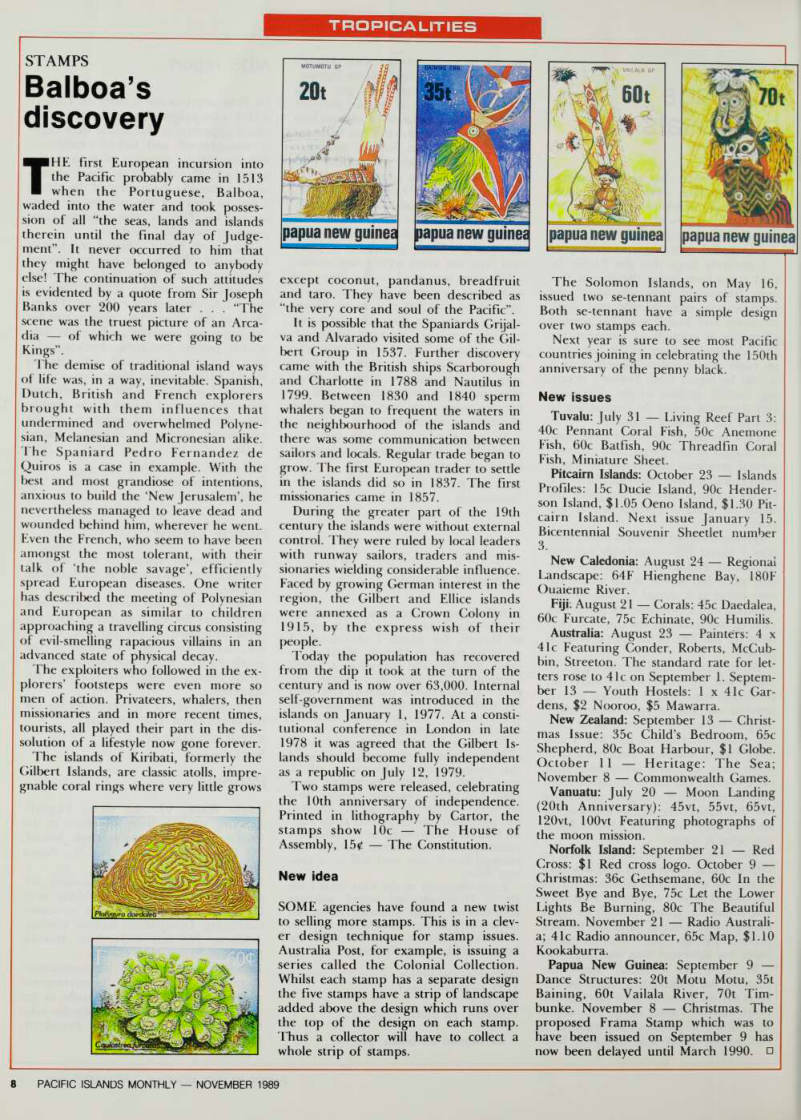
Papua New Guinea: September 9 Dance Structures: 20t Motu Motu, 35t Baining, 60t Vailala River, 70t Tim bunke. November 8 Christmas. The proposed Frama Stamp which was to have been issued on September 9 has now been delayed until March 1990. □