Pacific Stamp Box
pp. 48-49 · Read in the full issue
Edited by John Hunter
I recently reported on the sale of Caphco Ltd (formerly the Crown Agent’s Stamp Bureau) to West
wood Rogers Marketing Group Ltd of
Australia. Collectors of old Common wealth stamps will be aware of the CA watermarks characteristic of the Crown Agent of long ago. Here is a brief history of the company.
The Crown Agents were set up in itially to deal with the enormous volume of work generated by the Brit ish Colonies. By the 1830 s the work was too much for the clerks at the Colonial Office and so Agents for the Crown Colonies were appointed. They looked after the needs of the 13 Crown colonies of the time Ceylon, Mauritius, Sierra Leone, Gambia, Tri nidad, St Lucia, British Guyana, Cape of Good Hope, Malta, Gibraltar, Van Diemen’s Land, New South Wales and Western Australia. Many more were added in the following years.
Caphco only became a limited com pany in 1985 but has had over 120 years of practical experience with postage stamps. It took over the
Crown Agents Stamp Bureau, which had commenced operations in 1848 when a contract to print the “Britan nia” series for Mauritius was placed with Perkins Bacon, the printers of the Penny Black. By the 1860 s the Crown Agents were arranging for the design and printing of many colonial stamps. There soon follower! the first of a long line of watermarks incorpor ating the letters CA introduced as a measure to prevent forgery of stamps.
The first use of the single CA mark in the Pacific was in Fiji around the turn of the century.
Caphco is renowned for its policy advice to stamp-issuing nations. It is important to carefully create a balance between stamps featuring domestic and international themes as the phi latelic market is particularly sensitive to any hint of exploitation thematic relevance to the issuing nation is desir able, if not vital. Capnco has guided many a nation through this difficult process.
The company also assists with artwork, keeping contact with a wide
range of illustrators and graphic de signers who specialise in stamp artwork. Caphco buyers first commis sion rough artwork which is then painstakingly checked for accuracy and amended or re-drawn as neces sary. Finished artwork is then pre pared and the stamps are printed.
Many postage stamps today are printed m fine-screen lithography a
technique capable of very precise re
sults. Even so, stamps are scrutinised under magnifying glasses to check for
colour matcning, registration and
spotting. Security is tight inside the
printers works and every square inch of watermarked paper must be accounted for. Every street of stamps is manually checked for missing or
misplaced colours.
Finished stamps are then shipped to the issuing country and extra supplies are kept in the Caphco strongroom to await orders from the trade.
The Crown Agent’s concern with philatelic sales dates from 1906 when the intensity of interest in British colo nial stamps dictated they should com
mence distributing stamps direct to the dealers. Interest remains high but
publicity and marketing are becoming
increasingly important. In a rapidly
changing world, stamp collecting
seems a rather sedate past-time when considered alongside computer games.
Caphco is seeking to establish a new identity for the hobby and no oppor tunity is missed be it a school stamp club display or international prom
otional activity.
Solomon Islands will be participat ing in this year’s World Stamp Expo, to be held in Washington, USA, in November. This major event will coin cide with the 20th Universal Postal
Union Congress. The Solomons have donated some 10,000 pieces of phi latelic materials to be given away to school-children as an introduction to the hobby of stamp collecting.
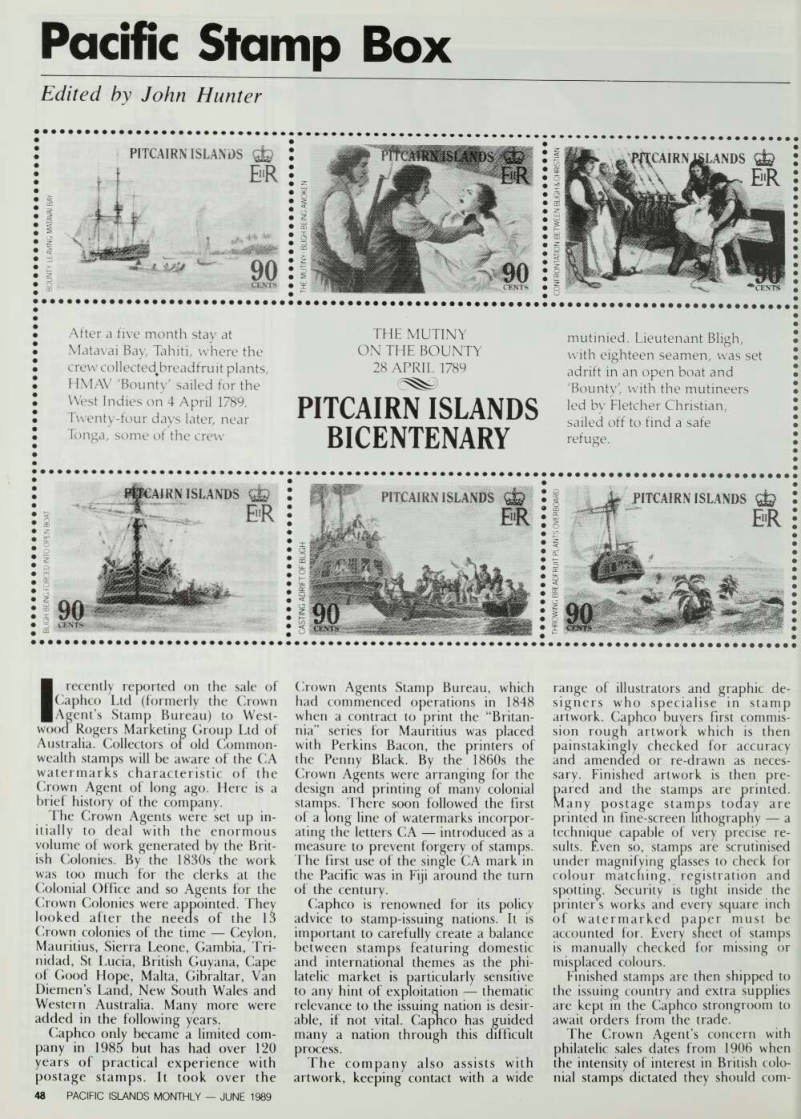
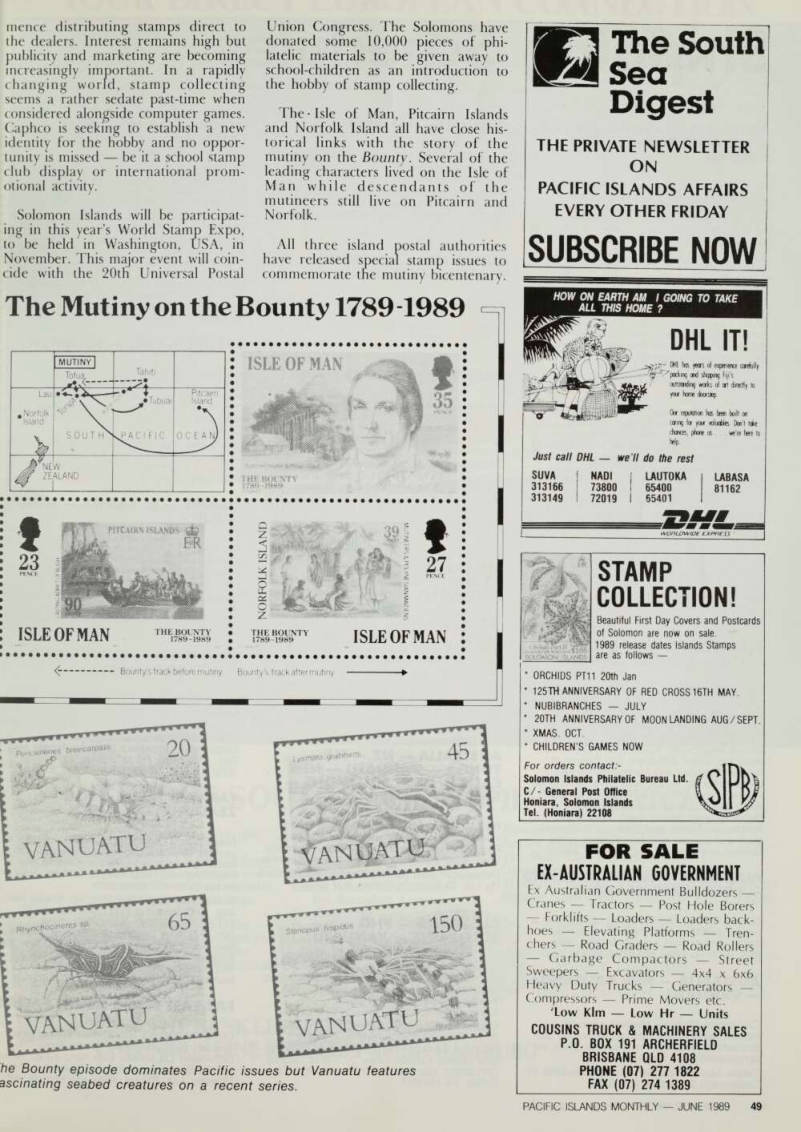
The • Isle of Man, Pitcairn Islands and Norfolk Island all have close his torical links with the story of the mutiny on the Bounty. Several of the leading characters lived on the Isle of Man while descendants of the mutineers still live on Pitcairn and Norfolk.
All three island postal authorities have released special stamp issues to
commemorate the mutiny bicentenary.