the mend
p. 44 · Read in the full issue
Economies on the mend
ECONOMIES of some South Pacific developing countries U showed signs of recovery in 1988, according to the latest annual report from the Asian Development Bank. It particularly identified Fiji, Solomon Islands and Papua New Guinea in this category.
Fiji’s Gross Domestic Product (GDP) grew by two per cent (following a de cline of 7,8 per cent in 198/) due mainly to increases in sugar produc tion, tourist arrivals and private invest ment. The report said there were in dications the economy of the Solomon Islands also recovered from the de cline of the previous three years due to the higher output and prices for fish, palm oil and timber. Papua New Guinea registered a GDP growth of 4.1 per cent compared to 4.8 per cent in 1987, due to reduced investment
and poor performance of major agri
cultural exports such as sawn timber, rubber, cocoa and copra.
Tonga and Western Samoa reg istered a GDP decline of two per cent,
mainly because of declining agricultu
ral production resulting from a severe drought, and lower prices for their major export commodities. Cook Is lands ana Vanuatu had not recovered from the considerable damage caused by cyclones in 1987 and 1988.
Inflationary pressures have been building up in the South Pacific states since 1987, the Asian Development Bank report said. This was attribut able to increased demand as a result of the economic recovery, depreciation of currencies, excessive creak expan sion and shortages of basic food items due to cyclones and droughts. Infla tion reached 10.5 per cent m Fiji, 19.3 per cent the Solomon Islands and 10 per cent in Tonga.
Imports grew faster than exports, which led to a general widening of trade deficits. Fiji s rose from |U§l32 million in 1987 to $l5O million owing to the economic recovery and associ ated inflation. But income from tour ism and transfers increased in the re
gion.
The bank said the South Pacific member countries could be expected to improve their economic growth in 1989 as prices for their primary pro ducts and tourism sector recovered, and their economies adjusted to the destabilising effects of the cyclones and political developments in 1987.
In Fiji, the Asian Development Bank said it supported the govern ment’s long-term objectives of econo mic diversification and employment
generation. The bank would help Fiji
to revitalise the economically produc tive sector in the wake of the slacken
ing of private sector development af
ter political upheavals. It would lend money and provide technical assist ance to agriculture, the country’s main economic base.
In Papua New Guinea, the bank’s operational strategy is geared toward promoting growth of smallholder agri culture, fisheries and forestry; main
taining and expanding physical and
social infrastructure which supports the productive sectors; broadening the industrial base by enhancing private investment in small and medium sized industries and agrobusinesses.
In the smaller states, the Asian De velopment Bank will continue to sup port new agricultural and industrial projects and, in energy, help to de
velop hydro power potential. Credit
lines were being provided to national banks to allow them to assist private
sector projects.
□ Rabuka To Step Down
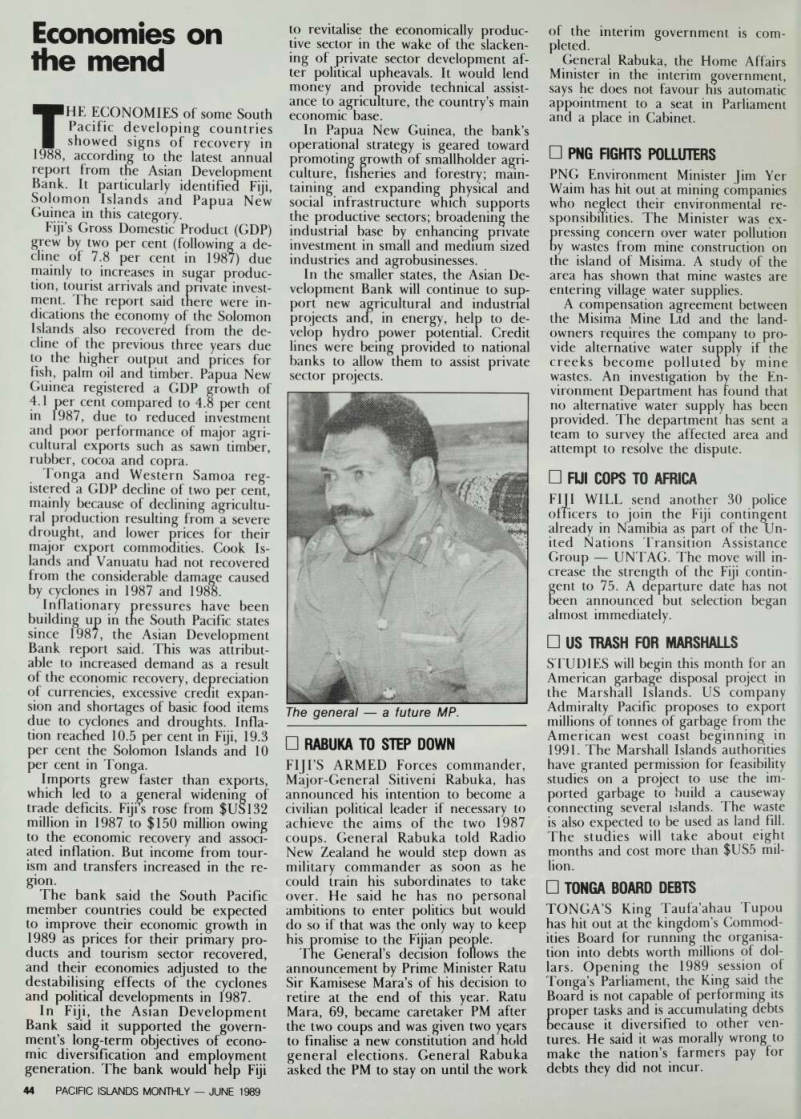
FIJI’S ARMED Forces commander, Major-General Sitiveni Rabuka, has announced his intention to become a civilian political leader if necessary to achieve the aims of the two 1987 coups. General Rabuka told Radio New Zealand he would step down as military commander as soon as he could train his subordinates to take over. He said he has no personal ambitions to enter politics but would do so if that was the only way to keep
his promise to the Fijian people.
Trie General’s decision follows the announcement by Prime Minister Ratu Sir Kamisese Mara’s of his decision to retire at the end of this year. Ratu Mara, 69, became caretaker PM after the two coups and was given two to finalise a new constitution and hold general elections. General Rabuka asked the PM to stay on until the work
of the interim government is com
pleted.
General Rabuka, the Home Affairs Minister in the interim government, says he does not favour his automatic appointment to a seat in Parliament and a place in Cabinet.
□ Png Fights Polluters
PNG Environment Minister Jim Yer Waim has hit out at mining companies who neglect their environmental re sponsibilities. The Minister was ex pressing concern over water pollution by wastes from mine construction on the island of Misima. A study of the area has shown that mine wastes are
entering village water supplies.
A compensation agreement between the Misima Mine Ltd and the land owners requires the company to pro vide alternative water supply if the creeks become polluted by mine wastes. An investigation by the En vironment Department has found that no alternative water supply has been provided. The department has sent a team to survey the affected area and attempt to resolve the dispute.
□ Fui Cops To Africa
FIJI WILL send another 30 police
officers to join the Fiji contingent
already in Namibia as part of the Un ited Nations Transition Assistance Group UNTAG. The move will in crease the strength of the Fiji contin gent to 75. A departure date has not been announced but selection began
almost immediately.
□ Us Trash For Marshalls
STUDIES will begin this month for an
American garbage disposal project in
the Marshall Islands. US company Admiralty Pacific proposes to export millions of tonnes of garbage from the American west coast beginning in 1991. The Marshall Islands authorities
have granted permission for feasibility
studies on a project to use the im ported garbage to build a causeway connecting several islands. The waste is also expected to be used as land fill.
The studies will take about eight months and cost more than SUSS mil lion.
□ Tonga Board Debts
TONGA’S King Taufa’ahau Tupou
has hit out at the kingdom’s Commod ities Board for running the organisa tion into debts worth millions of dol lars. Opening the 1989 session of Tonga’s Parliament, the King said the Board is not capable of performing its proper tasks and is accumulating debts because it diversified to other ven tures. He said it was morally wrong to make the nation’s farmers pay for debts they did not incur.
The general - a future MP.