Women who mean business
pp. 37-38 · Read in the full issue
Pacific societies are male-dominated bastions of chauvinism. But in Tuvalu
women are breaking out vie business co-ops.
By Diana McManus
PACIFIC does not exactly have a reputation as a bastion of I women’s rights: conservative and traditional societies exist in most Pacific nations, where male and female roles are clearly defined and women’s duties are primarily oriented to the home.
However, increasing numbers of the women are entering the workforce as
the region develops, seeking to supple
ment family incomes and to try their intellects. Many are wage and salary ear ners, but some are branching out into small business individually, with the
family or in co-operatives.
Even in the tiny nation of Tuvalu with a population of less than 9000, there are women who deserve attention for their business acumen and drive: who are redefining the possibilities open to Pacific women today and who are
setting examples of wnat imagination
and effort can achieve.
Marina Schupp is an extraordinary woman by anyone’s standards. Clever,
energetic and practical, she also typified
the Pacific woman’s modesty in her un
assuming, friendly profile: you would
never guess she’s tne proprietor and chief organiser of three thriving businesses and, more importantly, a pioneer in Tuvalu’s primary and secon
dary industries.
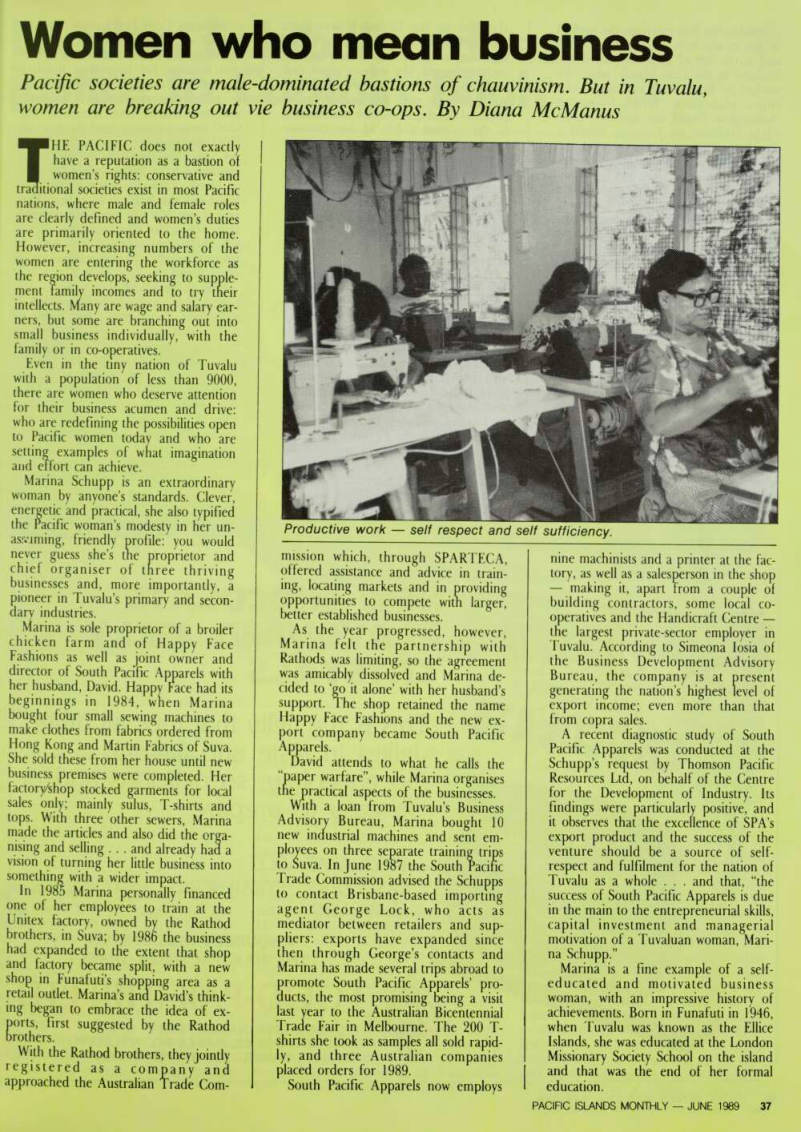
Marina is sole proprietor of a broiler chicken farm and of Happy Face Fashions as well as joint owner and director of South Pacific Apparels with her husband, David. Happy Face had its beginnings in 1984, when Marina bought four small sewing machines to make clothes from fabrics ordered from Hong Kong and Martin Fabrics of Suva.
She sold these from her house until new business premises were completed. Her factory/shop stocked garments for local sales only; mainly sulus, T-shirts and tops. With three other sewers, Marina made the articles and also did the orga nising and selling . . . and already haa a vision of turning her little business into something with a wider impact.
In 1985 Marina personally financed one of her employees to train at the Umtex factory, owned by the Rathod brothers, in Suva; by 1986 the business had expanded to the extent that shop and factory became split, with a new shop in Funafuti’s shopping area as a retail outlet. Marina’s and David’s think mg began to embrace the idea of ex ports, first suggested by the Rathod brothers.
With the Rathod brothers, they jointly registered as a company and approached the Australian Trade Com-
mission which, through SPARTECA, offered assistance and advice in train
ing, locating markets and in providing
opportunities to compete with larger, better established businesses.
As the year progressed, however, Marina felt the partnership with Rathods was limiting, so the agreement was amicably dissolved and Marina de cided to ‘go it alone’ with her husband’s support. The shop retained the name Happy Face Fashions and the new ex port company became South Pacific Apparels.
David attends to what he calls the “paper warfare”, while Marina organises the practical aspects of the businesses.
With a loan from Tuvalu’s Business Advisory Bureau, Marina bought 10 new industrial machines and sent em ployees on three separate training trips to Suva. In June 1987 the South Pacific Trade Commission advised the Schupps to contact Brisbane-based importing agent George Lock, who acts as mediator between retailers and sup pliers; exports have expanded since then through George’s contacts and Marina has made several trips abroad to promote South Pacific Apparels’ pro ducts, the most promising being a visit last year to the Australian Bicentennial Trade Fair in Melbourne. The 200 T shirts she took as samples all sold rapid ly, and three Australian companies placed orders for 1989.
South Pacific Apparels now employs
nine machinists and a printer at the fac tory, as well as a salesperson in the shop making it, apart from a couple of building contractors, some local co operatives and the Handicraft Centre
the largest private-sector employer in
Tuvalu. According to Simeona losia of
the Business Development Advisory
Bureau, the company is at present generating the nation’s highest level of export income; even more than that from copra sales.
A recent diagnostic study of South Pacific Apparels was conducted at the Schupp’s request by Thomson Pacific Resources Ltd, on behalf of the Centre for the Development of Industry. Its
findings were particularly positive, and
it observes that the excellence of SPA’s export product and the success of the venture should be a source of self respect and fulfilment for the nation of Tuvalu as a whole . . . and that, “the success of South Pacific Apparels is due in the main to the entrepreneurial skills,
capital investment and managerial
motivation of a Tuvaluan woman, Mari
na Schupp.”
Marina is a fine example of a self educated and motivated business woman, with an impressive history of achievements. Born in Funafuti in 1946, when Tuvalu was known as the Ellice Islands, she was educated at the London Missionary Society School on the island and that was the end of her formal education.
Productive work - self respect and self sufficiency.
Prior to her first marriage she worked at the newly built Vaiaku Lagi Hotel and at the age of 20 accompanied her husband to tne Line Islands, where he worked for Burns Philp as manager of a copra plantation. While living on Washington Island she had two sons; while resident on Fanning Island a daughter. During these years in the Line Islands, Manna also found time to run an active social club, and her fund raising efforts eventually resulted in a
large clubhouse being built on Fanning
Island. To this day it is named the Marina Club, after tne energy and time she invested in its establishment.
In 1981, three years after the Ellice Islands became the sovereign nation of Tuvalu, Marina’s husband aied. She re turned to Funafuti, where the following year she met Australian David Schupp, then working as an accounting adviser under an Australian air scheme. They married in 1984.
Marina was still restless for something to occupy her mind, at the suggestion of the Agriculture Office (which was trying to encourage individuals to take over egg production) became only the second Tuvaluan to establish a chicken farm.
She found the returns were not worth while so, with the help and advice of the Agriculture Office, switched to produc ing broilers with gratifying success.
In a remote island microstate that is
classified by the United Nations as a ‘least developed country’, Marina’s con tribution to her nation should not be underestimated. She is living proof that traditional Pacific roles and lack of for mal education need not be barriers to
personal development. Fler contribution
to the economic life of her country bears testimony to the important role of women in the development of the newly emerging Pacific nations, and deserves special recognition in Tuvalu’s brief his tory.
No less inspiring is the story of Miliama Manapa, manager of the co operative Tuvalu Women’s Craft Centre at Funafuti.
Miliama is 34 years old, married and the mother of five children three of whom were born since she became the Craft Centre’s manager. She was one of the first group of women to graduate from Motufoa High School on the is land of Vaitupu in 1973. It was a bitter pill f or Miliama to swallow when, though she was very good at her studies and enjoyed school, her father called an end to her education because she was a girl. Her excellent English came later, she says, as a result of working and speaking with former expatriate craft centre managers, especially Amanda
Courage and Jonathan Gaunt.
At first she was employed at the Cen tre on a casual basis, out was promoted
to Assistant Craft Development Officer in 1982 when her predecessor moved to Fiji. After the business moved to its pre sent location (an impressive builaing adjacent to Funafuti’s airport terminal) its administration was given a facelift and new names were accorded: The CDO became manager and the Assistant DDO (Miliama) became Assistant Mana ger. The last technical assistant to be appointed from Britain ended her term in March 1985, from which time Mili has been the official Manager. That year is one Mili will never forget: apart from the added responsibilities of the job, her eight-year-old son died of pneumonia while visiting relatives on an outer island.
Miliama’s managerial skills are contri buting in no small way to the success of the Craft Centre, and her personal background reflects the determination and drive required to bring success: as well as a wife and mother, Mili has de voted immense time, energy and travel to the business and to her own educa tion. The development of the Women’s Craft Centre owes a lot to this very modest, attractive and capable lady. De spite the obstacles created by tradition Miliama has established herself as a businesswoman, wife and mother within the traditional framework: a worthy ex emplar for Pacific women searching for new forms of identity and expression. □