Rural expansion a must
pp. 32-33 · Read in the full issue

The Solomon Islands Central Bank reports on strong growth during 1988 but sees population growth as a future problem.
THE FUNDAMENTAL problem
confronting the Solomon Islands in the 1990 s is that population growth is outrunning both the formal
monetary economy’s ability to provide
employment and the government’s capacity to provide social and adminis trative services. This is the prognosis contained in the just-released 1988 annual report of the Central Bank of the Solomon Islands. Moreover, the report said, no foreseeable combina tion of investible resources will sub stantially change this trend by itself. If
the underlying imbalance changes
there would have to be a marked de cline in population growth rates in the next five to 10 years.
To make provision for the rapid in crease in population, the country will have to expand the rural and informal sectors of the economy, and the for mal monetary sector must be encour aged to expand as rapidly as possible by a combination of sound macro economic policies and efficient use of public sector resources.
The Central Bank said the economy had grown strongly in 1988, the in crease in GDP growth by 8 per cent reversing the decline of the previous
two years. Output of primary industry
was recovering from the price set backs and cyclone damage of 1985-86.
There were important advances in Solomon Islander participation in all forms of business and in effective use of the financial system. Aid and pri vate capital inflows offset the con tinuing large deficit in the current account.
On the downside, the Central Bank reported the need to finance a fiscal deficit running at 5 per cent of GDP kept interest rates high to encourage savings and dampen the effect on domestic demand of the rapidly grow
ing money supply. The depreciation
of the Solomon Islands dollar along with the appreciation in the Australian dollar drove up the price of many consumer goods while urban retail in flation hit 17 per cent.
But the bank’s major concern is clearly the years ahead. In order to meet the needs of the growing population, the bank urged the Gov ernment to reduce domestic borrow ing so as to leave more resources to the private sector. A profitable en vironment has to be created for pri vate investment and government en terprises should be required to per
form efficiently and commercially.
The Central Bank wants a limit to
external debt, private and public, a monetary policy that avoids increasing money supply and an exchange rate policy that preserves the competitive ness of the SI dollar. It identified a number of major ingredients for eco nomic growth in the 19905: the tuna
fishing industry, with greatly increased
catching and processing capacity,
based on major investments at Noro and Tulagi; the established palm oil industry, together with increased coco nut and cocoa production from plantation and smallholders and a sub stantial move into diversified coconut processing; increased and better policed log output from the natural forest, with more of it locally pro cessed; greatly increased investment in plantation forestry, much of it com mercially owned or managed, includ ing planting on customary land; the opening of a small gold mine on Guadalcanal; expansion of tourism by investment in small resorts and im provement of existing hotels; con tinued investment in telecommunica tions and transport.
The bank said these elements are all established and the prospects for growth in the 1990 s are good. “But this will not be enough to raise living
standards overall, perhaps not even to maintain them. A marked reduction in population growth and strong expan sion of the informal sector are equally important if the welfare of the population as a whole is not to decline during the 19905,” the report said.
In a sector-by-sector analysis of the economy, the bank said the most strik ing feature of employment is that the overall total of formal salary and wage
employment had remained virtually
the same (about 24,000) for the past four years. This reflects the loss of 2300 lobs in agriculture during 1986-7 and tne almost equivalent increase in social and personal services. The after math of Cyclone Namu has resulted in 350 jobs being lost as a result of clos ing the government-owned rice farm, 450 when the LPT logging company closed and a decline in plantation agri culture. Only about 18 per cent of the 15-54 age group are m formal em ployment wnich, the bank said, high lights the importance of increased in vestment to create productive jobs.
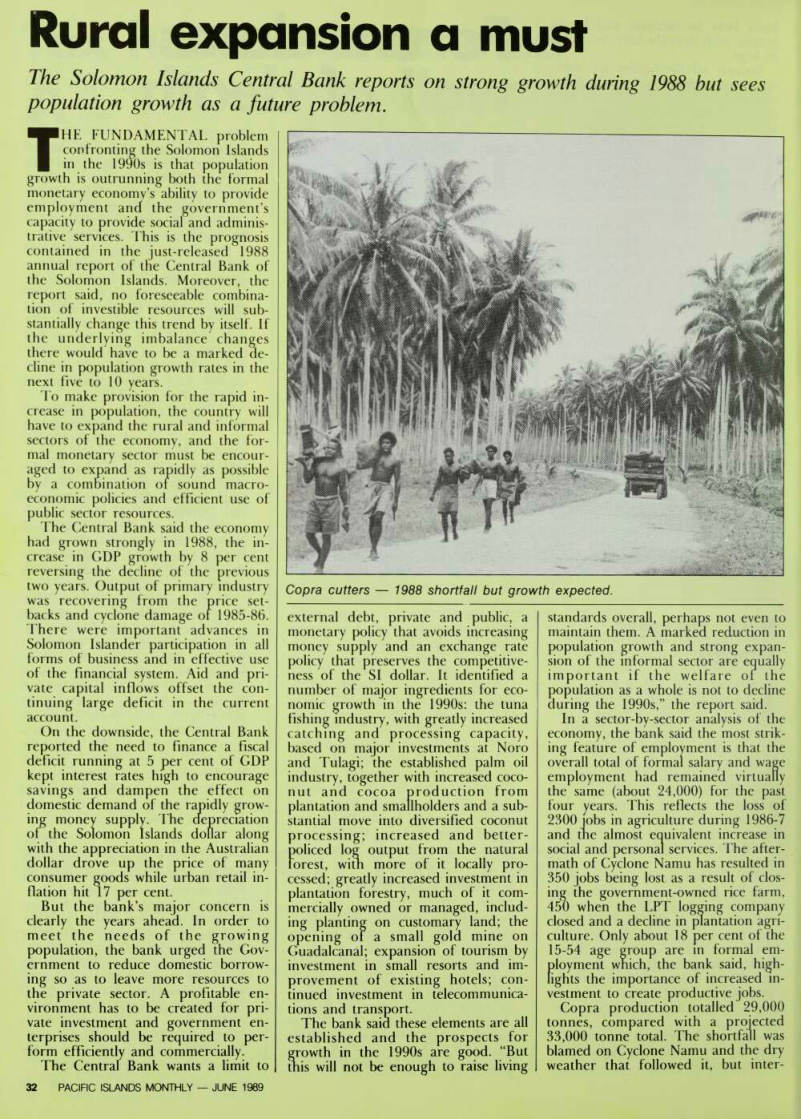
Copra production totalled 29,000
tonnes, compared with a projected 33,000 tonne total. The shortfall was blamed on Cyclone Namu and the dry weather that followed it, but inter
Copra cutters - 1988 shortfall but growth expected.
island shipping problems were also cited.
The same weather factors were blamed for a big drop in cocoa pro duction, Just 2759 tonnes for the year.
Recent planting should see production rise to 0000 tonnes within four years.
If yields can be kept high, cocoa pro duction is still a paying proposition in the Solomons, despite lower world
prices.
Palm oil and kernel production is expected to return to pre-Namu levels bv 1990-91 as new and replacement planting continues. Current world prices give a reasonable margin over
production costs.
The two large fishing companies,
STL and NFD, caught about 42,000 tonnes of tuna in 1988, up 30 per cent on 1987. A combination of a good catch and good prices took fish earn ings to $7B million almost half the nation’s exports. A new cannery and fish meal exports should contribute to future growth. The Central Bank says other fisheries potential tends to be overshadowed by the tuna industry but progress in reef fishing, artisanal commercial fisheries and aquaculture is of potentially great importance to levels of income in rural areas to food supply in urban areas and to foreign
exchange earnings.
Production of logs (290,000 cubic metres) hit its lowest level since 1981.
The bank said no customary landhold
ing groups were presently replanting
forest. Australia is paying for a forest inventory while New Zealand is financing the planting of trees on cus tomary land in Malaita. The bank said the prospects for a permanent, en
vironment-conserving forest industry
had brightened in 1988 but there is still a long way to go before the latest initiatives become a coherent forest
policy.
Minerals exploration declined due partly to problems obtaining permis sion from customary landholders.
There are also rumours circulating that gold has been illegally smuggled out to Australia, although the Govern ment believes the amount is insignifi cant. New mining legislation has Teen mired in lengthy consultation pro cesses.
Gathering of cocoa pods - still pays despite lower world prices.